“He Walked Onto the Stage Holding a Newborn… and Changed Everything in Silence”
The auditorium was a vast space filled with controlled excitement, the kind that comes when years of effort finally converge into one decisive moment. The scent of flowers mixed with polished wood and expensive perfume, while parents sat upright in their seats, trying to hide how emotional they already were. I sat in the third row, thirty-five years old, feeling every year of that number. At my feet rested a diaper bag—an object that didn’t belong in a place like this, yet had been part of my life for so long it no longer felt out of place to me.
I became a mother at seventeen. The father of my child left without warning, without explanation, and without even the courtesy of a goodbye. One day he was present, and the next he simply disappeared. From that moment forward, life narrowed into survival. There were no long-term plans, only immediate needs. Work, rent, food, and the constant effort to keep a small life stable while my own was still forming.
My son, Adrian, grew up in that reality. He didn’t grow up surrounded by comfort or certainty, but he grew up surrounded by effort. He saw long nights, early mornings, and the quiet exhaustion I tried to hide. He learned responsibility before most children learn independence. And he never once complained about the life he was given.
By the time he reached his final year of school, things had begun to look different. He was disciplined, focused, and carrying something unspoken behind his eyes. I noticed the late returns home, the longer hours at work, and the way he would pause before speaking, as if measuring every word carefully.
Three days before graduation, he asked me to sit down. His hands were tense, and his voice carried the weight of something he had rehearsed but still feared to say. He told me he was going to be a father. The words landed heavily in the room between us. A baby girl was coming, and nothing about it was planned or easy.
But what followed was not escape or denial. It was responsibility. He told me he was afraid, but he also told me he would not leave. He said he understood too clearly what abandonment looked like, and he refused to repeat it.
On graduation day, the auditorium filled with formal celebration. Names were called, applause rose and fell, and time moved forward in structured rhythm. I expected to watch from my seat like every other parent.
Then Adrian stepped out of line.
He walked directly toward me.
“Mom,” he said quietly, reaching out his arms. “Take her.”
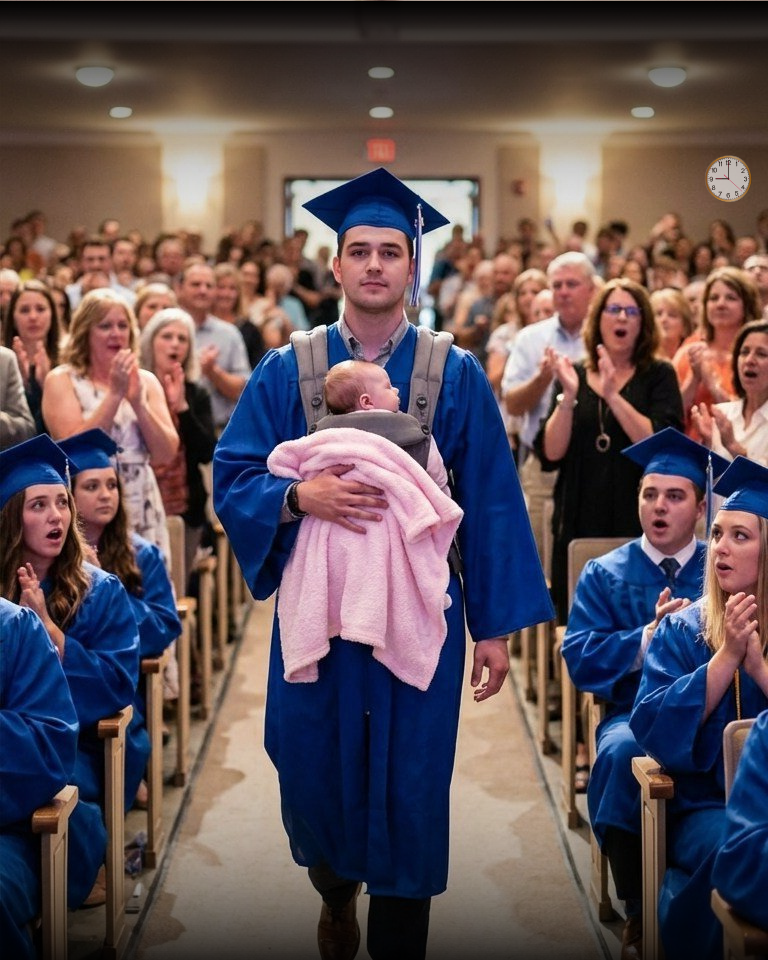
I hesitated only a moment before I saw the small infant wrapped in soft fabric. Carefully, I placed her in his arms. He held her with a kind of instinctive protection, as though he already understood his role in her life. Then he turned and walked toward the stage.
It didn’t take long for the atmosphere to shift. Whispering began almost immediately, followed by restrained laughter and judgment that spread through the rows. I heard comments I will never forget. Assumptions made in seconds about lives they had never lived.
But Adrian did not slow down. He did not react. He simply continued forward, step by step, carrying his daughter as if she were part of the future he had already committed to building.
When he reached the stage, he accepted his diploma, but did not leave. Instead, he approached the microphone. The room gradually quieted, unsure of what was about to happen.
He looked out at the audience, then down at the child in his arms, and spoke with a steady voice.
“My mother taught me what staying looks like.”
There was no anger in his tone. Only clarity.
He explained that people often judge what they do not understand. They see circumstances and assume failure. They see young parenthood and assume absence of responsibility. But what they did not see was endurance. What they did not see was sacrifice sustained over years without recognition.
He spoke about fear, about becoming a father at the same age his mother had once become a mother. He admitted that he was not prepared, but he was committed. He said he had seen what leaving does to a life, and he had chosen not to repeat it.
Then he paused, holding his daughter closer.
“This child will never wonder if I stayed,” he said.
The room fell completely silent.
For a moment, nothing moved. Then, one person stood. Then another. Within seconds, the entire auditorium rose in applause—not for perfection, but for accountability, for courage, and for truth spoken without defense.
After the ceremony, we went directly to the hospital. The baby’s mother was recovering, uncertain and overwhelmed. Adrian walked in and held her hand, not with blame, but with reassurance. He told her they would figure it out together. Not as children pretending to be adults, but as people choosing responsibility over avoidance.
In the days that followed, nothing became easier. Life did not suddenly organize itself into clarity or comfort. There were challenges, exhaustion, and uncertainty. But there was no abandonment. There was no disappearance.
There was staying.
A year later, life remains imperfect, loud, and often difficult. But it is shared. And in that shared reality, something stable has formed.
Sometimes I think back to that day in the auditorium, to the judgments spoken so easily, and to the assumptions made without understanding. And I realize that what people saw in that moment was only a fraction of the story.
Because in the end, it was never about perfection.
It was about choosing not to walk away.
Related Posts
-
 I Was Slapped by My Own Son for Asking This One Thing Then Everything Changed in a Single Phone Call
-
 Roseanne Barr, 71, Unveils Bold New Pixie Haircut, Ignites Buzz Among Fans
-
 She Was Hollywood’s Most Beautiful Woman. At 85, She’s Unrecognizable
-
 6 Times Taylor Swift Embraced Natural Beauty and Radiated Flawlessness Without Makeup