He Raised Me After the Accident… But the Truth Changed Everything
I was twenty-six when we buried my uncle, and for the first time since I was a child, the house felt hollow in a way I couldn’t ignore.
After most people had left, Mrs. Patel stopped me near the door. Her eyes were swollen, her voice unsteady as she pressed an envelope into my hand.
“He asked me to give you this,” she said quietly. “And… to tell you he’s sorry.”
Sorry?
I didn’t understand what that meant. Not then.
I’ve been in a wheelchair for as long as I can remember—since I was four. Most people think my life began there, in a hospital room. But I remember before that. Small things. My mom humming off-key while cooking. My dad’s work shirts that smelled like grease and mint gum. Bright sneakers that lit up when I ran. A world that felt wide.
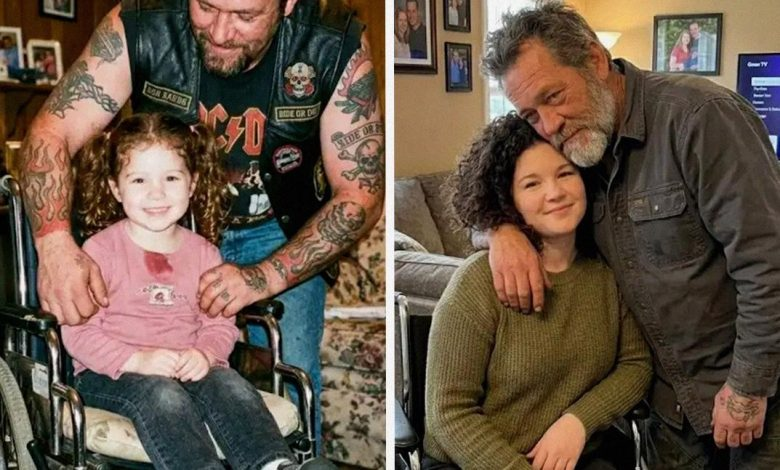
Then came the accident.
The version I grew up hearing was simple and clean: a crash took my parents, and I survived—but my spine didn’t.
There were talks about foster care. I vaguely remember a woman with a clipboard speaking in a careful, gentle tone about finding me a “good home.”
Then my uncle showed up.
Ray.
He wasn’t soft. He wasn’t warm in the way people expect caregivers to be. He was solid, rough around the edges, always a little intimidating.
“She’s coming with me,” he said. No hesitation.
He had no experience raising a child, let alone one who needed constant care. But he took me home anyway—to a small place that smelled like coffee and machine oil—and figured it out as he went.
He learned by watching, by asking questions, by writing things down. How to lift me without hurting me. How to shift my weight. How to make sure I was comfortable even when nothing about the situation was.
At night, he set alarms every couple of hours to turn me so I wouldn’t get sores. I’d wake up to the sound of him shuffling in, half-asleep, muttering nonsense just to keep himself awake.
“I’ve got you,” he’d say, every single time.
He built ramps out of scrap wood. Argued endlessly with insurance companies. Learned how to braid my hair—badly. Bought things he clearly didn’t understand, like makeup and hygiene products, after watching tutorials online with a seriousness that would’ve been funny if it wasn’t so sincere.
Whenever I felt like my world was shrinking, he refused to let me believe it.
“You’re not less,” he’d say. “Not in any way that matters.”
And somehow, he made life bigger. He adjusted everything in the house so I could reach it. Built things so I could do more on my own. Even made a small planter box after I complained I couldn’t cook like the people I saw on TV.
Then, slowly, he started to fade.
He got tired more easily. Took breaks halfway up the stairs. Burned meals he used to make without thinking.
The diagnosis came, blunt and final: stage four.
After that, everything became about time. Nurses. Schedules. Machines. Quiet conversations no one wanted to finish.
The night before he died, he sat beside me, quieter than I’d ever seen him.
“You know you’re the best thing that ever happened to me, right?” he said.
I tried to joke, because that’s what we did. “That’s a pretty low bar.”
He almost smiled. “Still true.”
I didn’t joke after that.
“I don’t know how to do this without you,” I admitted.
“You will,” he said. “You’re going to live. Really live.”
Then his voice shifted, softer, heavier. “There are things I should’ve told you. I’m sorry.”
He kissed my forehead. The next morning, he was gone.
At the funeral, people kept calling him a good man, like that summed him up neatly. Like people are ever that simple.
Later, back at the house, I finally opened the envelope.
My name was written in his familiar, uneven handwriting.
The first line stopped me cold.
“Hannah, I haven’t told you the truth about what happened. I can’t leave without saying it.”
What followed changed everything I thought I knew.
That night, before the accident, my parents had come to drop me off. They were leaving—starting over somewhere else.
Without me.
“They thought you’d be better off here,” he wrote. “I didn’t take it well.”
They argued. Voices raised. Old tensions boiling over. He admitted he’d been drinking. Said things he couldn’t take back.
“I let them leave angry,” he wrote. “I wanted to be right.”
He could have stopped them. Called a cab. Taken the keys. Done something.
He didn’t.
The call came less than half an hour later. A crash. A pole. No survivors.
Except me.
“At first, every time I looked at you, I saw what I’d done,” he admitted. “But you were just a child. You didn’t deserve any of it.”
Taking me in wasn’t framed as something noble. To him, it was the only decent choice left.
Over time, that obligation became something else. Something real.
He wrote about the money he’d set aside, the arrangements he’d made, the future he wanted me to have beyond the limits of that house.
And at the end, he left me with this:
“If you can forgive me, do it for your own peace. Don’t spend your life carrying what I did. If you can’t, I understand. I loved you the best way I knew how. I just wish I had done better sooner.”
I sat with that letter for days.
He had been part of the reason my life broke apart.
And also the reason it didn’t fall completely.
Weeks later, I checked into a rehab program. It wasn’t easy. Nothing about it was.
The first session, they strapped me into a harness over a treadmill.
“This is going to be hard,” the therapist warned.
“I know,” I said. “But I didn’t get here by accident.”
And I meant that in more ways than one.
Last week, something changed.
For the first time since I was four, I stood—really stood—holding most of my own weight. My legs trembled, my hands shook, and I cried the entire time.
But I was upright.
In my head, I could hear him like he was right there beside me.
“You’re going to live, kiddo.”
Do I forgive him?
Not all at once.
Some days, I feel the anger. The weight of what his choices cost.
Other days, I remember everything else—the effort, the sleepless nights, the quiet ways he showed up again and again.
I think forgiveness, for me, isn’t a single moment.
It’s something that’s been happening slowly, piece by piece, for years.
He carried me as far as he could.
Now the rest is up to me.


