 By Admin
Erin Callahan was a devoted mother of four young children. Her eldest daughter, Mabel, was four years old, her twin daughters, June and Ivy, were three, and her youngest child, Theo, was barely fourteen months old.
Before becoming a mother, Erin had worked as a pediatric occupational therapist at a children’s hospital in Columbus, Ohio. She loved her profession, but after having four children in a short period, she gave up her career to care for them.
Her husband, Brandon, worked full-time as a sales manager. He believed that earning money and supporting the family financially was his primary responsibility. Once he returned home from work, he expected to relax, eat dinner, and enjoy a quiet evening.
Erin’s work, however, never ended.
Her days began before sunrise with Theo crying for his bottle. Soon afterward, the twins would wake up, followed by Mabel, who wanted breakfast. Erin prepared meals, changed diapers, washed clothes, cleaned the house, arranged appointments, managed preschool drop-offs, and cared for the children whenever they were sick or upset.
She loved her children deeply. Nevertheless, the constant demands were wearing her down. She rarely had a moment to herself, often ate whatever food was left on the children’s plates, and sometimes went days without managing a proper shower.
Brandon didn’t seem to understand how exhausted she had become. He considered childcare something that naturally belonged to Erin because she stayed home. When she tried to explain how difficult her days were, he dismissed her concerns.
Gradually, Erin stopped complaining. It seemed easier to remain silent than to argue with her husband about whether her work counted as real work.
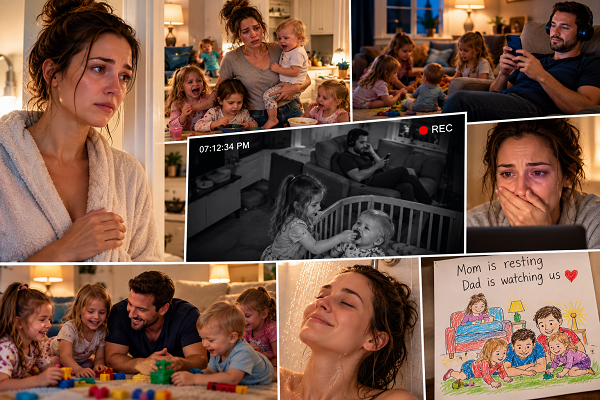
The evening everything changed
One Tuesday, Erin was especially exhausted. Theo had been teething and waking repeatedly throughout the night. The twins had experienced their usual difficulties, and Mabel’s preschool teacher had even called to ask whether everything was all right at home.
Despite her exhaustion, Erin prepared dinner and bathed all four children.
By seven o’clock, something unusual happened: every child was calm and settled in the living room. Theo was playing in his playpen, the twins were watching television together, and Mabel was sitting quietly on the couch with her favorite stuffed rabbit.
For once, Erin saw an opportunity to take a shower.
She approached Brandon, who was relaxing in his recliner with his phone and headphones.
She asked him to watch the children for twenty minutes while she washed herself.
Brandon sighed and acted as though she had asked him to take on an unreasonable burden. Still, he eventually agreed.
Erin hurried to the bathroom, hoping to enjoy a few minutes of peace. Yet even as the water ran, she remained anxious. She listened for crying, shouting, or the sound of something falling.
When she returned nineteen minutes later, all four children appeared perfectly fine.
But Brandon was furious.
He accused Erin of being selfish and ruining his evening. He claimed that the children had been uncontrollable, that they had climbed on him, fought with one another, and demanded his attention constantly.
Erin couldn’t understand what had happened. The children looked calm, and she had been gone for less than twenty minutes.
Nevertheless, she apologized. She was so accustomed to feeling guilty for asking for help that she began to believe she had done something wrong simply by taking care of herself.
That night, after putting the children to bed, she returned to the kitchen to finish the dishes and clean the house.
Then she remembered Theo’s favorite green pacifier.
It had been in his mouth when she left for her shower, but it was missing when she returned. Worried that he would wake during the night and struggle to settle without it, she decided to check the living-room security camera.
She expected to find the pacifier’s location.
Instead, she discovered something that changed her understanding of her family.
What the camera revealed
The recording showed the living room from above.
At first, everything looked exactly as Erin remembered it. The children were calm, Brandon was sitting in his recliner, and the television was playing.
Then Theo removed his pacifier and threw it over the side of his playpen. It bounced onto the rug and rolled beneath the couch.
When Theo began fussing, Mabel noticed him.
The four-year-old got up, approached her baby brother, and tried to work out what was wrong. She looked around for his missing pacifier and then turned to her father for help.
Brandon was absorbed in a game on his phone, with his headphones in his ears.
Mabel approached him and explained that Theo had lost his pacifier. Brandon barely acknowledged her before telling her to go back to her seat because he was busy.
The little girl returned to the playpen.
Rather than leave her brother to cry, she began singing the familiar lullaby her mother sang every night. Theo gradually settled down as he listened to his sister’s voice.
Mabel gently reassured him that their mother would return soon.
Watching this moment on her phone, Erin covered her mouth in disbelief. Her little girl was trying to comfort a baby when the adult responsible for watching them wasn’t paying attention.
But that wasn’t the only troubling moment.
A little later, June tripped over the rug and struck her forehead against the coffee table. She began crying in pain.
Brandon still didn’t immediately respond.
Mabel’s attempts to help, the children’s distress, and the absence of meaningful attention from their father revealed a very different picture from the one Brandon had described after Erin’s shower.
The recording continued to show Mabel trying to help her siblings and seeking her father’s attention. Instead of receiving the reassurance she needed, she learned to stay quiet and avoid upsetting him.
The most heartbreaking realization for Erin was that her daughter had begun behaving as though keeping the household peaceful was her responsibility.
Mabel was only four years old.
She should have been free to play, make mistakes, and seek comfort from her parents. Instead, she was already trying to protect her mother from her father’s anger.
Erin watched the recording several times. She had initially wanted to find a missing pacifier, but she had discovered how much of the family’s emotional burden her little daughter was carrying.
And she could no longer pretend that everything was fine.
The truth finally comes out
The following day, Erin confronted Brandon and showed him the recording.
At first, he struggled to accept what he was seeing. He had believed the children were difficult and that Erin had left him to deal with an impossible situation.
The footage contradicted that account.
It showed him absorbed in his phone while his daughter tried to comfort her brother. It showed a child seeking help and receiving little attention. Most importantly, it showed how Mabel had quietly adapted to the lack of support around her.
For Brandon, seeing the situation from outside his own perspective was deeply uncomfortable.
He had thought of himself as a hardworking provider who deserved rest after a demanding day. He had failed to recognize that Erin was also working continuously, without the breaks and boundaries that he took for granted.
The video forced him to confront the difference between loving his children and actively caring for them.
Erin also had to face a painful truth: her silence had not protected her children from tension. Mabel had noticed the arguments, the frustration, and her mother’s habit of apologizing.
The little girl was already trying to manage feelings that belonged to the adults.
Brandon could not undo what had happened, but he could choose what to do next.
He began to understand that being a father meant more than earning a paycheck or occupying the same room as his children. It meant paying attention, responding when they needed him, sharing the exhausting routines, and allowing his wife to have time for herself without making her feel guilty.
The change did not happen overnight. Rebuilding trust required more than one emotional conversation. It required consistent action.
A different kind of family life
Over time, Brandon began taking responsibility for the children’s care.
Every Saturday morning, he looked after all four children from seven until noon, allowing Erin to leave the house alone. Sometimes she went to the gym or visited a coffee shop. Other times, she simply sat in her car and listened to a podcast.
The important thing was that she could spend time without being responsible for someone else’s immediate needs.
Brandon also began handling bedtime on certain evenings. He learned to bathe the children, put them into pajamas, brush their teeth, read their books, and sing their familiar bedtime song.
He didn’t always get everything right. Sometimes he forgot the words or sang out of tune. But the children didn’t mind. What mattered was that their father was present and involved.
Eventually, Brandon removed the security camera. He explained that he wanted to become the person who noticed what was happening in the room rather than relying on a camera to show him what he had missed.
For Erin, another important change came when she returned to work part-time at the children’s hospital.
On her first day back, her former supervisor welcomed her warmly. Erin sat in her car afterward and cried. Returning to her profession reminded her that she was more than a mother and a homemaker. She was also a person with her own abilities, ambitions, and identity.
Her marriage was still healing, and she remained angry about the years when her exhaustion had gone unrecognized. But the division of responsibilities was becoming more equitable, and Brandon was learning to show his commitment through everyday actions.
The picture on the refrigerator
One day, Mabel brought home a drawing from school.
It showed their family in the living room. Her mother was sitting comfortably on the couch, with a cup in her hand and her feet resting up. The four children were playing nearby.
Her father was lying on the floor with them, surrounded by toys and little arms and legs.
Across the top, Mabel had written a message in her careful, young handwriting: her mother was resting, and her father was watching the children.
Erin placed the picture on the refrigerator.
When Brandon saw it, he stood looking at it for a long time. He didn’t need to be told what it meant.
The drawing captured something that had been missing from their family life: a mother who could rest without guilt and a father who was genuinely sharing the work of raising their children.
It also showed how much the change mattered to Mabel. Her picture reflected the family she was beginning to experience, not simply the family she had once hoped for.
Twenty minutes of peace
Months later, the family had settled into a different routine.
One evening, all four children were clean, dressed in their pajamas, and relaxing in the living room. Theo was playing with his stacking cups, the twins were sitting together on their blankets, and Mabel was reading aloud from a book.
Brandon was on the floor, playing with the children instead of sitting apart from them in his recliner.
Erin appeared in the doorway and announced that she was going to take a shower.
Brandon looked up and told her to take her time.
She instinctively began to promise that she would be quick, but he gently repeated that she didn’t need to rush.
So Erin took a long shower.
She washed her hair, used her conditioner, shaved her legs, and stood under the warm water with her eyes closed. For the first time in a long while, she wasn’t listening anxiously for every noise in the house.
She wasn’t counting the minutes or worrying that her husband would resent her for taking care of herself.
She simply breathed.
When she returned, the children were asleep. Theo had his pacifier, the twins were holding hands, and Mabel had fallen asleep with her stuffed rabbit beside her.
Brandon was sitting on the floor near the couch, watching over them.
He wasn’t distracted by his phone or complaining about his evening. He was simply there, caring for his children.
Erin stood in the doorway and watched him.
It was an ordinary moment, but it represented an extraordinary change.
What Erin never forgot
People eventually asked Erin how she had managed to make her husband understand what she was going through.
Her answer was that she hadn’t found the right argument or delivered a perfect speech.
Instead, Brandon had finally seen what had been happening in his own home.
A twenty-minute recording had shown him that his daughter was trying to comfort her baby brother while he was too distracted to notice. It had shown him that the children needed more than an adult physically present in the room. And it had revealed that his wife was not asking for luxury or special treatment when she requested a short break.
She was asking for the basic consideration that every exhausted parent deserves.
Erin kept the original recording. She wanted Mabel, when she grew older, to understand how caring and brave she had been as a little girl. But she also wanted her daughter to know that it had never been her responsibility to manage her parents’ emotions.
The recording reminded Erin of how much her daughter had tried to do for the family. It also reminded her of the changes Brandon had made afterward.
She began keeping another video, too.
It showed Brandon sitting beside his sleeping children, watching them peacefully while Erin enjoyed her shower.
Nothing dramatic happened in that recording. There were no arguments, no accidents, and no tears. It was simply a father looking after his children while their mother took time for herself.
For Erin, that ordinary scene became the more meaningful memory.
The first video had shown her what was wrong. The second showed her what could change when someone finally acknowledged the problem and took responsibility for making things better.
The lesson of the story is simple: parenting is a shared responsibility, rest is not a selfish luxury, and children notice far more than adults sometimes realize. A family begins to heal when the invisible work of caring for one another is finally seen—and when understanding is followed by meaningful, lasting action.