 By Admin
My phone rang at 11:42 on a Thursday morning.
I was in the middle of changing a patient’s dressing when I felt it vibrating inside my scrub jacket. I almost ignored it. The hospital was busy, three more patients needed attention, and my break was still hours away.
But something made me check the screen.
Unknown number.
I answered.
“Hello?”
“Ma’am, this is Officer Benny Reyes. I’m calling about your boys.”
My heart stopped.
“Are my children okay?”
“Your children are safe,” he said quickly. “But I need you to come home as soon as possible. Your older son has been involved in a situation, and I think it would be better to explain everything in person.”
My hands began to shake.
“What situation? Is Logan hurt? Please, Officer, tell me what happened!”
“There’s no immediate danger. Just come home, ma’am.”
Then the call ended.
I stood frozen in the hallway, staring at my phone.
My name is Rachel Alvarez. I was forty-one years old, and I had been a nurse for nineteen years. I had handled medical emergencies, held frightened patients through painful procedures, and watched doctors fight to save lives.
But nothing had ever frightened me the way those thirty-eight seconds did.
Because when someone tells you that your child is involved in a situation, your mind doesn’t wait for facts.
It creates nightmares.
I imagined my seventeen-year-old son in handcuffs. I imagined a fight, an accident, drugs, or something terrible happening to his little brother.
I told my supervisor I had a family emergency and rushed out of the hospital.
The drive home took twenty minutes.
I spent every one of them praying.
Please, God. Whatever happened, please let my boys be alive.
When I turned onto my street, I saw a police cruiser in my driveway.
Officer Benny Reyes stood beside it.
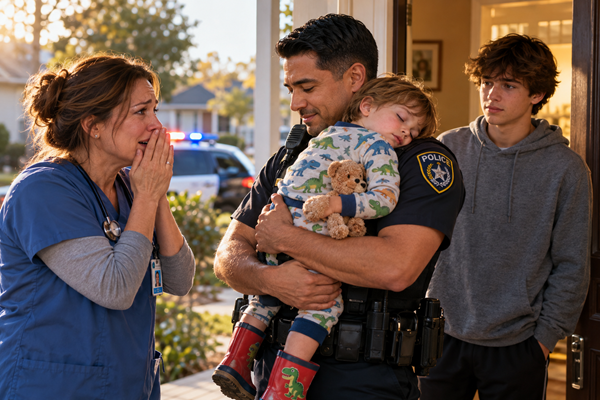
He was holding my three-year-old son, Andrew.
Andrew was asleep against his shoulder, wearing dinosaur pajamas and red rain boots on the wrong feet. His little hand was still clutching a half-eaten cracker.
I couldn’t understand what I was seeing.
My youngest child was safe.
But where was Logan?
I jumped out of the car and hurried toward the officer.
“Benny, what’s going on? Where’s my son? What happened?”
He looked at me with an expression I couldn’t read.
“Rachel, take a breath. Your son didn’t do anything wrong.”
I stared at him.
“Then why are you here?”
He glanced toward the front door.
“Because I think you need to hear what he did.”
And suddenly, I was more frightened than ever.
Because I had spent the last two years worrying about my oldest son.
And I was terrified that, somehow, I had been right to worry.
The boy I was afraid of losing
Logan was seventeen when his father died.
Before that, he had been a cheerful boy who loved soccer, played the drums, and hummed while doing practically everything.
His father, Daniel, was the same way.
Daniel was forty-two when a massive heart attack struck him while he was driving home from a construction job. He managed to pull his truck onto the shoulder of Route 12 and switch on his hazard lights.
Then he died.
A truck driver eventually found him, but by then it was too late.
The paramedics told us it had happened quickly. They said there was probably nothing anyone could have done.
I tried to believe them.
But one thought haunted me.
My husband had been alone on the side of that road for forty minutes.
Cars had passed him. People had driven by. Nobody knew he needed help.
Nobody stopped.
When Daniel died, our world collapsed.
I worked more shifts to pay the mortgage and cover daycare for Andrew. Logan began picking up his little brother every afternoon and taking care of him whenever I worked late.
He never complained.
Not once.
Sometimes I came home after a double shift and found Logan sitting at the kitchen table with his homework spread out in front of him and Andrew asleep against his chest.
Other nights, he cooked dinner, gave Andrew a bath, and put him to bed before finishing his schoolwork.
He was only fifteen.
And somehow, he had become the second adult in our house.
But while he took care of everything around him, something inside him seemed to disappear.
He stopped playing soccer. He sold his beloved drum kit and left the money on the kitchen table with a note that read, “For bills.”
He rarely talked about his father.
He spent hours alone in his room, and sometimes I heard the back door open late at night.
I would lie awake, wondering where he was going.
I was exhausted, grieving, and frightened. I had two boys depending on me, and I didn’t know whether I was doing anything right.
So I began looking for signs that Logan was getting into trouble.
And our small town gave me plenty of reasons to worry.
When he was fourteen, he and his friends had raced their bicycles down a steep hill and nearly crashed into a parked car. A police officer made them sit on the curb while he lectured them.
When Logan was sixteen, he skipped school to watch his best friend, Marcus, play in a regional soccer tournament.
He explained that Marcus’s father had abandoned him years earlier, and he didn’t want his friend to look into the stands and see nobody cheering.
I grounded him anyway.
Then came the incident at the old water tower.
Someone spray-painted an insulting message about the high school principal across its side. Logan had been walking home nearby that night, wearing a gray hoodie.
Someone reported seeing him.
The police questioned him.
He hadn’t done it. His friend confirmed that Logan had been at his house playing video games, and the real culprits were eventually found.
But the damage had already been done.
People had started looking at my son as though they were waiting for him to become a problem.
And I began to fear that they might be right.
One evening, I sat on the edge of his bed.
“Promise me you’ll be careful, Logan.”
He looked confused.
“Mom, I didn’t do anything.”
“I know. But people are watching you. I can’t lose you, too.”
His expression softened.
“Okay, Mom. I promise.”
I believed him.
I always believed him.
But grief has a way of making even love feel like fear.
And I spent the next two years worrying about the boy I thought I was losing.
I never stopped to ask whether he was struggling in ways I couldn’t see.
The truth in my kitchen
When Officer Reyes walked into our house that morning, Logan was standing at the kitchen counter, holding a glass of water.
His gray hoodie was wrinkled. His sneakers were untied. His hands trembled slightly.
He looked like a boy waiting to be punished.
“Mom?” he asked.
“What happened, Logan?”
My voice came out sharper than I intended.
Officer Reyes gently laid Andrew on the couch and covered him with a blanket. Then he turned toward us.
“Rachel, your son did something remarkable today.”
Logan immediately shook his head.
“It wasn’t a big deal, Officer.”
“It was a very big deal,” Benny replied.
I looked between them.
“Somebody please tell me what happened!”
Logan swallowed.
“This morning, I took Andrew for a walk. He wanted to see the Jacksons’ dog.”
I nodded impatiently.
“And?”
“We were passing Mr. Henson’s house when I heard a noise.”
Walter Henson lived four houses down. He was seventy-eight, a widower who grew tomatoes in his backyard and gave butterscotch candies to neighborhood children.
After Daniel died, he had brought a pot of chili to our house and left it at the door.
He had told me something I never forgot.
“When someone you love dies, it doesn’t get better. It gets different.”
Now Logan looked down at his hands.
“Mr. Henson was lying on his porch. He wasn’t moving.”
My stomach tightened.
“I told Andrew to hold on to the fence and stay there. Then I ran over and called 911.”
Officer Reyes continued the story.
“The emergency dispatcher stayed on the phone with Logan. She told him how to check Mr. Henson’s breathing and instructed him to begin chest compressions.”
I knew what that meant.
I was a nurse. I knew how exhausting CPR could be.
“Logan performed compressions for nearly six minutes,” Benny said. “He kept going until we arrived.”
I turned toward my son.
“Six minutes?”
Logan shrugged, staring at the floor.
“The lady on the phone kept counting. I just did what she told me.”
Officer Reyes nodded.
“When my partner and I turned onto your street, we saw Andrew holding the fence and screaming for his brother. Logan was on the porch, still performing CPR. He looked up at me and said, ‘He’s down. I can’t stop.’”
My eyes filled with tears.
“Is Mr. Henson alive?”
“Yes. The paramedics managed to restore his heartbeat. They took him to St. Agnes, and he was awake in the ambulance.”
I covered my mouth.
My son had helped save a man’s life.
The same boy I had spent two years worrying might be going down the wrong path had been kneeling on a porch, fighting to keep someone alive.
Then Logan spoke.
“I just didn’t want him to be alone, Mom.”
The room became silent.
I knew exactly what he meant.
He was thinking about his father.
The man who had died alone beside a highway while cars passed without stopping.
My son had never forgotten those forty minutes.
He had never stopped wondering whether somebody could have helped.
And when he found Walter Henson lying on his porch, he had done everything he could to make sure another family didn’t have to live with that same memory.
I walked toward Logan, but I couldn’t speak.
I had spent so long being afraid of what grief might do to him that I had failed to see what grief had taught him.
Officer Reyes cleared his throat.
“Rachel, there’s something else I need to tell you.”
He looked at Logan.
“Your son took a CPR class at the community center last fall. He learned how to do this before today.”
I turned toward my son.
“You took a CPR class?”
He nodded.
“On Tuesday nights. The nights I told you I was at Marcus’s.”
“Why didn’t you tell me?”
For a moment, he didn’t answer.
Then he whispered, “Because of Dad.”
He rubbed his eyes.
“I kept thinking about what happened to him. If somebody had stopped, maybe they could have helped. I know the doctors said there was probably nothing anyone could do, but I kept thinking about it.”
His voice cracked.
“I didn’t want to be someone who just drove past.”
I reached for the kitchen chair because my knees felt weak.
All those nights I had worried about where Logan was going, he had been learning how to save a life.
All those nights I had imagined him getting into trouble, he had been trying to make sure that what happened to his father never happened to someone else if he could help it.
Officer Reyes looked at my son.
“Logan, you should be proud of yourself.”
Then he turned toward me.
“And Rachel, I owe both of you an apology. When the water tower incident happened, I was the one who suggested questioning Logan. I let his earlier mistakes—and what people said about him after his father died—influence my judgment.”
He paused.
“That wasn’t fair to him.”
Logan looked up, surprised.
Benny continued.
“Today, I saw the young man he really is. I thought you deserved to know that, too.”
Then he picked up his cap and left.
And for the first time in two years, I looked at my oldest son without fear clouding my vision.
I saw him.
Really saw him.
The little boy who understood
A few moments after Officer Reyes left, Andrew climbed off the couch.
He shuffled across the kitchen in one rain boot and one sock and wrapped both arms around Logan’s leg.
“You falled down too?” he asked sleepily.
Logan smiled and touched his little brother’s hair.
“No, buddy. I was helping somebody.”
“Helping the man?”
“Yeah.”
“His heart was broken?”
“Something like that.”
Andrew thought for a moment.
“Is his heart working now?”
Logan’s smile wavered.
“Yeah, buddy. It’s working now.”
I watched my two boys standing together.
The seventeen-year-old who had quietly carried so much responsibility since his father died.
And the three-year-old who still believed his big brother could fix almost anything.
I wished Daniel could have seen them.
He would have been so proud.
That afternoon, after Andrew fell asleep, I sat with Logan on the back porch.
We watched the old swing set Daniel had built when Logan was little. The paint was peeling, and one of the chains squeaked in the wind.
“Were you scared?” I asked.
“Not while I was doing it,” Logan replied. “I just kept listening to the lady on the phone. My arms hurt so much. I thought I was going to throw up.”
He looked down at his hands.
“After Officer Benny took over, I sat on the steps and started shaking.”
I nodded.
“That’s normal. It happens to me, too.”
He looked surprised.
“Really?”
“Every time something frightening happens at work.”
For the first time that day, he almost smiled.
We sat quietly for a while.
Then I asked the question that had been troubling me for months.
“Is that why you go out at night? When I hear the back door?”
He looked at me.
“You hear that?”
“Logan, I’m your mother. Of course I hear it.”
He gave a small, embarrassed laugh.
“I just walk around the neighborhood. Sometimes I go to the park. I can’t sleep sometimes. My head gets too loud.”
He looked away.
“I miss Dad.”
My heart broke all over again.
“Why didn’t you tell me?”
“Because you’d cry.”
I started crying immediately.
He sighed and put an arm around my shoulders.
“See? That’s exactly what I mean.”
I laughed through my tears.
“Then let me cry,” I told him. “You don’t have to protect me from every sad thing in your life. I’m your mother. You can tell me when you’re hurting, even when I’m tired. Even when I cry.”
He was quiet for a moment.
“Okay.”
“And if you can’t sleep, come knock on my door. Don’t sit alone with all those thoughts.”
“Even if it’s three in the morning?”
“Especially if it’s three in the morning.”
He nodded.
“Okay, Mom. I promise.”
This time, his promise wasn’t about staying out of trouble.
It was about letting me back into his world.
And I realized that, somewhere along the way, we had both been trying to protect each other by keeping our pain a secret.
We didn’t have to do that anymore.
The man who got a second chance
The next morning, I took Logan and Andrew to St. Agnes Hospital to visit Walter Henson.
I knew the nurses on the cardiac unit, and word of what had happened had already spread.
One of them, Patrice, shook Logan’s hand.
“Six minutes of CPR by yourself?” she said. “That’s something you should be proud of.”
Logan turned red.
“Thank you.”
He looked as though he wanted to disappear into his hoodie.
When we entered Walter’s room, the old man was sitting upright in bed, reading the newspaper through his glasses.
He looked up.
“Well, there he is.”
Logan approached the bed cautiously.
“Hi, Mr. Henson.”
Walter reached out and took his hand.
“They tell me you broke two of my ribs.”
Logan’s face went pale.
“I’m so sorry. I didn’t know—”
Walter squeezed his hand.
“Son, if breaking two ribs is the price of keeping me alive, I’d say we made a pretty good deal.”
Logan laughed.
It was a real laugh. A surprised, unguarded laugh that I hadn’t heard from him in a long time.
Walter explained that he had gone outside to collect his mail when he suddenly felt dizzy and collapsed. His last clear thought had been that he was going to die alone on his own porch.
Then he had heard a voice.
“I don’t remember what you said,” Walter told Logan. “I don’t remember the words. But I remember hearing somebody talking to me. Somebody was there.”
His eyes filled with tears.
“I thought I was going to be alone. But I wasn’t.”
Logan looked down and nodded.
I turned toward the window because I couldn’t hold back my own tears.
Then Andrew stepped forward.
He reached into his little pocket and pulled out a slightly crushed butterscotch candy.
He held it out to Walter.
“Here. For your heart.”
Walter stared at the candy in his palm.
“I usually give these to you,” he said softly.
Andrew smiled.
“Now it’s my turn.”
Walter closed his fingers around the candy.
And I understood that kindness doesn’t always arrive in grand gestures.
Sometimes it’s a seventeen-year-old boy refusing to stop pressing his hands against a stranger’s chest.
Sometimes it’s a little boy sharing a candy.
And sometimes it’s an old man holding the hand of the child who gave him another chance to live.
What my son taught me
Over the following days, news of what Logan had done spread through our small town.
The same people who had once watched him suspiciously now greeted him with smiles.
The principal called to ask whether he would accept a certificate at a school assembly.
Logan immediately refused.
“Mom, I’m not standing in front of the entire school.”
We compromised. The principal presented him with the certificate privately, with me and Officer Reyes in attendance.
Logan shook her hand, thanked her, turned bright red, and escaped as quickly as possible.
I smiled the whole way home.
But there was something more important than the certificate.
I noticed that Logan seemed lighter.
He began talking a little more at dinner. He smiled at Andrew’s silly jokes. One evening, he even mentioned that he might consider returning to the soccer team.
He wasn’t suddenly free of grief.
Neither was I.
But perhaps we were finally learning that healing didn’t mean forgetting the people we had lost. It meant allowing ourselves to keep living while carrying their love with us.
One evening, I sat at the kitchen table while Logan washed the dishes.
I had offered to help, but he waved me away.
“Sit down, Mom. You worked a long shift.”
So I sat and watched him at the sink.
Then I heard it.
A quiet humming.
I froze.
It was a song I hadn’t heard in our house for years.
“Brown Eyed Girl.”
Daniel’s favorite song.
He used to hum it while driving, fixing things around the house, and rocking our boys to sleep. He hummed it so often that I used to beg him to learn another tune.
“Why would I need another song?” he’d say. “This one’s perfect.”
After he died, Logan stopped humming.
I hadn’t even realized how much I missed that little sound until I heard it again.
I watched my son washing plates, humming his father’s song as though it had been waiting patiently inside him all this time.
I didn’t interrupt him.
I simply sat there and listened.
For the first time in two years, our kitchen felt like home again.
Later that night, I was lying in bed when I heard the back door open.
My heart tightened out of habit.
Then I heard footsteps on the stairs.
A soft knock came at my bedroom door.
“Mom? Are you awake?”
I sat up.
“I’m awake, sweetheart.”
The door opened slightly. Logan stood in the hallway wearing his father’s old blue hoodie.
“I can’t sleep,” he said. “My head’s too loud.”
I pulled back the blankets.
“Come here.”
He hesitated. He was seventeen, taller than me, and probably thought he was too old to climb into his mother’s bed.
But then he came in and sat beside me, just as he had when he was a little boy afraid of thunderstorms.
“I was going to go for a walk,” he admitted. “But you told me to knock.”
“I did.”
“So I knocked.”
I reached over and squeezed his hand.
“I’m glad you did.”
We sat together in the quiet darkness.
After a while, he began humming.
Softly.
His father’s song.
Twenty minutes later, he fell asleep with his head resting on my shoulder.
I didn’t move.
I sat there listening to his breathing, thinking about Walter Henson on his porch, about Daniel on the side of Route 12, and about my son counting chest compressions while refusing to let another person die alone.
For two years, I had been terrified of losing Logan.
I had watched his every move, questioned his silences, and imagined the worst whenever he walked out the door.
I thought being a good mother meant keeping my children safe from every possible mistake.
I thought I had to hold our family together by myself.
But that night, with my son’s head resting against my shoulder, I finally understood something.
My job wasn’t to carry all our pain for him. My job was to make sure he never had to carry it alone.
Logan was still grieving. He would have difficult days, sleepless nights, and moments when he missed his father so much that the world felt unbearable.
So would I.
But we could face those moments together.
And I no longer had to wonder who my son was becoming.
I had seen him.
He was the boy who stayed beside a dying stranger because he knew what it meant to be alone.
He was the big brother who made his little brother laugh, even when his own heart was hurting.
He was the young man who had turned his greatest heartbreak into a reason to help someone else.
He wasn’t becoming the person I had feared.
He was becoming someone extraordinary.
The next morning, when sunlight slipped through the curtains, Logan was still asleep beside me.
For a moment, I watched him and imagined Daniel standing in the doorway, smiling that familiar, crooked smile.
I knew exactly what he would say.
He would tell everyone in town what our son had done. He would call his family, his friends, and every person he knew. He would make a fuss, buy Logan a huge dinner, and embarrass him until the boy begged him to stop.
And he would be right to do it.
Because our son had done something brave.
But more than that, he had shown us something beautiful.
Even when grief changes a person, it doesn’t necessarily make them worse.
Sometimes, beneath the silence, beneath the sadness, beneath the mistakes everyone remembers, a good heart is still beating.
Sometimes, a child who seems to be drifting away is simply trying to find his way through a pain he doesn’t know how to explain.
And sometimes, the person we are most afraid of losing is the very person helping us survive.
I used to spend my nights listening for the back door.
Now, I listen for the knock.
And whenever I hear it, I open the door.
Because my son doesn’t have to face the darkness alone anymore.
Neither of us does.
And when I look at my boys now, I no longer see everything that could go wrong.
I see everything that is still good.
I see kindness.
I see courage.
I see a family that is still healing, still growing, and still finding its way forward.
Most of all, I see the truth I nearly missed while I was busy being afraid.
I thought I was the one holding my family together.
But my son had been holding us together, too.
And he had been doing it all along.
My boys are going to be fine.
More than fine.
They are going to grow into men who know how to love, how to help, and how to stand beside someone when the world becomes frightening.
And every day, I will try to remember that I don’t have to wait for a crisis to see the good in them.
I can see it now.
I can tell them now.
I can love them now.
Because the greatest lesson my son taught me wasn’t how to save a life.
It was how to truly see one.
And I will never stop being grateful that I finally learned to see his.