 By Admin
The Childhood Love I Left Behind in Poland Returned to Me After So Many Years
Part One: The Courtyard
My name is Zofia Lewin Berman, although most people have known me as Zoe ever since I arrived in the United States. Zofia was the name my mother chose for me, and it is the name I still remember most fondly.
I am ninety-six years old and live in a brick two-family house on the Northwest Side of Chicago with my granddaughter, Maya, and our cat, Pierogi. The cat acts as if the entire building belongs to him. My legs are no longer strong, and I need thick glasses to see clearly, but my memory has remained surprisingly sharp.
Sometimes, I wish it were not quite so sharp.
I was born in Warsaw, Poland, in 1929. Our apartment was on Twarda Street, inside a four-story yellow building with iron balconies. In the center was a courtyard where children played while women hung their laundry between the windows.
We lived on the third floor. My father owned a little watch repair shop nearby, while my mother gave piano lessons to children from wealthy families. My younger brother, Aron, was four years behind me and followed me everywhere.
My grandmother, Babcia Ruchla, also lived with us. Her hair was white and always gathered into a neat bun. Her hands carried the sweet smell of cinnamon. Every Friday evening, she placed two tall brass candlesticks on our dining table, lit them, and quietly sang a blessing.
Our neighbors across the hallway were the Nowaks. Mr. Nowak worked as a streetcar driver, and his wife made dresses for many women in our building. They had one son, Stanislaw, who was eleven months older than me.
Stanislaw was probably the most stubborn child in the whole city. His brown hair always stood up at the back, no matter how much water his mother used to flatten it. He had freckles over his nose, a small space between his front teeth, and a whistle that could be heard from almost anywhere.
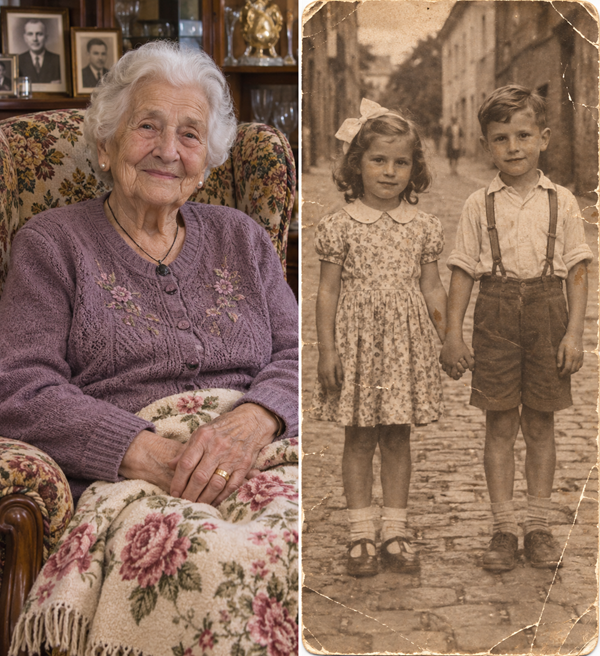
He was my closest friend.
Every morning, we walked to school together. He attended a Catholic school, while mine was different, but both buildings were along the same road. At the corner, he turned left and I continued right. We always met again at that exact spot after school.
We exchanged books and spent hours discussing the stories we had read. Stanislaw preferred tales about explorers, pirates, and distant adventures. I enjoyed books about courageous girls who managed to overcome difficult situations.
During summer, we spent nearly every afternoon in the courtyard. We played with the other children, chased fireflies, and stayed outside until our mothers called us through the windows.
Sometimes we sat on the stone steps and imagined what our adult lives would look like.
Stanislaw wanted to become an engineer and construct enormous bridges.
“I’m going to build bridges so high that they’ll almost touch the clouds,” he once told me.
I laughed and explained that bridges could not possibly reach the sky.
“Mine will,” he insisted.
I dreamed of becoming a teacher, just like my mother, except I wanted to teach children how to read.
“You’ll be good at it,” he said. “You already spend all your time telling me what to do.”
I playfully hit his arm, and he laughed so hard that he nearly fell off the steps.
Those were wonderful days, and neither of us imagined how quickly everything would change.
Part Two: The Promise
One warm evening in June 1939, when I was ten years old, Stanislaw and I were sitting outside in our courtyard.
We had a paper bag full of cherries that his mother had purchased at the market. We were eating them and competing to see who could spit the pits farthest into a flowerpot.
I was winning, naturally.
The evening sunlight covered the yellow walls of our building in beautiful shades of orange and pink. Someone upstairs was playing music on a gramophone, while swallows flew above the rooftops.
Suddenly, Stanislaw became unusually quiet.
“Zofia,” he said, looking directly at me, “when we’re older, I’m going to marry you.”
I started laughing because he looked so serious, even though cherry juice was running down his chin.
“All right,” I answered. “But you’d better remember what you just said.”
He extended his hand toward me. His little finger was bent because he had broken it after falling from a tree.
“I promise,” he said.
I wrapped my smallest finger around his.
Then he reached into his pocket and removed a little object wrapped in a handkerchief.
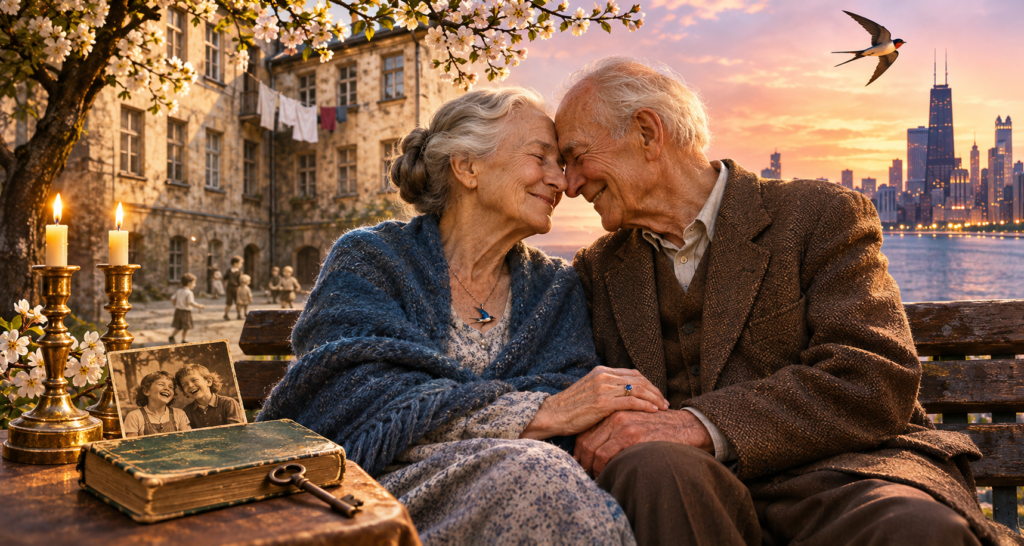
Inside was a beautiful silver pendant shaped like a swallow. Its wings were spread wide, and the body was decorated with blue enamel. It was attached to a thin chain and was small enough to fit against my thumbnail.
“My mother allowed me to choose it,” he explained. “I bought it at a shop on Marszałkowska Street. I’ve been saving my money for four months.”
He placed the necklace in my hand.
“Swallows always return when spring comes. Even after traveling far away. Whenever you look at this, remember that.”
I fastened the necklace around my neck. The little silver bird rested just below my throat.
“I will never take it off,” I promised.
“You’d better keep that promise,” he replied.
Afterward, he returned to our cherry competition as if nothing important had happened.
I won that game, too.
I had no idea that it would be our last summer evening together.
Part Three: September
By August, the adults in our building had started behaving differently.
They gathered in the stairwell, speaking quietly whenever children came near. My father spent longer hours at his shop, listening carefully to the radio. My mother stopped teaching piano, and Babcia Ruchla began watching the street from our window much more often.
I was too young to understand what was happening. Still, I could feel the fear around me.
One evening, my father asked me to sit with him at the kitchen table.
“Zofia, our family is going to travel somewhere far away,” he explained. “We’re going to America.”
I was surprised.
“Why would we go there?”
He remained silent for a moment before answering.
“Because it will be safer for us. Your father’s cousin in Chicago has arranged the necessary documents. We must leave before it becomes impossible.”
“When are we leaving?”
“Tomorrow night.”
I immediately thought about Stanislaw.
“What about him? Can I say goodbye?”
My father gently placed his hand over mine.
“You may visit him tomorrow morning, but you must not tell him where we are going. You cannot tell anybody. Do you understand?”
I nodded, although I could not understand why everything had to happen so suddenly.
The next morning, I went across the hallway to find the Nowaks.
Their apartment was locked. Mrs. Nowak had taken Stanislaw to visit her sister in the countryside, and they had left before sunrise.
I stood outside their door for a long time, hoping someone would answer my knocking.
Nobody did.
That evening, we left Warsaw.
Each family member was allowed one suitcase. My mother packed clothing and family photographs. My father carefully wrapped his watchmaking tools in velvet. Aron took his favorite wooden horse.
I packed two dresses, my school notebook, and the adventure book Stanislaw had lent me shortly before our departure.
My grandmother refused to travel with us.
She stood in the doorway wearing her nightdress and insisted that she was too old to begin a new life in another country. She had been born in Warsaw, she said, and she intended to remain there.
My parents tried everything to change her mind. My mother cried, and my father begged her to reconsider.
Babcia simply shook her head.
“Don’t worry about me. The Nowaks live across the hallway. They will look after me.”
Before we left, she kissed each of us. When she reached me, she held my cheeks between her warm hands.
“Be courageous, my little bird. One day, you must come home.”
Then she gave me a small iron key attached to a piece of string.
“This opens our apartment door. Keep it, so you will always have a way back.”
We departed Warsaw around midnight. We traveled by train, changed trains, boarded a ship, and eventually crossed the ocean on a much larger vessel. The journey lasted eleven days.
On September 1, while we were traveling toward the coast, the war began.
We reached New York in October and continued to Chicago by train. My father’s cousin had arranged a small apartment for us above a bakery on Milwaukee Avenue.
Everything seemed unfamiliar. The buildings looked darker and taller, the weather was cold, and people spoke English so quickly that I could barely understand them.
At school, my teacher struggled to pronounce my Polish name. She began calling me Sophie, and the other children soon shortened it to Zoe.
Eventually, even my own family started using that name.
Part Four: The Silence
After arriving in America, we tried to stay in contact with the people we had left behind.
My mother regularly sent letters to Babcia. I also wrote to Stanislaw. I described our new life in Chicago, the enormous lake that reminded me of the ocean, and the heavy snow that sometimes reached my knees.
I told him that I still wore the swallow necklace he had given me.
But no letters ever came back.
The war continued for six long years.
We listened to radio reports and read frightening newspaper stories. My mother often removed disturbing photographs before Aron could see them.
My father became increasingly quiet. During dinner, he would sit without speaking, slowly turning his wedding ring around his finger.
When the war finally ended in 1945, he began searching for information.
He contacted the Red Cross and several other organizations. He wanted to know what had happened to Babcia, the Nowak family, and our old home on Twarda Street.
The answers were disappointing and incomplete.
Our apartment building had been destroyed, and much of the surrounding street had disappeared. There were no official records concerning Ruchla Lewin after 1942. Nobody could provide reliable information about the Nowaks either.
My father kept every letter he received, but he eventually placed them in a drawer and stopped discussing the subject.
I continued wearing the swallow pendant.
It accompanied me throughout high school and college. I attended the University of Illinois and studied education, determined to become the teacher I had once dreamed of being.
I wore the necklace when I met Abe Berman at a dance organized by the Jewish community center.
Abe was kind, tall, and gentle. He laughed at my jokes, including the ones that were not particularly funny.
We married in 1951.
On our wedding day, I removed the swallow for the first time in twelve years and placed it inside a small velvet box.
I thought it was time to leave my childhood behind.
Part Five: A Long Life
Abe and I built a happy life together, and I want that to be understood.
We raised three children: Ruth, David, and Miriam. We eventually purchased a modest brick house in Albany Park.
Abe worked as an accountant for forty years, while I spent thirty-four years teaching third grade at a public school on Lawrence Avenue.
Over those decades, I helped thousands of children learn to read. Some had arrived in America from other countries and could not speak English when they first entered my classroom.
I always made an effort to pronounce every child’s name correctly. I knew how painful it could be when people replaced your name simply because they found it difficult.
Abe passed away in 2009 after suffering a sudden stroke. He was eighty-two, and we had shared fifty-eight years of marriage.
After his funeral, I went into our bedroom and opened the drawer where I had kept the little velvet box.
The swallow was still inside.
I took it out and held it in my palm for a long time. I did not put it around my neck, but I could not bring myself to return it to the drawer immediately either.
For an entire week, I carried it in my pocket before finally putting it away.
Our children eventually had families of their own, and I became a grandmother and later a great-grandmother.
Warsaw and Stanislaw slowly became memories from another lifetime.
Every now and then, I dreamed about our old courtyard. I could almost see the golden sunlight on the walls, hear the gramophone playing upstairs, and remember the sound of cherry pits hitting the flowerpot.
But whenever I opened my eyes, I was back in Chicago.
The little girl who had once lived in Warsaw seemed very far away.
Three years ago, my granddaughter Maya moved into my home.
She is Miriam’s youngest daughter, twenty-nine years old, and has dark curly hair similar to the hair I had as a young woman. Her laughter reminds me of Abe.
Maya works as a physical therapist, helping older patients recover their ability to walk after injuries, strokes, and operations.
She originally said she wanted to help me with shopping and household tasks. However, I suspect she also needed somewhere comfortable to stay after a difficult breakup.
We have become good companions, and we look after each other.
When Maya completed her physical therapy studies, I decided to give her the swallow necklace.
My daughters had never shown much interest in old jewelry, and my other grandchildren lived too far away.
Maya was different. Even when she was a little girl, she loved listening to my stories about Poland.
She would sit on the floor beside my chair, rest her chin on her hands, and ask me to describe our old courtyard again.
I fastened the necklace around her neck.
“This little bird is a swallow,” I explained. “They travel far away, but they always find their way back.”
She gently touched it.
“Who gave it to you, Grandma?”
“A boy I knew when I was young. Back in Warsaw.”
She smiled mischievously.
“Was he handsome?”
“He had freckles, a gap between his teeth, and cherry juice all over his chin. He was also the most stubborn boy in the country.”
Maya burst out laughing.
From that day forward, she wore the pendant every single day.
Part Six: The Package
One Tuesday evening in early October, I was preparing chicken soup in the kitchen.
The weather had turned colder, and the leaves on the maple tree outside our window were becoming red. Maya had seemed exhausted that morning, so I wanted to make something warm for her.
I heard her climbing the stairs, but her footsteps sounded slower than usual.
When she entered the kitchen, she was carrying a small parcel wrapped in brown paper and tied with string.
Her face was unusually pale.
“Grandma, something very unexpected happened at work today,” she said.
I immediately turned off the stove.
“What happened?”
She carefully placed the package on the table.
“You know I work at Saint Hedwig’s Senior Residence on Belmont Avenue?”
“Yes, the Polish senior home.”
“There is an elderly man living there. He’s in the memory care section, although he doesn’t actually seem confused. He moved there after falling last spring and breaking his hip. I’ve been helping him with physical therapy for about six weeks.”
She sat down.
“He must be around ninety-seven. He is very quiet and usually spends most of his time looking out the window. He’s always polite, though. He thanks everyone in Polish.”
I listened carefully.
“Today, while I was helping him practice walking with his frame, he kept looking at my neck.”
She touched the swallow pendant.
“He asked where I got it. I told him it belonged to my grandmother. Then he wanted to know where you were born. When I answered Warsaw, everything changed.”
Her voice became quieter.
“He suddenly stopped moving. He just stood there holding his walker. Then he asked whether my grandmother was named Zofia.”
I felt my heart beating faster.
It had been decades since anybody had used my real name. In America, everyone called me Zoe. My children rarely even remembered that I had once been Zofia.
“What did you tell him?”
“I said yes. He immediately sat down on the hallway floor, even though his hip was still injured. The nurses came running because they thought something terrible had happened.”
I placed both hands on the table.
“Was he hurt?”
“No, Grandma. He was all right. But he began crying and refused to get up for quite some time. Eventually, he asked a nurse to bring something from his room.”
Maya pushed the parcel toward me.
“He wanted me to bring this to you.”
I stared at it.
“How could he possibly know that you’re my granddaughter?”
She touched the necklace again.
“He recognized the swallow immediately. He said he could never mistake it. He told me he had personally chosen it many years ago.”
I felt as if the room had begun spinning.
“Did he tell you who he was?”
Maya shook her head.
“I asked him, but he said you would recognize him. He also asked me to pass along one message.”
I looked at her.
“What message?”
She paused before speaking.
“He said you must keep the promise you made.”
Part Seven: What Was Inside
My hands were shaking so badly that Maya had to help me remove the string.
The brown paper was old and soft, as though it had been handled many times. Beneath it was a little wooden box, similar to the boxes once used for cigars. It had a small brass clasp.
I opened it slowly.
Inside lay a book with a faded green cover. An illustration of an elephant and two children appeared on the front. Its corners were damaged, and the spine had become worn with age.
The title was W pustyni i w puszczy, which means In Desert and Wilderness.
I immediately recognized it.
It was the adventure novel Stanislaw had lent me during the summer of 1939. It was the same book I had carried around before our family escaped Poland.
I had always believed I had lost it during our journey.
Then I remembered something.
I had not lost it at all.
During our hurried departure, I had left it on the kitchen table. My mother had been crying, my grandmother was refusing to leave, and there had been so much confusion that I had forgotten to take it.
I opened the cover with trembling fingers.
On the first page, a child’s handwriting said:
“This book belongs to Stanislaw Nowak. It was lent to Zofia Lewin. She must return it.”
Beneath the book was an old photograph.
It showed two children sitting on the stone steps of a building. The boy had messy hair and a gap between his front teeth. The girl wore dark braids and a tiny pendant around her neck.
They were both looking toward the sunlight. The boy was smiling widely, while the girl appeared to be laughing.
I had never seen that picture before.
On its back, somebody had written in faded pencil:
“Staś and Zosia. June 1939.”
I continued looking through the box.
Under the photograph was a piece of faded blue fabric. When I unfolded it, I discovered a small handmade ring.
It was made from twisted copper wire, with a tiny blue glass bead in the middle. The wire had darkened over the years, and the bead had a small chip.
Below it was another object.
A little iron key attached to a string.
I recognized it immediately.
It was the key Babcia had given me on the night we left Warsaw.
I remembered holding it tightly during our journey and believing I had lost it somewhere along the way.
But I had left it on the kitchen table, beside Stanislaw’s book.
At the very bottom of the box was a folded letter.
It was written in Polish, in the uneven handwriting of an elderly man.
I had not read Polish regularly for many years, so I took my time.
The letter said:
“Dear Zofia,
I kept your book and the key. The little ring was made shortly after you left. I wanted to have something ready for the day you returned.
You never came back, but I continued waiting.
I am now living at Saint Hedwig’s, in Room 214. My body is old and slow, but I am still the stubborn boy you once knew in Warsaw.
You told me not to forget.
I didn’t.
Staś.”
I could not speak after finishing the letter.
I sat at the kitchen table, holding the old wooden box against my lap. Tears rolled down my face as I looked at the little copper ring and the key.
I had not cried like that since I was a little girl.
Maya came around the table and wrapped her arms around me.
She did not ask questions or try to comfort me with words.
She simply held me.
Part Eight: Room 214
We went to see him the following morning.
Maya drove while I sat beside her, holding the wooden box carefully in my lap.
I had changed clothes several times before leaving home. Eventually, I chose my favorite blue dress and pearl earrings.
I felt nervous in a way I had not experienced for many years.
At a red traffic light, Maya glanced toward me.
“Are you feeling all right?”
“I am ninety-six years old,” I replied. “And somehow I’m nervous about meeting a boy.”
She laughed and reached across to squeeze my hand.
Saint Hedwig’s was a red brick building on Belmont Avenue. White columns stood near the entrance, and a small garden filled with marigolds decorated the front.
Inside, the lobby smelled of coffee and cleaning products. Maya signed us in and pushed my wheelchair down a long hallway decorated with photographs of Polish churches.
Eventually, we reached Room 214.
The door was open.
The room was modest, with a bed, a dresser, a comfortable chair beside the window, and shelves filled with books. A pot of red geraniums stood on the windowsill.
An elderly man was sitting in the armchair.
He was small and thin, with rounded shoulders and hands covered in age spots. His fingers were bent by arthritis, and he rested them on top of a wooden cane.
He wore a gray cardigan that had been buttoned incorrectly.
His hair was almost completely white and very thin.
But it still stood up at the back.
When he heard us enter, he turned toward the doorway.
He looked at me.
For several seconds, neither of us moved or spoke.
Then a smile slowly appeared on his face.
Between his front teeth was the same familiar gap.
“Zosia,” he whispered.
His voice was weak and rough, but I recognized it immediately.
It was like hearing a song I had not heard since childhood.
“Staś,” I answered softly.
He attempted to stand. Maya quickly moved forward, but he raised one hand to stop her.
Using his cane for support, he slowly pushed himself upright.
Then he took several small steps toward me.
He stopped directly in front of my wheelchair and looked down at my face.
“You’ve become old,” he said.
“So have you,” I replied.
“But I’m still taller.”
We both began laughing and crying at the same time.
He leaned toward me, and I reached up to hold him.
We embraced in the middle of Room 214 while Maya stood near the doorway, covering her mouth with both hands.
Part Nine: What Happened
We spent six hours talking that first day.
Maya brought coffee and sandwiches from the cafeteria. Later, she returned with dinner and contacted her mother, aunt, and uncle, telling them what had happened.
Meanwhile, Stanislaw and I sat near the window, holding hands as though we were children again.
He finally explained everything that had happened after our family disappeared.
When his mother returned him from the countryside in September 1939, he immediately ran upstairs to our apartment.
The door was open, but our family was gone.
Inside, he found Babcia Ruchla sitting alone at the dining table beside her brass candlesticks.
“Where is Zofia?” he asked her.
My grandmother looked at him sadly. She handed him the book and the little iron key.
“She left these behind,” she explained. “She didn’t mean to. Please keep them safe until she comes back.”
Then the war reached Warsaw.
The city was bombed, and our building suffered damage, although it did not collapse completely. The Nowak family remained there.
As conditions became increasingly dangerous for Jewish families, Mrs. Nowak made an extraordinary decision.
She secretly brought Babcia into their apartment and hid her in a small space behind a wardrobe.
For two years, my grandmother lived with them.
She slept in that hidden room, taught Stanislaw how to play chess, and showed his mother how to prepare cinnamon bread.
Every Friday evening, once the curtains were closed, she lit two candles and quietly sang her blessing.
Stanislaw had memorized the words.
He still remembered them after all those years.
His voice became unsteady when he continued the story.
During the winter of 1942, Babcia became seriously ill with pneumonia. Calling a doctor or taking her to a hospital would have been dangerous.
Mrs. Nowak stayed beside her every night, and Stanislaw did the same.
My grandmother died peacefully in February.
“She passed away while sleeping,” he told me. “My mother was holding her hand.”
He paused before telling me her final message.
“She asked us to tell you that she was proud of you for leaving. She wanted you to know that you had made the right decision. And she wanted you to return one day.”
I could barely breathe.
For eighty-four years, I had lived without knowing what had happened to my grandmother.
My father had searched for answers until the end of his life, but nobody had been able to tell us anything.
Now I discovered that she had not been alone.
She had been protected and loved by the people who lived directly across our old hallway.
Stanislaw explained that they could not arrange a proper burial during the war.
Instead, he and his father carried her body at night to the old cemetery on Okopowa Street.
They buried her near the cemetery wall.
His mother wrote Babcia’s name on a small stone and placed it beside her grave so that someone might eventually discover where she was buried.
After the war, Stanislaw returned to the cemetery.
The little stone was still there.
He arranged for a proper grave marker to be placed in its location.
It carried her name:
Ruchla Lewin.
Grandmother. Beloved.
Part Ten: Chicago
Stanislaw continued telling me about the years that followed.
He had been fifteen during the Warsaw Uprising in 1944. He carried messages through the underground sewers, helping those who were fighting.
His father died during the fighting, but Stanislaw and his mother managed to survive.
After the war, he studied engineering in Kraków.
He had finally achieved the dream he had talked about on our courtyard steps.
He became a bridge builder.
“I constructed real bridges,” he told me. “Across the Vistula River.”
I smiled.
“Did you manage to build one that reached the clouds?”
He laughed.
“Not completely. But I came close.”
In 1954, he married a woman named Halina. They had two sons together.
Four years later, when life in Poland became difficult, they decided to move to America.
They settled in Chicago.
I stared at him in disbelief.
“You have lived in Chicago since 1958?”
“Yes,” he answered. “First in Avondale, then Jefferson Park, and later Norwood Park.”
I told him that I had been living in Albany Park since 1952.
We sat silently for a moment.
We had spent almost seven decades in the same city, sometimes only two or three miles apart.
And neither of us had known.
Stanislaw told me that he had searched for me when he first arrived in America.
He visited Jewish organizations, contacted people from Poland, and placed notices in newspapers.
He asked whether anyone knew a woman named Zofia Lewin.
But he never found me.
“There was no Zofia Lewin in Chicago,” he explained sadly.
I lowered my eyes.
“Because I had become Zoe Berman.”
He nodded.
He had continued searching whenever he met someone who came from Warsaw. Sometimes he even thought he recognized me on a bus or in a grocery store when he saw a dark-haired woman around my age.
But life continued.
He raised his sons, worked as an engineer, and cared for Halina when she became ill.
She died in 2016.
Eventually, he convinced himself that I must have died or disappeared somewhere during the war.
“I thought I would never see you again,” he said.
“I never forgot you,” I answered.
He looked at the swallow necklace.
“I know. You gave it to your granddaughter. A person doesn’t pass something like that on unless it still means something.”
Part Eleven: The Candlesticks
Later that afternoon, when the sunlight outside began turning orange, Stanislaw asked Maya to open his closet.
“Look on the highest shelf,” he instructed her. “There should be a box wrapped in a towel.”
Maya found it and carefully brought it over.
Stanislaw slowly removed the towel with his stiff fingers.
Inside were two tall brass candlesticks.
I immediately recognized them.
One had a small dent near its base. Aron had accidentally knocked it off our dining table when he was only three years old.
They were Babcia’s Sabbath candlesticks.
I covered my mouth.
Stanislaw explained that his mother had protected them throughout the war.
Whenever soldiers searched the neighborhood, she wrapped them in cloth and hid them beneath the floor.
When the family finally left Warsaw, she packed them in her suitcase.
After arriving in America, she gave them to Stanislaw.
“She told me they belonged to your family,” he said. “She said that if I ever found you, I had to return them.”
He held them out toward me.
His mother had died in 1971, but she had continued asking about me until her final day.
“She wanted to know whether I had found you,” he explained.
His eyes filled with tears.
“I told her I hadn’t. She said I must continue searching. She reminded me that swallows always return.”
I accepted the candlesticks.
They felt heavier than I remembered. Perhaps it was because my hands had become weaker with age.
I held them against my chest.
For a moment, I thought I could smell cinnamon, although it may simply have been a memory.
That Friday evening, my entire family gathered at Saint Hedwig’s.
My daughters, Ruth and Miriam, arrived with their families. David came with his wife, and several grandchildren and great-grandchildren joined us.
Stanislaw’s son Tomasz also came, bringing his wife and teenage daughter.
There were too many people to fit inside Room 214, so the staff allowed us to use the small chapel.
We placed the candlesticks on a table near the front.
Maya had purchased two white candles from a nearby drugstore.
As evening arrived, I carefully stood up from my wheelchair. Maya supported one arm, while Stanislaw held the other.
I struck a match.
My fingers were trembling, and it took three attempts before I managed to light the candles.
I covered my eyes, just as Babcia had always done.
I tried to remember the blessing.
But the words would not come.
Then I heard a familiar voice beside me.
Stanislaw began singing.
He remembered every word and every note of my grandmother’s blessing.
He had learned it while hiding in that small room behind the wardrobe, listening to a woman who smelled of cinnamon and reminded him of the girl he loved.
For eighty-four years, he had carried those words inside him.
I lowered my hands and looked at him.
Tears were running down his cheeks.
When he finished, nobody in the chapel spoke.
The silence was broken by my four-year-old great-granddaughter.
“Is he Grandma’s boyfriend?”
Everyone began laughing through their tears.
Part Twelve: The Promise
During the following month, I visited Stanislaw every day.
Maya usually drove me before beginning her work shifts.
Some afternoons, we talked about Warsaw and the people we had known. Other times, we simply sat together beside the window, holding hands and watching the leaves fall outside.
Stanislaw eventually read the ending of In Desert and Wilderness to me.
He read it in Polish, slowly, because I had not used the language regularly for decades.
I finally discovered what happened to the children in the story.
They made it home safely.
One afternoon in early November, Stanislaw took the little copper ring out of the wooden box.
He held it carefully between his crooked fingers.
“I made this using a piece of wire from my father’s toolbox,” he explained. “The blue bead came from my mother’s sewing basket. I planned to give it to you when you returned.”
He looked directly into my eyes.
“I’m ninety-seven years old, Zosia. I don’t know how many springs I have left. But I made you a promise on those steps, and you told me never to forget it.”
My heart began beating faster.
“Staś, we are not young anymore.”
“I am aware of that,” he replied.
“I was married to a wonderful man for fifty-eight years.”
“I know. And I was married to a wonderful woman for many years, too.”
He smiled.
“Halina knew about you. She used to joke that if my little girl from Warsaw ever appeared, she would fight her.”
I laughed so hard that tears filled my eyes.
Then he asked the question.
“Will you keep your promise?”
I looked at the handmade ring, at the tiny blue bead, and at the elderly man sitting in front of me.
For a moment, I could see the boy from the courtyard again.
The boy with untidy hair and cherry juice on his chin.
“All right,” I said. “But you had better not forget.”
Part Thirteen: The Wedding
We were married on the second Sunday of December in the small chapel at Saint Hedwig’s.
It was a modest celebration. Our families attended, along with a few residents and members of the nursing staff.
Maya stood beside me as my maid of honor, while Stanislaw’s granddaughter Ola served as his best person.
A rabbi and a Catholic priest stood together at the front of the chapel. Neither had ever participated in a wedding ceremony quite like ours.
They later said it had been one of the most meaningful weddings they had ever performed.
I wore my favorite blue dress and pearl earrings.
Maya placed the swallow necklace around my neck. The little bird rested exactly where it had rested when I was ten years old.
Stanislaw wore a gray suit, although his son had to help him button it correctly.
His hair was still sticking up at the back.
He insisted on standing throughout the ceremony, supporting himself with his cane. Nobody could persuade him to sit down.
When the time came to exchange rings, he brought out the little copper ring with the blue glass bead.
Unfortunately, it was far too small for my finger.
It had been made for the hand of a ten-year-old girl.
We both started laughing.
“I should have checked the size,” Stanislaw joked.
“You were only ten,” I reminded him.
Maya had thought ahead. She took a delicate gold chain from her jewelry box and threaded the copper ring onto it.
Then she fastened it around my neck, beside the swallow pendant.
The two little objects rested together over my heart.
Before the ceremony ended, the rabbi and priest invited us to say a few words to one another.
Stanislaw held both of my hands.
“I told you I would marry you,” he said. “I’m sorry it took me so many years.”
I squeezed his hands.
“You kept your word. That’s what counts.”
Maya began crying, and soon my daughters were crying too. Stanislaw’s son could barely hold back his tears.
Even the priest removed his glasses to wipe his eyes.
Then my little great-granddaughter asked whether the wedding cake was finally going to be served.
Of course, we had cake.
Part Fourteen: Spring
We shared one winter together.
I moved into Room 215, directly across the hallway from Stanislaw.
It reminded me of our childhood apartments on Twarda Street.
Every morning, I knocked on his door.
Every morning, he pretended not to know who was there.
We read books, discussed the stories, and sometimes disagreed about the characters.
He still preferred adventure novels, while I continued enjoying stories about courageous girls.
We also played chess.
My grandmother had taught him the game during those two hidden years in Warsaw, and he had become very good at it.
He defeated me every single time.
On Friday evenings, we lit Babcia’s candlesticks together in my room.
Several nurses eventually learned the blessing, and some of the residents began joining us.
Among them were Wanda, a retired Catholic schoolteacher, and Jerzy, who had once worked as a train conductor.
They both started attending every Friday.
One evening, Wanda told me that she enjoyed having something that returned regularly.
She was talking about the candles, but I understood that she meant much more than that.
In March, Stanislaw developed pneumonia.
He was taken to the hospital for several days before returning to Saint Hedwig’s.
The doctors explained that there was little more they could do and that the most important thing was keeping him comfortable.
He was ninety-seven years old.
He had lived a full life, built bridges, raised a family, and kept a promise for eighty-seven years.
He was exhausted.
During his final afternoon, I sat beside his bed and held his hand. Maya sat on his other side, while his son Tomasz stood near the window.
The window was slightly open.
It was the first genuinely warm day of the year, and the air carried the smell of fresh earth from the garden.
Stanislaw slowly opened his eyes.
“Zosia,” he whispered. “Listen.”
I became completely still.
Outside, I could hear small birds calling to one another.
I looked toward the sky above Belmont Avenue.
The swallows had returned.
Stanislaw smiled, showing the familiar space between his front teeth.
“You see?” he whispered. “They always come back.”
Then he gently squeezed my hand.
“And so did you.”
He closed his eyes again.
A little after sunset, he passed away while I was still holding his hand.
I thought about his mother holding Babcia’s hand during her final moments.
And I thought about how life sometimes brings people together again, even after the longest separation.
Part Fifteen: Twarda Street
In June, Maya took me to Poland.
My children were convinced that the journey was too difficult for someone my age. I was ninety-seven, my knees caused me constant trouble, and I had not traveled by airplane in fifteen years.
Maya reminded me that I did not have to make the trip.
But I told her that I had a key.
Our old building on Twarda Street no longer existed. A modern glass office building now occupied its place.
However, a small section of the original courtyard wall had survived beside the neighboring property.
The yellow stone had become gray with age.
Maya pushed my wheelchair close to it.
I reached out and placed my hand against the old stones.
I closed my eyes.
For a brief moment, I imagined hearing children laughing in the courtyard. I could almost hear music coming from an upstairs apartment and mothers calling their children home.
Then Maya took me to the old cemetery on Okopowa Street.
Finding the grave was not easy.
The cemetery was enormous, with narrow paths, old trees, and many weathered gravestones. Maya pushed my wheelchair for almost an hour before we reached the older section.
Near the cemetery wall, beneath a large linden tree, we finally found it.
A small gray gravestone stood among carefully planted geraniums.
Someone had clearly been looking after it.
The inscription read:
RUCHLA LEWIN
Grandmother. Beloved.
Protected by the Nowak family, 1940–1942.
Come back someday.
I stared at the words for a long time.
Then I began to cry.
Maya knelt beside my wheelchair and held my hand.
When I was finally able to speak, I opened my purse and removed the little iron key.
It was the key to our old apartment, the one Babcia had given me before we left Warsaw. It was also the key Stanislaw had protected for so many decades.
I placed it gently on top of the gravestone.
“I came back, Babcia,” I whispered. “Just like you wanted. I’m sorry it took me so long.”
Then I removed a small brass candlestick from my bag.
Maya helped me place a candle inside and light it.
I covered my eyes.
This time, I remembered every word of the blessing.
When I finished, I opened my eyes and looked up.
A swallow was sitting on a branch of the linden tree above us.
It remained perfectly still, watching.
Maya noticed it, too, and squeezed my hand.
“Grandma,” she whispered.
“I see it,” I answered.
The little bird tilted its head before spreading its wings.
It flew above the cemetery wall, crossed the rooftops of Warsaw, and slowly disappeared into the open sky.
I am back in Chicago now, living in our brick house with Maya and Pierogi.
The two brass candlesticks stand on our dining table, and every Friday evening we light them.
The swallow pendant and the little copper ring hang together on a gold chain around my neck.
I never remove them.
The book In Desert and Wilderness rests beside my bed. Some evenings, before going to sleep, I read a few pages in Polish.
The old handwriting is still visible on the first page.
It says that the book belongs to Stanislaw Nowak and was lent to Zofia Lewin, who must return it.
One day, I will give the book to Maya, together with the necklace, the ring, the candlesticks, and all the stories connected to them.
I have already told her what she must say when that day comes.
She must pass the story on to the next generation.
She must tell them what Stanislaw said on those stone steps, what his mother said before she died, and what my grandmother whispered to me as we left our home.
She must remind them that the people we love are like swallows.
Sometimes they travel across enormous distances. Sometimes they remain away for years, and sometimes we become convinced that we will never see them again.
But love can survive separation, distance, and even the passing of generations.
If we remember the people who matter, honor our promises, and never completely close the door to the past, there is always a possibility of finding our way back to one another.
Because swallows always return.