After 42 Years in the School Cafeteria, My Mother’s Retirement Party Was a $10 Gift Card and a Cheap Cake Then Hundreds of Former Students Walked Through the Gym Doors
After 42 years of serving lunch at the same high school, my mother’s retirement celebration consisted of a $10 coffee shop gift card and a grocery store sheet cake in the teachers’ break room.
The new principal delivered a brief speech about how “nobody is irreplaceable, especially in food service.”
Mom simply smiled and thanked him.
But just as he turned to leave, hundreds of footsteps began echoing down the hallway.
And everyone in town knew the woman they had come to honor as Miss Bernie.
My mother, Bernice, started working in the school cafeteria in 1984—the same year I was born. Over the next four decades, she became far more than the woman behind the lunch counter.
She knew every student by name.
She remembered who wanted extra gravy, who had a serious peanut allergy, and who quietly walked through the lunch line hoping nobody would notice they didn’t have enough money to pay.
Those students were the ones she never forgot.
Whenever a child came to her line without money, Mom always found a solution.
“Oh, honey, I made too much today. Can you help me finish this?”
Sometimes she claimed a tray had been prepared by mistake. Other times, she simply added another serving and told the student not to worry about it.
The truth was that she often paid for those meals herself.
She never bragged about it. She never expected recognition. In fact, she rarely spoke about it at all.
I didn’t discover the extent of her generosity until after my father passed away, when I found old receipts tucked away among his belongings.
For years, she had quietly helped children who might otherwise have gone hungry.
Then came Dr. Whitfield, the school’s new principal.
He had arrived the previous year, bringing expensive sneakers, polished suits, and a vocabulary filled with words like “efficiency” and “optimization.”
Under his leadership, the school planned to replace the traditional hot lunch program with vending machines and a low-cost outside food service.
Mom was the last remaining member of the cafeteria’s original staff.
Her final day was a Friday.
I took time off work and drove her to school myself. I wanted to be there for a moment that should have meant something after 42 years of faithful service.
The retirement party was scheduled for 2:30 p.m. in the teachers’ break room.
When we arrived, I immediately noticed how little effort had gone into it.
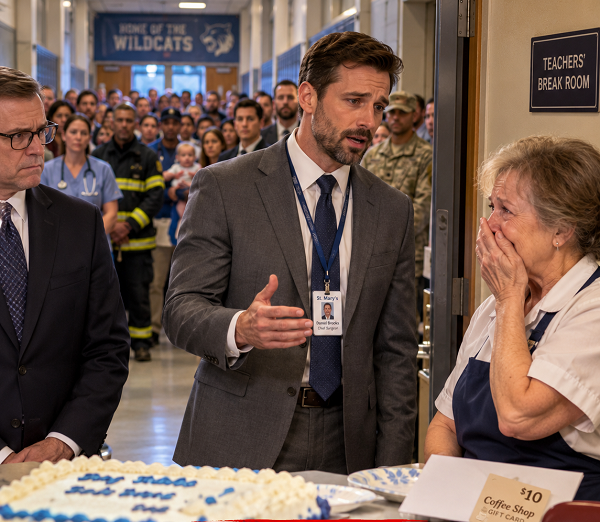
A cheap grocery store cake sat on the table. The white frosting was decorated with blue lettering, and even her name had been misspelled.
Eight teachers stood nearby, holding paper plates. A few offered Mom warm smiles, but several looked uncomfortable with the whole arrangement.
Dr. Whitfield arrived at 2:41, glancing at his watch as he entered.
He handed Mom a plain envelope.
Inside was a $10 coffee shop gift card.
Then he raised his paper cup.
“Bernice, thank you for your service. In education, we often say that nobody is irreplaceable. Especially in food service.”
He chuckled at his own remark.
“But you’ve certainly been a fixture around here. Cheers.”
One teacher winced. Another looked down at the floor.
Mom did what she had always done when someone treated her poorly.
She offered a kind smile.
“Thank you, Dr. Whitfield. It’s been an honor.”
He was already checking his phone.
“Well, I have a budget meeting to attend. Enjoy the cake.”
He turned toward the door.
Then he stopped.
From the far end of the hallway came a sound that didn’t belong at a small retirement party.
Footsteps.
Hundreds of them.
The gymnasium doors had swung wide open, and people were pouring into the hallway.
Men in work boots stood beside men in business suits. Women in hospital scrubs walked alongside mothers carrying babies. A firefighter came in wearing his station uniform. Near the back, an Army soldier stood tall among the growing crowd.
They kept coming.
One hundred people. Then two hundred. Then more.
Soon, the hallway was packed from wall to wall.
Dr. Whitfield stepped backward into the break room, his face losing its color.
“What is going on here?”
Nobody answered him.
Mom slowly placed her paper plate on the table. Her hands began to tremble.
“Oh, my Lord,” she whispered. “Oh, my Lord.”
At the front of the crowd stood a tall man in a gray suit, wearing an identification badge from the local medical center.
He stepped into the doorway and took in the scene: the inexpensive cake, the misspelled name, and the little gift card resting in my mother’s hand.
Then he turned toward the principal.
“Sir,” he said, his voice carrying through the suddenly silent room, “before we begin, I think someone should tell you what Miss Bernie did for me during the winter of 1996.”
Mom covered her mouth with one trembling hand.
The man took a breath, looked directly at her, and began to speak.
And in that moment, Dr. Whitfield was about to discover that the woman he believed was easily replaceable had spent 42 years changing lives in ways he could never have imagined.
Related Posts
-
 Drink Coconut Water Every Day To Balance Blood Sugar Levels, Burn Fat And Much More
-
This Is Why Scientists Urge You To Never Make Your Bed Again…
-
THIS MIRACULOUS GRASS HEALS PARALYSIS AND OTHER DISEASES, SEE HOW TO PREPARE IT!
-
DO THESE 4 EXERCISES FOR ONLY 15 MINUTES A DAY AND YOU WILL RELIEVE YOUR BACK PAIN IN NO TIME!


