 By Admin
My mother arrived at my house on a Tuesday evening in March, carrying her purse and wearing the same coat she had worn all afternoon.
She never took it off.
My father sat beside her at the kitchen table, turning his old seed cap over and over in his hands. He had always done that when he was uncomfortable, even when we were children.
I poured coffee into three mugs.
My husband, Dale, sat quietly at the other end of the table, still wearing his barn socks after a long day working with the hogs.
Nobody spoke for several seconds.
Then my mother finally said the words I had been expecting.
“This is about Jeff.”
Of course it was.
My younger brother was forty-three years old. His marriage had fallen apart in January, and his wife had moved away, leaving him with their three children, a pile of bills, and nowhere permanent to live.
Since February, Jeff and the kids had been sleeping in our parents’ basement.
The boys had air mattresses beside the chest freezer. Their little sister, Kenzie, had been crying herself to sleep in the bathroom because she didn’t want her father to hear her.
My mother had reached the point where she couldn’t bear watching them struggle anymore.
“Those children need a proper home,” she said.
“I know, Mom.”
She looked at Dad.
He stared at his cap.
Then she took a deep breath.
“Your father and I have been talking. We’d like you to sell the farmhouse back to us for a dollar. The same way we sold it to you. Then Jeff and the children could have it.”
For a moment, I couldn’t hear anything except the furnace humming beneath the floor.
I knew exactly what that furnace had cost us.
My name is Tammy Rensink. I’m forty-six years old, and I’ve spent nineteen years delivering mail along the rural roads outside Sheldon, Iowa.
I keep track of things for a living.
And I knew exactly what I had put into that house.
Before I could explain why their request hurt so much, I needed to tell them—and you—how we got there.
The House That Cost Far More Than a Dollar
My great-grandfather built our farmhouse in 1912. It was a white two-story home with a wide front porch and cedar trees lining the northern edge of the property.
My father grew up there.
So did I.
And so did Jeff.
When my parents retired from farming in 2005, they sold their cattle, rented out the farmland, and moved into a smaller house in town. Their knees and backs were giving them trouble, and neither wanted to keep maintaining a large farmhouse.
The old place sat empty for months.
Then, in 2006, I married Dale.
One evening, my father called us to the kitchen table.
“Your mother and I want to sell you the house,” he said. “For a dollar. We want you close.”
I laughed because I thought he was joking.
He wasn’t.
My parents arranged the paperwork, separated the house and two acres from the surrounding property, and transferred ownership to us.
At the closing, I took a dollar bill from my wallet and handed it to Dad.
He folded it neatly, tucked it into his shirt pocket, and patted it.
“Paid in full,” he announced.
Everyone laughed.
Mom cried.
I was twenty-six years old, and I believed we had been given the opportunity of a lifetime.
What I didn’t understand was that the house would demand years of work, thousands of dollars, and more patience than either of us knew we possessed.
That first winter, the old oil furnace struggled to heat the upstairs. Dale and I wore stocking caps to bed, and the bedrooms stayed so cold that we eventually closed them off.
Three years later, an electrician discovered dangerous old wiring in the basement. Replacing it cost us $11,500.
In 2011, a hailstorm destroyed the roof. Insurance covered part of the damage, but we still paid $14,000 out of pocket.
In January 2014, the furnace finally gave up on the coldest night of the winter. A new propane system and ductwork cost another $7,800.
Then came the well pump, septic repairs, windows, porch flooring, and water heaters.
Every year, I saved the receipts in a spiral notebook in the kitchen hutch.
By the time my parents sat down at my table that March, the repairs had totaled $60,340.
That figure didn’t include the countless hours Dale and I had spent fixing things ourselves.
It didn’t include the Saturdays he spent repairing the porch or the evenings I spent patching walls and restoring old windows.
We had worked for twenty years to make that house safe, warm, and comfortable.
It wasn’t simply a property my parents had given us anymore.
It was our home.
And now they wanted it back for a dollar.
The Decision I Made Before Sunrise
I looked at my mother across the table.
She was seventy-four years old, with a bad hip and a heart that had always made room for everyone else’s problems.
Especially Jeff’s.
When he broke his arm as a boy, she drove him to the hospital in the middle of the night. When he wrecked his first car, Dad helped pay the deductible. When money became tight during his marriage, Mom quietly gave him cash.
I had never resented her for helping him.
He was the youngest. He was her baby.
But I couldn’t ignore what she was asking me to give up.
Dale’s hand found my knee beneath the table. He squeezed it once.
He didn’t need to say anything. He was reminding me that whatever I decided, he would stand beside me.
I took a breath.
“Thank you for coming here and asking me directly,” I told my parents. “You could have sent Jeff. You could have written me a letter. Instead, you came yourselves.”
My mother looked surprised.
“I appreciate that,” I continued. “But I need time to think. I’ll give you my answer on Saturday.”
Dad finally lifted his eyes.
“Tammy…”
He stopped before he could finish.
They left a few minutes later.
That night, Dale and I lay awake listening to the March wind rattle the windows.
“What are you going to do?” he asked.
“I don’t know yet.”
He turned toward me.
“I won’t tell you how to handle your family. But I put twenty years into that house, too. I’m not ready to give it away.”
“I know.”
He reached for my hand.
“Whatever you decide, I’m with you.”
I thought about Jeff’s children sleeping on air mattresses. I thought about Kenzie crying alone in the bathroom and little Cole waking up in the middle of the night.
Then I thought about the two unused bedrooms upstairs.
We had closed them off years earlier to save on heating costs. One had become a storage room. The other was filled with old furniture, Christmas decorations, and things we had never found time to sort through.
There was also a small bedroom beneath the sloping roof where Jeff and I had slept as children.
Three bedrooms.
One bathroom.
Enough space to give those children something they desperately needed.
A real home.
By three in the morning, I had made my decision.
I wasn’t giving away our farmhouse.
But I wasn’t going to let my brother’s children continue living in a basement, either.
The next morning, I called Jeff while parked at a gas station during my mail route.
“What are you doing Saturday?” I asked.
“Working until noon. Why?”
“Because Dale and I are cleaning out the upstairs. I want you and the kids moved in by supper.”
He went silent.
“Tammy, I can’t ask you to do that.”
“You didn’t ask. I’m offering.”
“I’ve got three kids.”
“I know.”
“Cole still gets up during the night. Brody eats constantly.”
“I’ve got a freezer full of pork,” I replied. “Dale raises hogs. We’ll manage.”
For the first time that morning, Jeff laughed.
It was a tired, broken laugh, but it was a laugh.
“Does Dale know?”
“Of course he does.”
That was only partly true. Dale had supported the idea of helping Jeff, but we hadn’t discussed every detail.
Still, I knew he would understand.
“Just until you get back on your feet,” I told my brother. “However long that takes.”
After a long pause, Jeff quietly said, “Thank you.”
He never mentioned the house.
At the time, I thought nothing of it.
I would understand later.
Three Children and a Fish Named Pickles
Saturday arrived with a bright blue sky and frost covering the yard.
Dale carried space heaters upstairs. I cleaned the bedrooms, and our fifteen-year-old daughter, Hannah, vacuumed years of dust and dead flies from the windowsills.
“This is disgusting, Mom,” she announced.
“It’s an old farmhouse.”
“It’s a fly cemetery.”
We laughed, and she kept cleaning.
We brought out the old bunk beds, made up a double bed for Jeff, and put fresh sheets in the small bedroom beneath the eaves.
I even found a pink curtain for Kenzie’s window.
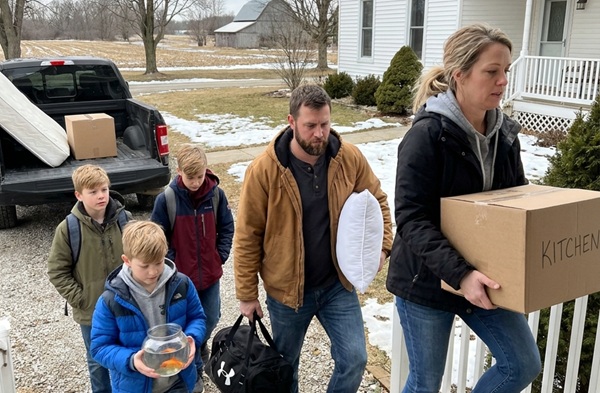
At noon, Jeff’s pickup came up the gravel road. A mattress was tied down in the truck bed, and black garbage bags filled with clothes were wedged around it.
Jeff climbed out carrying a duffel bag.
Brody, twelve, stepped out behind him with his backpack. Kenzie, nine, followed quietly.
Cole, six, was the last to emerge.
He was holding a goldfish bowl in both hands.
“This is Pickles,” he informed me.
“Hello, Pickles,” I said. “Welcome to the farm.”
“Does Pickles get his own room?”
“He gets the dresser in your room. He’s got the best view in the house.”
Cole considered this carefully, then nodded.
Apparently, the matter was settled.
That evening, seven people squeezed around a table designed for six.
Brody ate three sloppy joes and asked for another. Dale handed him his own sandwich without hesitation.
Hannah sat beside Kenzie and began gently braiding her hair.
“Did your mom used to do this?” she asked.
Kenzie shook her head.
“Daddy tries,” she whispered. “He’s not very good.”
Jeff smiled sadly from across the table.
“She’s right about that.”
“I’ll teach you,” Hannah told Kenzie. “Then you can learn to do it yourself.”
I found an excuse to visit the pantry because my eyes had started to fill with tears.
For the first time in months, those children seemed to be relaxing.
They weren’t sleeping beside a freezer anymore.
They had bedrooms, clean sheets, and people around them who wanted them there.
That night, after everyone had gone upstairs, I sat at the kitchen table with my old spiral notebook.
I didn’t open it.
I simply rested my hand on the cover and thought about the decision I’d made.
Then I heard footsteps on the stairs.
Jeff entered the kitchen holding an old wooden yardstick.
“Tam,” he said quietly. “Did you know this was still upstairs?”
I followed him to the small bedroom beneath the eaves.
He had opened the closet door.
And there, along the inside of the doorframe, were dozens of pencil marks.
Our childhood growth chart.
The Marks on the Closet Door
Every summer, on the last day of school, Mom had stood Jeff and me barefoot against that doorframe.
She would place the yardstick across our heads, draw a line, and write our names, ages, and the year.
Jeff always tried to cheat by standing on his tiptoes.
Mom always caught him.
The marks began with our earliest childhood years and climbed higher and higher.
TAMMY, AGE 3.
JEFF, AGE 2.
TAMMY, AGE 8.
JEFF, AGE 5.
Then came the year Jeff finally grew taller than me.
Beside his mark, Mom had written one tiny word.
Finally.
Jeff ran his finger along the old pencil lines.
“You painted this room,” he whispered.
“Years ago. And again last spring.”
“You painted around them?”
“Every time.”
I had carefully taped off that section of the doorframe so we wouldn’t lose the marks.
Dale used to tease me about it.
I called it historical preservation.
Jeff laughed softly, wiping his eyes.
“I don’t remember being that little.”
“I do,” I told him. “You were a pain.”
He smiled.
Then he went across the hall and returned carrying Cole, who was half asleep in his superhero pajamas.
Jeff stood him barefoot against the doorframe.
“Stand up straight, buddy. No tiptoes.”
He laid the old yardstick across Cole’s head.
I handed him a pencil.
Jeff drew a new line and wrote:
COLE — AGE 6 — 2026.
Cole’s mark was higher than Jeff’s had been at the same age.
“Is that good?” he mumbled.
“That’s real good,” Jeff whispered.
Then his voice broke.
“You’re going to be bigger than me.”
He carried Cole back to bed.
I stood beside the closet door, looking at the marks that had recorded our family growing up.
Forty-three years of memories were written into that old wood.
Now there was a new mark, drawn by a father who was trying to rebuild his life.
Jeff returned a few minutes later.
“Why are you doing all this for me?” he asked. “The rooms. The kids. Everything.”
I could have told him that our parents had asked me to give him the house.
But that wasn’t my story to tell.
“Because you’re my brother,” I said. “And because Pickles needed a dresser.”
He laughed, and for a moment, he looked like the little boy who used to follow me around the farmhouse.
The next day, our parents arrived for Sunday dinner.
Mom carried a dish of scalloped corn. Dad shook Dale’s hand and looked around the kitchen at the children’s boots, backpacks, and coats.
Cole ran into the room to announce that he was taller than his daddy had been at six.
Mom smiled.
We sat down to eat.
For a little while, everything felt normal.
Then my mother put down her fork.
“Well, Jeff,” she said brightly, “this is a good start. Once the papers are signed, you can fix the upstairs however you like.”
Jeff stopped chewing.
“What papers?”
The room went quiet.
Mom glanced at Dad.
Dad stared at his plate.
Then she explained that she expected me to sell the farmhouse back to our parents for a dollar so they could transfer it to Jeff.
“We talked to Tammy on Tuesday,” she said. “We wanted it to be a surprise.”
I set down my fork.
“I never agreed to sell the house.”
Mom looked at me as though I had broken a promise.
“You said you would give us an answer.”
“I did. My answer was to give Jeff and the children a place to stay.”
Jeff slowly placed both hands on the table.
His face had turned red.
“You asked Tammy to give me her house without telling me?”
“Jeff, honey,” Mom replied, “you have nothing right now. Your wife left, the children are living on air mattresses, and your sister has Dale. She has his work and his family’s farm connections. She’ll be fine.”
Then she said the words that explained more than she realized.
“Tammy always lands on her feet.”
I had heard that sentiment my entire life.
I was the responsible one.
The one who could manage.
The one who would somehow make everything work.
And because I was capable of surviving hardship, people assumed I could afford to carry more of it.
Jeff stood up.
For a moment, I thought he was going to walk out.
Instead, he gripped the back of his chair and looked directly at our parents.
“I’m forty-three years old,” he said calmly. “I have a job. I have a pickup that runs. My marriage ended, and I’m ashamed of that. I’m ashamed my kids have had to live in somebody else’s house.”
He turned toward me.
“But I never asked you for this farmhouse. And I’m not going to take it from you.”
Then he faced Mom again.
“Tammy and Dale put sixty thousand dollars into that place. I helped Dale with the porch. I watched them work on that house for years.”
His voice grew quieter.
“You were going to take all of that away from her because you couldn’t stand seeing me struggle. That’s not really for me, Mom. That’s for you.”
Nobody spoke.
My mother covered her mouth with her napkin.
My younger brother, the child everyone had spent years protecting, had finally said what the rest of us had been afraid to say.
Dad cleared his throat.
“Sit down, son.”
Jeff sat.
Then Dad looked at me.
“Tammy, did you ever think about just saying no?”
“Every minute since Tuesday.”
“Why didn’t you?”
“Because I wasn’t going to let Cole sleep beside a chest freezer another night. And I wasn’t going to give away the house Dale and I rebuilt. I found another way.”
Dad nodded slowly.
“You could have been angry with us.”
“You came here and asked me directly,” I said. “That told me you weren’t trying to hurt me. You were scared for Jeff and the children.”
I looked at Mom.
“I was scared for them, too.”
My mother reached across the table and placed her hand over mine.
She didn’t apologize that day.
But she held my hand for a long time.
Then Cole broke the silence.
“Grandma, Daddy measured me in the closet. I’m taller than he was!”
Mom looked up.
“In the little bedroom?”
“Your pencil marks are still there,” Jeff told her. “Tammy never painted over them.”
My mother’s hands flew to her face.
Dad put his arm around her.
For several minutes, nobody touched the food.
And somehow, that quiet moment said more than any argument could have.
A Home Without Giving Away My Own
The arrangement worked better than I expected.
Dale offered Brody paid work helping with chores in the hog barns after school. Brody started out shy and quiet, but within weeks, he was explaining which pigs weren’t eating properly and asking questions about animal health.
Hannah taught Kenzie how to braid hair.
Before long, Kenzie was doing French braids without needing a mirror. Some mornings, she even braided mine before I left for my mail route.
Cole and Pickles settled into their new routine. Cole discovered the barn cats and named them after pies.
Pecan.
Cherry.
Rhubarb.
Lemon Meringue.
The house became noisy again.
There were shoes by the back door, backpacks in the hallway, and children asking for food every few hours. The water heater seemed to run constantly.
Some evenings, I wanted to sit alone in my pickup for ten minutes before going inside.
But when I looked around the dinner table, I saw seven people sharing a meal in a house built to hold a family.
My great-grandfather had built it in 1912 with four bedrooms.
Perhaps he had always expected those rooms to be filled.
Jeff refused to let us carry the financial burden indefinitely.
After several arguments, we agreed that he would contribute $400 a month toward groceries and propane. He saved the rest of his earnings.
He worked long hours at the local agricultural cooperative and spent evenings reading to Cole or helping the boys with their homework.
Our parents began visiting every Wednesday.
Mom brought casseroles, coffee cakes, or homemade desserts. She helped Kenzie with spelling and taught Hannah how to make pie crust using the recipe our grandmother had passed down.
She never mentioned the farmhouse again.
Neither did I.
In May, I came home from work and found Mom standing alone in the little bedroom upstairs.
The closet door was open.
Her hand rested against the old growth marks.
She was looking at the line beside Jeff’s name.
I quietly went downstairs and put the coffee on.
Some things didn’t need to be discussed before a person was ready.
The Day My Brother Bought His Own House
That August, a small house down our gravel road went up for sale.
It was an older one-and-a-half-story home with a detached garage, a garden, and two lilac bushes beside the back door.
The asking price was $138,000.
By then, Jeff had saved $9,400.
One evening, he spread his mortgage paperwork across our kitchen table.
“Do you think I have enough?” he asked.
Dale studied the numbers.
“I think you should let me look at the furnace.”
“I already checked it,” Jeff replied. “It’s newer than yours.”
Dale looked offended.
Hannah laughed so hard she had to leave the room.
Jeff qualified for a mortgage, and the payments would be manageable with his income.
In October, he closed on the house.
He had earned the down payment himself.
He had saved his money.
And he had made the decision to buy a home for his children without asking anyone to give him one.
We helped them move on a Saturday.
The same pickup carried the same mattress down the gravel road.
But this time, they weren’t moving into someone else’s house.
They were moving into their own.
Cole rode in the cab holding Pickles in his lap, carefully protecting the fishbowl during the short drive.
Somehow, Pickles survived another move.
The next morning, Dad arrived at my farmhouse alone.
He stood in the kitchen holding his old seed cap.
“I’ve got something that belongs to you,” he said.
He reached into his wallet and carefully removed a dollar bill.
It was folded into quarters and worn soft from years of being carried.
“This is the dollar you gave me at the closing in 2006,” he said.
I stared at it.
“I kept it all these years. Every time I opened my wallet, I saw it. I used to show it to the men at the grain elevator and tell them I’d sold the old home place for a dollar.”
He placed it on the table and smoothed it with his thumb.
“I never stopped to think about what you paid for it afterward. The wiring. The roof. The furnace. All those winters you spent trying to make that place livable.”
His voice became rough.
“Then I came here in March and asked you to give it back as though it were still worth a dollar.”
He looked at me.
“I’m sorry, Tammy.”
My father had never been a man who apologized easily.
He had missed important events, made mistakes, and sometimes let his pride speak louder than his feelings.
But he had never apologized to me like that.
Not until that morning.
“I forgive you, Dad,” I told him. “I forgave you back in March. I just wasn’t going to give you the house.”
He let out a short, tearful laugh.
Then he pushed the dollar toward me.
“Keep it,” he said. “You paid more for that house than anybody.”
I placed the bill inside the spiral notebook where I’d kept every receipt.
It seemed like the right place for it.
The house had cost us money, labor, and years of hard work.
But that dollar had become something else entirely.
It was a reminder of what a home was worth—and how easily people could forget the sacrifices hidden behind something they thought they had given away.
The Quiet After Everyone Left
That night, Jeff’s children slept in their own home for the first time.
I went to bed at my usual hour and listened to the farmhouse settle around me.
The furnace kicked on.
The wind moved through the cedar trees.
The upstairs floor creaked softly.
But there were no boys arguing about the top bunk. No whispered conversations between Kenzie and Hannah. No little feet coming down the stairs in the middle of the night.
For months, I had longed for a little peace and quiet.
Now I had it.
And I discovered that I missed the noise.
I missed Brody asking for another sandwich.
I missed Kenzie sitting at the kitchen table while Hannah braided her hair.
I even missed Cole explaining, in great detail, why Pickles deserved the best spot in the room.
Dale turned toward me in the dark.
“You awake?”
“Yeah.”
“It’s too quiet.”
I reached for his hand.
“Yeah,” I whispered.
The following morning, I walked upstairs to the little bedroom beneath the eaves.
I opened the closet door and looked at the old pencil marks.
At the bottom was the newest one.
COLE — AGE 6 — 2026.
A small line in a long family history.
I stood there for a while, thinking about my brother, my parents, and the house that had brought all of us to the edge of an argument none of us would forget.
Then I went downstairs and found a roll of blue painter’s tape.
Because when it came time to paint that bedroom again, I would protect those marks.
The next spring.
And the spring after that.
And every spring after that, for as long as the house stood.
There was still plenty of room left on that doorframe.
And Cole was going to grow.
Sometimes, the greatest gift you can give your family isn’t the house itself. It’s the chance to find their own way home—without losing the home you’ve worked so hard to build.