 By Admin
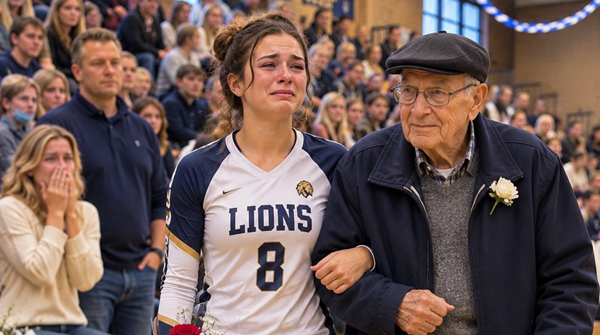
My Husband Said Senior Night Was “For Real Dads” So My 79-Year-Old Father Walked My Daughter Out on His Cane
“That walk is for real dads, Kay.”
Travis said it with his fork resting against the edge of his plate. He had that particular way of putting his fork down whenever he was about to say something he’d clearly been thinking about for a while.
It was a Tuesday evening in mid-October, just two days before senior night.
I’d made tater tot hotdish, the one meal I can put on the table without worrying about somebody complaining.
Kaylee had asked him a simple question. She always did that thing where she spoke quickly, as though getting the words out before she changed her mind would somehow make things easier.
“Will you walk me out on Thursday?”
Travis looked at her.
“I don’t want to take something that isn’t mine,” he said. “That’s something your dad should do. If he ever decides to show up, that is. It wouldn’t feel right for me to stand in his place.”
Kaylee was seventeen, a high school senior, and a middle hitter on the volleyball team. She’d worn her long blonde hair in the same braid since fourth grade, when she’d decided bangs were for little kids.
She looked at him for a few seconds.
I watched something change in her expression.
Then she simply said, “Fine.”
Her voice was so flat it sounded like someone reading the weather forecast.
She got up, rinsed her plate, placed it in the dishwasher, and headed upstairs.
Her bedroom door didn’t slam.
Part of me wished it had. At least then there would have been something to respond to.
Mason, our eight-year-old son, sat quietly at the table with ketchup on his chin. He was Travis’s biological son and mine, and Kaylee’s younger half-brother. But in our house, nobody had ever used the word half when talking about family.
He looked at me, waiting.
He was expecting me to fix things, because that’s usually what I did. I handled the phone calls, remembered the permission slips, knew which teacher needed an email, and somehow always managed to find the scissors nobody else could locate.
But that evening, I said nothing.
I scraped the remaining hotdish into a plastic container, snapped the lid shut, and kept quiet.
I’ve replayed that moment in my mind more times than I can count.
The easy version would be to say I was too shocked to speak.
But that wouldn’t be honest.
I knew exactly what I could have said. I could have looked at Travis and told him he was walking Kaylee out, and that was the end of the discussion.
He would have done it.
He’s that kind of man. When someone asks him to do something, he usually does it.
But then my daughter would have walked onto that gym floor beside a man who was only there because his wife had forced him.
And she would have known it.
I wanted him to choose her himself.
After nine years together, I wanted him to stand up and take his place without anyone having to tell him that it was his to take.
So I kept quiet.
Maybe that was pride. Maybe it was a mistake.
But it was the truth.
My name is Jodi Brandt. I’m forty-one years old, and I work as a dental hygienist in a small town in southern Minnesota, about forty minutes from Mankato.
To understand what happened that Thursday, you need to know a little about Kaylee’s biological father.
His name is Ryan.
We married young, when I was twenty-two, in the Lutheran church where I grew up.
When Kaylee was four, Ryan took a job in the oil fields of North Dakota. The money was good, but the distance seemed to suit him even better.
He started coming home less often.
Eventually, he stopped coming home altogether.
For a while, he remembered her birthday and called. Then he started missing some of those calls, too.
The last time he promised to visit was when Kaylee turned eleven. He said he’d drive down for her confirmation.
He never showed up.
That was six years ago.
Kaylee still has his number saved in her phone, but she hasn’t called him since seventh grade. His name appears in her contacts simply as Ryan.
Not Dad.
Travis entered our lives when Kaylee was seven.
He sells seed corn and soybeans from a large metal shed north of town. I first met him when he came into the dental clinic with a cracked molar.
For two years, I cleaned his teeth before he finally found the courage to ask me out.
Later, he admitted he’d been scheduling his regular cleanings a month early just to have an excuse to see me sooner.
On our second date, he asked whether he could meet Kaylee.
He explained that he didn’t want to continue dating a woman with a young daughter unless that little girl was comfortable having him around.
Kaylee treated that meeting like an official interview.
She asked whether he owned a dog, whether he knew how to braid hair, and whether he liked the Minnesota Twins.
He answered yes, no, and only when they win.
He learned to braid hair that summer.
He even practiced on a piece of orange baler twine tied to a cabinet handle in his shed.
I once walked in and caught him doing it. He turned bright red and immediately tried to pretend he’d been doing something else.
We married when Kaylee was eight.
She continued calling him Travis, just as she does today. Neither of them ever made a big deal out of it, and I never insisted she call him anything different.
I honestly thought everything was working out.
Travis drove her to every volleyball practice from seventh grade onward. Sometimes it was an hour each way, especially when her club team practiced in Mankato.
He built her a volleyball hitting net behind the shed using old fence posts and cargo netting.
He attended every match and kept statistics on a clipboard nobody had ever asked him to bring.
He knew her hitting percentage better than her coach did.
And yet, he had never once called himself her father.
I had always interpreted that as respect. I thought he was simply giving Kaylee space and allowing her to decide what their relationship meant.
It took me until that Thursday to understand something important.
Sometimes a person can be so careful about not crossing a line that eventually fear becomes the line itself.
After dinner on Tuesday, Travis went out to the shed.
Whenever something was bothering him, he’d claim he needed to check inventory. There wasn’t much inventory to check in October, but I knew better than to question him.
I went upstairs and knocked on Kaylee’s bedroom door.
“Come in,” she called.
She was lying on her bed with her shoes still on, staring at the ceiling fan. She knew I hated when she did that.
Her room smelled of vanilla body spray and the volleyball knee pads she constantly forgot to air out.
I decided not to mention either.
“You don’t have to talk about it if you don’t want to,” I said.
“Good,” she replied. “Because I don’t.”
I sat on the edge of her bed.
After a while, she spoke.
“He’s not wrong, you know. He’s not my real dad.”
She continued staring at the ceiling.
“I just thought… I don’t know. I thought it didn’t matter anymore.”
“It doesn’t,” I told her.
“Apparently it matters to him.”
I placed my hand gently on her ankle. She didn’t move it away.
At seventeen, those little moments when your daughter still lets you comfort her become more precious than you realize.
“Who would you like to walk you out?” I asked. “Not who you think you’re supposed to choose. Who do you actually want?”
She thought for a while.
Then she said, “Could Grandpa do it?”
My father, Duane Ostrem, was seventy-nine years old.
He’d spent fifty-one years milking Holstein cows on the same farm east of town. Twice a day, every day of the year.
He sold the herd in 2011, the spring after my mother passed away.
He once joked that the cows no longer needed a man who talked to them so much.
He still lived on the farm and continued getting up at 4:30 every morning.
Two winters earlier, he’d undergone a left hip replacement. Since then, he’d walked with a cane. It was a simple wooden hickory cane with a rubber tip he replaced whenever it wore out.
Kaylee had spent nearly every summer of her childhood following him around that farm.
When she was eleven, he taught her to drive in his old Ford pickup, out in the hayfield.
That was the same summer Ryan had stopped calling regularly.
“Grandpa walks pretty slowly these days, sweetheart,” I said.
“I know,” she answered. “I don’t care. I want him.”
Then she turned toward me.
“And Mom? I want it to be just him. I want Grandpa to have that moment by himself. Is that okay?”
I’ll admit, that hurt a little.
But I understood.
I’d be sitting in the bleachers, watching her, and I wouldn’t have to be the person holding her together as she crossed the gym.
“I’ll call him tomorrow,” I promised.
The following morning, between my eight and nine o’clock patients, I called the high school’s activities director, Mrs. Larson.
Every senior had to submit a form listing the people who would accompany them during the ceremony.
I’d filled out Kaylee’s form the previous week.
Without giving it much thought, I’d written Jodi and Travis.
Now I needed to change it.
Mrs. Larson asked what name she should put down instead.
“Duane Ostrem,” I said. “Her grandfather.”
There was a brief silence.
“Oh, that’ll be lovely,” she replied.
Then she carefully asked, “Is everything all right at home, Jodi?”
In a small town, people tend to know when something isn’t quite right.
“Everything’s fine,” I told her. “Kaylee asked for her grandpa.”
It was true.
It just wasn’t the whole story.
On Wednesday evening, after supper, I called Dad.
He always answered on the fourth ring. His phone hung on the kitchen wall, while his favorite recliner sat in the front room.
I told him everything.
I told him what Travis had said, how Kaylee had reacted, and how disappointed she’d been.
He listened without interrupting.
He didn’t criticize Travis or ask what kind of man would say something like that.
He simply waited until I finished.
Then he asked one question.
“Does Travis know you’re asking me?”
“No,” I answered.
He was quiet for a long time. I could hear the old kitchen clock ticking in the background. It had been hanging there since before I was born.
Finally, he spoke.
“Well, what time do I need to be there?”
I told him the junior varsity game started at 5:30 and senior night would follow, probably around 6:45.
“I’ll be there by six,” he said.
My father had never been late for anything in his life.
“Dad, you’ll have to walk across the entire gym floor. That’s a long way, especially with your cane.”
He chuckled.
“I’ve walked a lot farther than that in a snowstorm to get to the barn. I reckon I can manage a gymnasium for my granddaughter.”
I didn’t tell Travis that Dad was coming.
I could have.
Perhaps he would have understood what was happening and changed his mind before Thursday.
But then his decision would have been made because another man was about to take his place.
I didn’t want that.
I wanted him to make the choice himself.
So I went to bed that night without telling him.
He kissed me goodnight, set his alarm for 5:15, and went to sleep as he always did.
We didn’t mention Kaylee.
I lay awake beside him, wondering whether I’d done something unfair by allowing the situation to unfold without giving him a chance to explain himself.
I still don’t have a perfect answer.
Thursday finally arrived.
I spent the day cleaning teeth from eight in the morning until four in the afternoon.
One of my patients, Mrs. Bauer, who was eighty-four and had owned the same partial dentures since the Carter administration, told me she wouldn’t miss senior night.
“I haven’t missed one since my Jim’s sister played in 1974,” she said. “They wore bloomers back then, or something close enough.”
That’s how things work in our town.
Our school district had been formed by combining three small communities back in the nineties. There were only about four hundred students in the entire building, from kindergarten through twelfth grade.
That year, six girls were graduating from the volleyball team.
Everybody knew their names.
At 4:30, I picked Mason up from his after-school program.
He proudly showed me the poster he’d made in art class.
It said GO KAYLEE and featured a drawing of a volleyball.
It looked suspiciously like a pumpkin.
“It’s a volleyball,” he insisted before I could say anything. “I ran out of white paint.”
We arrived at the gym around 5:15.
I wore my maroon booster club sweatshirt, the one with the little volleyball printed on the sleeve.
Travis came directly from the shed, wearing his fleece vest with the seed company logo on the front.
He sat beside me in the front row of the bleachers.
The gym smelled of popcorn, floor wax, and that slightly hot electrical smell coming from the old scoreboard.
Maroon and gold streamers decorated the railings.
Each senior had a large photograph displayed on an easel beside the scorer’s table, showing her jersey number and a picture from the season.
Kaylee’s photograph showed her jumping for a hit during a home match the previous fall. Her long braid was flying behind her.
A bucket of red roses sat on the scorer’s table.
Each graduating player would carry one across the court and hand it to the person accompanying her.
That was how the school had always done it.
Travis glanced at the roses, then quickly looked away.
His hands were clasped between his knees. His thumb kept rubbing the side of his index finger, something he always did when he was nervous.
“You okay?” I asked.
“Fine,” he replied.
His voice sounded exactly like Kaylee’s had on Tuesday.
For a moment, I almost laughed at how similar they were.
Almost.
The junior varsity girls played the visiting team from two towns away. They lost the first set but came back to win the next two.
Mason cheered for both sides because he hadn’t quite figured out which team we were supposed to be supporting.
At six o’clock, I found myself watching the side entrance.
At six-oh-five, I was watching it even more closely.
Dad was never late, but he was seventy-nine years old, had a replaced hip, and was coming out on a cold October evening.
Travis noticed me looking toward the door.
“Who are you waiting for?” he asked.
“Nobody,” I lied.
At 6:12, the side door finally opened.
And my father walked in.
I felt an enormous weight lift from my chest.
He wore his tan Sunday sport coat, the same one he’d worn to my mother’s funeral and to Mason’s baptism.
Underneath was a white shirt buttoned neatly to the collar.
He also wore his good green seed corn cap, the one he kept hanging by the back door and rarely wore anywhere except town.
His cane was in his right hand.
His shoes were polished.
He didn’t climb into the bleachers.
Instead, he walked straight toward the end of the gym where the seniors were gathering.
He stopped beside Kaylee, looking as though he’d been officially appointed to the position.
Travis noticed him immediately.
I watched the realization spread across his face.
First came confusion.
Then understanding.
Then something I couldn’t quite identify.
He turned toward me.
I looked back.
“Jodi,” he said quietly.
“She asked for him,” I replied. “Tuesday night, after you went out to the shed.”
He nodded slowly.
Down on the gym floor, Kaylee slipped her arm through Grandpa’s free arm and laughed at something he said.
Her laughter carried all the way across the gym.
Travis looked down.
He didn’t say another word.
But he stopped rubbing his thumb against his finger.
He became completely still.
The junior varsity game ended, and the varsity girls lined up along the far sideline.
Our players wore maroon. The visiting team wore white.
Mr. Halvorson, who had taught shop at our school for thirty years, stepped up to the microphone.
He had the kind of booming voice that could probably be heard across an entire farmyard.
He tapped the microphone twice.
“Ladies and gentlemen, please welcome our senior volleyball players and their families as we honor them during their final regular-season home game.”
The first girl was introduced with her mother and father. They walked together toward the center of the court, and she handed her mother the rose.
They posed for photographs while the crowd applauded.
The second girl walked out with her mother and stepfather.
I noticed that, of course.
I didn’t look at Travis, but I knew he’d noticed it too.
The mother received the rose, while the stepfather put his arm around both of them.
The third girl came out with her parents and grandmother, who was sitting in a wheelchair pushed by her uncle.
The grandmother received the loudest applause so far.
Then Mr. Halvorson looked down at his index card.
He paused briefly before reading the next name.
“Number seventeen. A middle hitter and four-year letter winner. Kaylee Brandt, escorted tonight by her grandfather, Mr. Duane Ostrem.”
A murmur passed through the bleachers.
Half the people in that gym had bought milk from my father at some point. Others had gone to school with him decades ago or served with him on church committees.
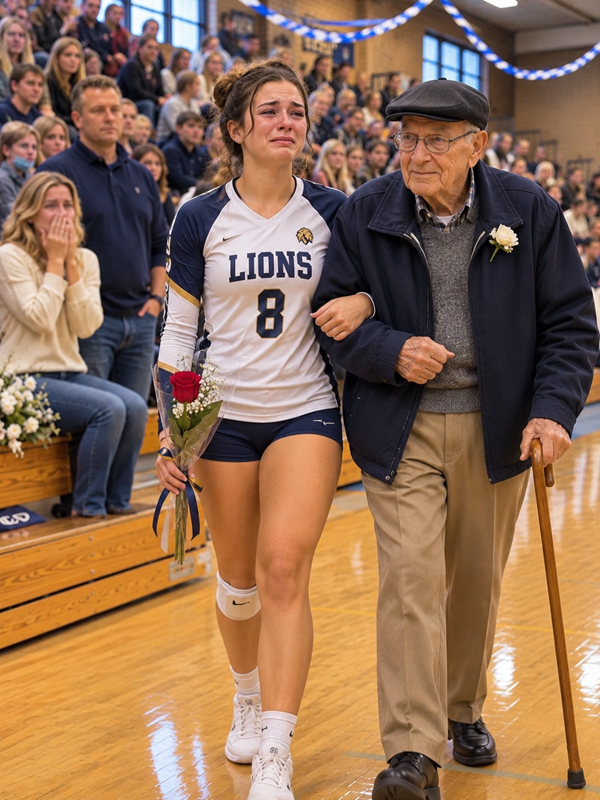
Kaylee moved the rose into her left hand and slipped her right arm through Grandpa’s left.
He planted his cane firmly on the floor.
And they began walking.
Slowly.
He couldn’t move quickly anymore, and nobody expected him to.
Cane. Step. Step.
Cane. Step. Step.
The rubber tip squeaked against the polished gym floor with every step.
Mr. Halvorson continued reading the information about Kaylee.
“She has been on the honor roll throughout all four years of high school. She’s a member of the National Honor Society and has shown dairy heifers in 4-H for eight years…”
Then someone in the top row stood up.
I never found out who started it.
Perhaps it was Mrs. Bauer, although I doubt she could get to her feet that quickly.
A person in the row below stood next.
Then another.
Within seconds, the entire top section was standing.
The applause spread downward until the whole home side of the gym was on its feet.
Older men who had worked alongside my father stood and clapped. Women from his church group rose from their seats. Even little children stood up, although most of them probably had no idea why.
Then the visiting volleyball players began clapping.
Their parents followed.
Soon, the entire gym was standing.
I covered my mouth with both hands.
I hadn’t planned to cry. The tears simply came.
My father didn’t look up.
He kept his eyes on the floor ahead of his cane, carefully watching where he placed each step.
Kaylee leaned toward him and said something quietly.
Beside me, Travis stood up.
At first, I assumed he was simply joining the crowd.
But he wasn’t clapping.
His arms hung at his sides, and he stared toward the stairs at the end of our row.
His jaw moved from side to side.
I’d seen him do that only twice before in our nine years together.
Once when he proposed to me.
And once at his mother’s funeral.
He placed one hand on the metal railing and started down the steps.
Mr. Halvorson was still reading.
“After graduation, Kaylee plans to attend Minnesota State University in Mankato, where she hopes to study nursing…”
Travis continued down.
There were four steps between our front row and the gym floor.
I counted every single one.
He stepped onto the polished floor in his work boots and fleece vest.
Kaylee and Grandpa were about ten feet from the center of the court.
Travis quickened his pace until he caught up with them.
He didn’t interrupt.
He didn’t ask anyone’s permission.
He simply walked up beside Kaylee, on her left side, away from Grandpa’s cane.
Then he offered her his arm.
The way a man offers his arm to a woman at a wedding.
Kaylee stopped.
She looked at his arm.
Then she looked up at him.
I couldn’t see her face clearly from where I sat, but I could see her shoulders move.
They rose slightly.
Then relaxed.
She slipped her hand through his arm.
And the three of them continued toward the center of the gym.
Cane. Step. Step.
Cane. Step. Step.
Travis matched Grandpa’s pace perfectly.
The noise in that gym became something I will never forget.
Mason was jumping up and down on the bleacher seat beside me.
“That’s my dad! That’s my dad!” he shouted.
Mr. Halvorson had finished reading everything on his card.
He stood beside the scorer’s table, looking at the three people now standing together in the middle of the court.
Then he made a decision.
He walked over and handed the microphone to Travis.
Nobody thought it was strange. In a small town, people know one another, and everyone understood that something important was happening.
The gym gradually became quiet.
Travis stared at the microphone as though he wasn’t sure what to do with it.
He wasn’t a man who enjoyed speaking in front of crowds. He sold seed to farmers who didn’t like salesmen, and his approach had always been simple: talk less, work hard, and show up when people needed you.
He raised the microphone.
His hand was shaking.
“I’m Travis,” he began. “I’m Kaylee’s stepdad. I’ve been her stepdad for nine years.”
He paused.
He looked down at the floor.
My father remained still. Kaylee stood beside him.
“On Tuesday night, at supper, Kaylee asked me if I’d walk her out tonight. And I told her no. I told her that this walk was for real dads.”
A quiet murmur moved through the crowd.
“I said that because I thought I didn’t have the right to do it. I thought I’d be taking something that belonged to someone else. I’ve spent nine years thinking that way.”
He turned toward Kaylee.
He looked directly at her, standing in front of hundreds of people.
“I was wrong, Kay. I’ve been your dad for nine years. I just never had the courage to say it out loud.”
His voice broke.
“I want to say it now. And I’m sorry.”
He handed the microphone back to Mr. Halvorson.
For a moment, Travis looked as though he wished the floor would open beneath his feet.
Kaylee didn’t say anything.
She simply turned toward him and buried her face against his fleece vest.
He wrapped both arms around her.
Her long blonde braid fell down his back.
And then my father did something I will remember for the rest of my life.
Kaylee had handed him the rose when they reached the center of the court. He’d been holding it against his cane.
He waited until she stepped away from Travis.
Then he extended his hand and offered the rose to my husband, stem first.
Travis looked at it.
He shook his head slightly, as though telling Dad that the flower belonged to him. He had earned it. He was the one who had walked all the way across the gym.
But my father didn’t lower his arm.
He simply kept holding the rose out, patient and steady.
It reminded me of the way he’d once held a bottle out to a stubborn calf, waiting until it finally decided to drink.
The gym was so quiet that I could hear his words from the front row.
“I already raised mine, son,” Dad said. “This one’s yours.”
Travis finally accepted the rose.
My father touched the brim of his green cap toward Kaylee, almost like a farmer greeting someone at the local co-op.
Then he turned around, planted his cane firmly on the floor, and began making his way back across the gym.
He walked alone.
A sophomore from the junior varsity team came over to offer him assistance. He allowed her to walk beside him, although he didn’t take her arm.
He made it all the way to the bleachers himself.
Then he climbed the four steps, one at a time, holding the railing.
When he finally reached our row, he sat down beside me, breathing heavily.
He patted my knee twice.
“Well,” he said. “That went all right.”
I couldn’t answer.
I simply rested my head against his shoulder, on the tan sport coat that still carried the faint smell of cedar from his closet.
And I cried harder than I had since my mother died.
Down on the gym floor, Kaylee’s coach had come out with her phone to take a photograph.
Travis stood beside Kaylee in front of her senior poster, holding the rose.
She had her arm through his.
Both of them were red-faced from crying.
Then Kaylee looked up toward the bleachers and waved for Mason, Grandpa, and me to come down.
Mr. Halvorson leaned into the microphone.
“Come on, Jodi! Bring everybody down here!”
The crowd laughed.
So we made our way onto the court.
Dad walked down those steps a second time without complaining.
The five of us stood together beneath the maroon and gold streamers.
Mason held his homemade volleyball poster upside down.
Nobody noticed until the photograph was printed.
We decided to leave it that way.
It’s still on our refrigerator.
We didn’t talk much on the drive home.
Mason fell asleep against the window before we even reached the edge of town. Kaylee went with her teammates to their pizza party at Casey’s.
Travis drove with both hands on the steering wheel.
The rose rested on the dashboard, rolling slightly whenever we turned a corner.
For eleven miles, neither of us said a word.
When we got home, I carried Mason upstairs and tucked him into bed.
When I returned to the kitchen, Travis was sitting at the same table where he’d been sitting on Tuesday night.
The rose lay in front of him on the oilcloth.
I made a pot of decaf coffee.
Then I sat across from him and waited.
“I should apologize for not telling you Dad was coming,” I finally said. “I wanted you to make your own decision, but I should have been honest with you.”
Travis shook his head.
“You were right not to tell me,” he said. “If I’d known, I probably would have done it because of you. Tonight, I needed to do it for her.”
Then he told me something he’d never shared with me during our entire nine years of marriage.
Something that explained more than I could have imagined.
When Travis was twelve, his mother remarried.
Her new husband’s name was Dale.
According to Travis, Dale wasn’t a terrible man. He worked hard, paid the bills, and never raised a hand to anyone.
That spring, Travis played Little League baseball.
At the end of the season, the team held a small awards ceremony at the American Legion hall. The boys’ fathers were expected to stand behind them when they received their trophies.
Travis had asked Dale to come.
But at the kitchen table, in front of his mother, Dale told him:
“You’re not mine to raise. That’s your father’s job. I’m not going to stand up there pretending.”
Travis’s biological father wasn’t coming either.
So he walked up alone, accepted his trophy, and returned to his seat.
After that, he never asked Dale for anything again.
Travis slowly turned the rose on the table.
“I promised myself I’d never do that to a child,” he said. “I’d never make a kid feel the way I felt that day.”
He looked at me.
“And on Tuesday, I sat right here in this chair and said almost exactly the same thing.”
“Why?” I asked softly.
He rubbed his face with both hands.
“Because I’ve been afraid of overstepping for nine years. Every time I wanted to call her mine, I’d think about Ryan. What if he comes back? What if she gets angry with me? What if she thinks I’m trying to take something that doesn’t belong to me?”
He paused.
“When I said real dads, Jodi, I wasn’t talking about her. I was talking about myself. I didn’t think I counted. I didn’t think I had the right to count.”
He looked down at the rose again.
“Then I watched your father walking her across that gym with his cane. A seventy-nine-year-old man, making his way across that entire floor just to be there for his granddaughter. And I thought, what am I doing sitting up there?”
He shook his head.
“He showed up. That’s what a real dad does. He shows up. I’ve been showing up for nine years, and all that time I’ve been telling myself it didn’t mean anything.”
I reached across the table and placed my hand over his.
His hands were rough from years of working in the shed, lifting seed bags, repairing machinery, and doing all the things that come with farm life.
He turned his palm upward and held my hand.
We sat quietly like that until Kaylee came home around eleven.
She entered through the back door wearing her warmup jacket, with her braid half undone. She smelled of pizza and the gym.
She stopped when she saw us sitting at the kitchen table.
Her eyes moved from me to Travis, then settled on the rose.
Then she did something she hadn’t done since she was ten years old.
She walked over and sat on Travis’s knee.
At five feet ten, she was far too big to sit comfortably on him.
But she didn’t seem to care.
“Everybody kept showing me the video at the party,” she said. “I put my phone away for a while. Someone already posted it on Facebook. Grandpa has four hundred likes.”
Travis laughed, although his eyes were still wet.
“Your grandpa doesn’t even know what Facebook is.”
“I know,” she replied. “That’s the best part.”
She became quiet for a moment.
Then she leaned toward his ear.
“I wasn’t really mad because you said no, Travis. I was mad because I thought you didn’t want to.”
Travis looked at her.
“I always wanted to, Kay. Every single time. I was just scared.”
“Scared of what?”
He thought about it before answering.
“Of you telling me I wasn’t your dad.”
Kaylee pulled back and stared at him as if he had just said something completely ridiculous.
“Travis,” she said, “who do you think taught me how to braid my own hair?”
That was when I had to get up and walk over to the kitchen sink for a few minutes.
The next morning was Friday.
Dad called at 6:15, which was practically sleeping in for him.
He wanted to know whether the rose had been put in water.
He explained that a flower that beautiful deserved to last at least a week, provided we cut the stem at an angle.
Travis followed his instructions.
He placed the rose in a canning jar on the windowsill above the kitchen sink.
It lasted nine days.
Dad considered that a remarkable achievement for a florist’s rose in October.
Travis never made another speech about what happened that evening.
He wasn’t the kind of man who needed to talk about his feelings every day.
But some things changed in our house after senior night, and those changes mattered more than anything he could have said.
He began coming with me to Kaylee’s parent-teacher conferences.
For years, he’d waited outside in the truck, saying the teachers only needed one of us.
Now he came inside, squeezed into those tiny plastic chairs, and asked her chemistry teacher how she was doing.
The Saturday after senior night, he drove out to my father’s farm and spent the afternoon repairing the latch on the machine shed.
It had been sticking since August.
Dad hadn’t asked him to fix it.
Travis simply showed up.
Later, Dad told me they hadn’t talked much.
They repaired the latch, sat on the tailgate of Travis’s pickup, and drank coffee from Dad’s old green thermos.
At one point, Dad said, “She’s a good girl.”
Travis replied, “She sure is.”
That was practically a long conversation for two men like them.
As for Ryan, Kaylee’s biological father, he never found out what had happened.
I briefly considered sending him the video.
Then I decided it wasn’t my place.
Kaylee never asked me to send it, so I left it alone.
Her volleyball season ended in November with a five-set loss in the section semifinals.
She cried for two days, then eventually moved on.
Spring came, and graduation got closer.
One afternoon in April, Kaylee sat at the kitchen table with her laptop, filling out the information for her graduation announcements.
The school used an online form where students entered their names, graduation dates, open-house details, and parents’ names.
I was at the stove making supper.
Tater tot hotdish.
I hadn’t planned it that way.
Travis sat across from Kaylee, working on his spring seed delivery schedule.
She typed for a while.
Then she turned her laptop around so we could both see the screen.
She didn’t say anything.
She just waited.
Travis looked at the screen and slowly removed his reading glasses.
For a long moment, he didn’t speak.
Under Kaylee’s name, on the line marked “Parents,” were three names.
Jodi Brandt.
Travis Brandt.
Duane Ostrem.
Travis reached across the table and gently touched the edge of the laptop screen, almost as though he were afraid it might break.
Finally, he spoke.
“You spelled Ostrem right,” he said, his voice rough. “Your grandpa will want to know you spelled his name correctly.”
Kaylee smiled.
“I know how to spell my own grandpa’s name, Travis.”
“I know you do, Kay.”
She turned the laptop around and pressed submit.
Then she looked toward the stove.
“Is that hotdish?”
“It is,” I answered.
“Good. I’m starving.”
And the four of us sat down to supper at the same kitchen table where everything had started.
Nothing about the meal was special.
The food was the same. The table was the same. The people were the same.
But something had changed.
Nobody was waiting for someone else to fix things.
Nobody was questioning where they belonged.
And nobody had to ask.
Because family isn’t always defined by blood, biology, or the names printed on a birth certificate.
Sometimes it’s defined by the person who drives you to practice, waits through every game, learns to braid your hair, and stands beside you when life gets difficult.
It’s the person who keeps showing up, even when they’re afraid they don’t have the right to be there.
And sometimes, all it takes is one old man with a wooden cane to remind everyone what love really looks like.
My father walked slowly that night.
But he gave our family something none of us will ever forget.
He showed us that being a real father isn’t about having the right title.
It’s about being there.
And sometimes, the greatest thing one father can do is make room for another one.