 By Admin
I was standing in my kitchen with a turkey sandwich in one hand and a roll of plastic wrap in the other when my phone rang.
“What does he want?” I asked.
“I honestly don’t know, honey,” Mrs. Fogle replied. “He won’t explain. He just keeps insisting that he needs to speak with you.”
Then she lowered her voice.
“Becky, there’s something else. He’s crying.”
I stopped what I was doing.
Dale Heckert was crying?
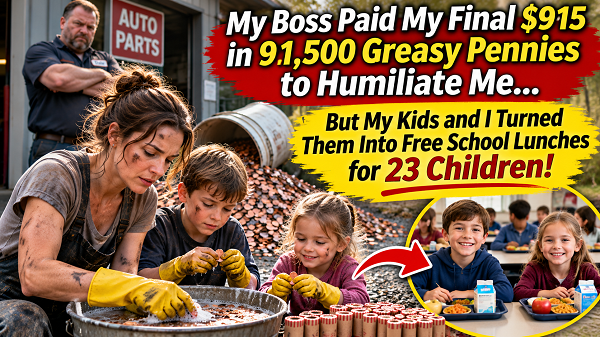
The same man who had dumped 91,500 oil-covered pennies across my driveway because I had decided to leave his auto parts shop?
I couldn’t imagine what could possibly have happened.
At eight o’clock, I dropped the children off at school. Lily headed toward kindergarten, while Noah went to his second-grade classroom.
I reminded Noah to go straight to class and not stop by the school office.
He looked at me suspiciously. He could tell something unusual was happening.
“Is it because of the pennies?” he asked.
“I’m not sure yet, sweetheart. Just go to class, okay?”
He nodded and walked away.
I made my way toward the office.
The seventy-four shoeboxes containing our rolled pennies were still stacked against the back wall. The bank’s armored vehicle wasn’t scheduled to collect them until Friday.
Mrs. Jaeger was sitting at her desk, concentrating very hard on her paperwork and deliberately avoiding eye contact.
Mr. Okonkwo stood in the doorway of his office with his arms folded across his chest.
And there, sitting in one of the small plastic chairs beside the front counter, was Dale Heckert.
I had never seen him look like that before.
He seemed smaller somehow.
He was wearing his usual work clothes: Dickies, a gray Heckert Auto T-shirt, and steel-toed boots with their laces tied in knots.
His shoulders were slumped forward.
His short crew cut looked uncombed, and his face was red and blotchy.
He was holding an old coffee can in his lap.
It was a red Folgers can with a dented metal lid.
The moment he noticed me, he jumped to his feet so quickly that the plastic chair fell backward.
“Becky,” he said.
His voice sounded rough and strained.
I didn’t answer immediately.
I stood just inside the office doorway with my purse hanging from my shoulder.
A moment later, Mrs. Fogle came out of the cafeteria wearing her apron and hairnet.
She positioned herself beside the counter, between Dale and me, with her arms crossed.
“I’m not here to cause any problems,” Dale said.
He paused and swallowed.
“I just need to tell you something. And there’s something I need to give you.”
He extended the old coffee can toward me.
“I don’t want anything from you, Dale,” I replied.
“It’s not for you,” he said quickly. “It’s for the children. The kids who need help paying for lunch.”
I remained where I was.
He placed the can on the counter and carefully removed the lid.
Inside were stacks of folded bills.
Not pennies.
Twenties, fifties, and hundreds, each bundle held together with rubber bands.
“Four thousand three hundred dollars,” he said quietly. “Mrs. Fogle told me that’s what the school still owes. All the grades, from kindergarten through fifth.”
I looked toward Mrs. Fogle.
She slowly nodded.
“He called yesterday afternoon around three,” she explained. “He wanted to know the total amount of unpaid lunch balances across the entire school. I gave him the figure, and he hung up.”
She glanced at the coffee can.
“He was already waiting in the parking lot when I arrived this morning. Six-thirty.”
I turned back toward Dale.
“Why?”
He didn’t answer immediately.
Instead, he stared at the can before looking over at Mrs. Fogle.
“Edna, would you tell her?” he asked softly. “I can’t seem to get the words out.”
Mrs. Fogle slowly unfolded her arms.
“Becky, do you know how long I’ve worked at this school?”
“Thirty-one years,” I answered.
“That’s right. But do you know who worked here before me?”
I shook my head.
“My mother,” she said. “Irene Bauer. She worked in the cafeteria at Washington Elementary from 1962 until 1993.”
She turned toward Dale.
“Dale used to stand in her lunch line every single day. From first grade through sixth grade.”
Dale lowered his eyes toward the floor.
“My father drank,” he began.
His voice was strangely emotionless, as though he had repeated the story to himself many times but had never actually told anyone.
“He owned the shop and made decent money. But most of it disappeared at the Rusty Nail on Main Street. Some weeks, we barely had enough money to buy groceries. Paying for school lunches wasn’t even an option.”
He paused.
“So I got the cheese sandwich.”
He looked down at his hands.
“Second grade. Third grade. Fourth grade. Every day for three years. A white lunch tray. One slice of cheese between two pieces of white bread, wrapped in a plastic bag. And a carton of milk.”
Nobody in the office spoke.
“Kids started calling me Cheese,” he continued. “It followed me all the way through high school. Even after the shop started making money. Even after I joined the Navy and came home. Some of those same guys still call me Cheese when they see me at the Rusty Nail.”
He let out a short, bitter laugh.
“Forty-five years later.”
He rubbed his face.
“I never told anyone how much that bothered me. I just learned to be meaner than everybody else. Figured if I made people afraid of me, nobody would notice that I was once the kid eating a cheese sandwich.”
Mrs. Fogle stepped closer.
“When Dale was in fifth grade,” she said quietly, “his lunch account was eighty-four dollars behind. That was a tremendous amount of money in 1975. The school was preparing to send a letter home to his father.”
She looked directly at him.
“My mother paid the entire balance. She took the money out of her own purse. It was money she needed for groceries.”
Dale’s expression changed.
“She never told him,” Mrs. Fogle continued. “She never told the school or anybody else. She simply made sure he started receiving a regular hot lunch again.”
Dale’s face crumpled.
“I didn’t know,” he whispered. “I had no idea until 2009.”
He wiped his eyes with the back of his hand.
“At Irene’s funeral, Edna told me what her mother had done. That’s when I finally found out.”
He looked at Mrs. Fogle.
“She paid for my lunch for two years. And I never thanked her. I didn’t even know she was doing it.”
He took a shaky breath.
“When I saw that post about the pennies yesterday, I couldn’t stop thinking about it.”
His eyes moved toward the rows of shoeboxes against the wall.
“Twenty-three kids,” he said. “Twenty-three children who won’t have to stand in that lunch line and get a cheese sandwich.”
His voice cracked.
“I paid you in pennies because I wanted to hurt you. I wanted you to feel small. You were leaving, and I couldn’t stand it. Everybody leaves eventually. My wife. My son. Every good mechanic who ever worked for me. And then you.”
He looked straight at me.
“You were the best parts person I’ve ever had. Better than my father. Better than I ever was. And when you handed me that resignation letter, I didn’t know how to deal with it.”
He shook his head.
“So I did what my father would have done.”
His eyes filled with tears again.
“I wanted you down on your knees in that gravel. I wanted you counting every single penny and thinking about me the entire time. I wanted you to be angry.”
He glanced toward the shoeboxes.
“But instead, you turned every one of those coins into lunch money for children.”
He looked back at me.
“Last night, I sat in my truck in the shop parking lot for three hours. I kept reading that school post. I read the comments over and over. Everybody in this town thinks I’m a terrible person.”
He paused.
“They’re right.”
For a long moment, I couldn’t find anything to say.
I simply looked at Dale Heckert.
He was sixty-one years old, standing in an elementary school office in his dirty work clothes, holding a coffee can full of money and crying in front of the woman who managed the school cafeteria.
I thought about those pennies scattered across my driveway.
I remembered Noah and Lily wearing their little yellow rubber gloves.
I remembered my sore knees, my cracked fingertips, and the countless hours we had spent washing and rolling coins.
And I remembered Lily’s final roll, covered in tiny fingerprints.
Finally, I spoke.
“Dale, why did you ask me to come here?”
He looked up.
“Because I owe you an apology,” he answered. “And I wanted to say it before anything else. Before I give the school this money. Before I do anything.”
He took a deep breath.
“I’m sorry, Becky. I’m sorry for the pennies. For covering them in oil. For making your children clean them. For ignoring you during your final two weeks. And for spending six years taking your work for granted without ever telling you how much I appreciated it.”
He looked toward the shoeboxes again.
“I’m sorry.”
I was so focused on him that I never noticed the office door opening behind me.
Then I heard a familiar voice.
“Mr. Heckert?”
Everybody turned.
Noah was standing in the doorway, holding his backpack by one strap.
He had apparently left his classroom and come straight to the office. I later discovered that he had asked his teacher if he could use the bathroom before heading down the hallway.
He looked at Dale.
Dale’s expression immediately changed.
“Hi, Noah,” he said quietly. “Your mom used to bring you to the shop sometimes when you were little.”
“I remember,” Noah replied. “You gave me a lollipop from the jar.”
Dale nodded.
“That’s right.”
Noah walked farther into the office and stopped beside the counter.
He looked at the open coffee can.
“Is that money for the cheese sandwich kids?”
Dale nodded again.
“Yes. It’s for the whole school. Every grade.”
Noah stood silently for a few seconds, thinking.
Then he asked a question that none of us had anticipated.
“Did you get the cheese sandwich when you were little?”
Dale stared at him.
Nobody had explained Dale’s story to Noah. He had only heard part of the conversation.
“Yes,” Dale answered. “Every day for three years.”
Noah slowly nodded.
“Mason gets it,” he said. “He’s in my class. Tyler calls him Cheese Boy.”
Dale closed his eyes.
“I didn’t say anything to Tyler,” Noah continued. “I didn’t know what I was supposed to say.”
He looked up at Dale.
“Did anybody ever say anything when they called you that?”
Dale shook his head.
“No. Nobody did.”
Noah became quiet.
Then he reached into the pocket of his coat.
He pulled out a single penny.
It was bright, clean, and shiny.
One of the coins we had washed together.
I later learned that Noah had secretly kept it on the final day of rolling. He had taken a penny from his own piggy bank and put it in our collection instead because he wanted to save one of the cleaned coins as a memory.
He held it out toward Dale.
“This is one of yours,” he explained. “We washed it. It was really dirty.”
Dale stared at the penny resting in Noah’s palm.
He didn’t take it immediately.
“Why are you giving me that?” he asked.
Noah considered the question.
“Because you said sorry to my mom. And because nobody said anything when they called you Cheese.”
He extended his hand a little farther.
“So I’m saying something,” Noah said. “I’m sorry they called you that.”
Dale finally reached out and took the coin.
He held it in his large, scarred hand and looked at it for several seconds.
Then he slowly sat back down in the small plastic chair.
He covered his face with both hands.
And he began crying again.
The bank’s armored vehicle arrived on Friday.
The employees counted the entire collection.
Exactly $915.
Every penny was accounted for.
Mrs. Fogle used $908.40 to clear the outstanding lunch balances belonging to the twenty-three second-graders.
The remaining $6.60 went into a glass jar on the cafeteria counter.
Someone attached a small handwritten label:
For Whoever Needs It.
Dale’s $4,300 donation covered the remaining unpaid balances throughout the school.
For the first time in eleven years, Washington Elementary had no students with negative lunch accounts.
But the story didn’t end there.
The following week, Dale called me.
I nearly let the phone go to voicemail.
After everything that had happened, I wasn’t sure I wanted another conversation with him.
But eventually, I answered.
“Becky,” he said. “I’ve got a question.”
“Okay. What is it?”
“There’s something at the shop. A jar under the counter. It’s been there since my father opened the business.”
I waited.
“Whenever somebody pays cash, the loose change goes into it. Mostly pennies.”
I wasn’t sure where he was going with this.
“How many pennies are we talking about?” I asked.
He paused.
“One of the guys weighed the jar. About sixty-six pounds. Maybe twelve thousand pennies. They’ve been collecting there for fifty-seven years.”
“Dale, what exactly are you asking me?”
He took a breath.
“I was wondering if you and the kids would show me how to roll them.”
I didn’t respond immediately.
Then he continued.
“Mrs. Fogle mentioned that the middle school has unpaid lunch balances, too. And the high school. I was thinking that if people could see how this works, maybe they’d start bringing their own change.”
He cleared his throat.
“Maybe we could get other people involved.”
There was another pause.
“I’ll wash the coins myself first,” he added. “No oil this time. I promise.”
I couldn’t help smiling a little.
Two Saturdays later, we organized an event at the Merrill Fire Hall.
Dale brought the old jar from his shop.
He had washed all twelve thousand pennies himself in the shop sink. They were clean and shining.
I brought my blue plastic washing tub and the old plaid blanket with the burn hole.
Noah brought the masking-tape trick he had developed for organizing the rolls.
Lily brought her stuffed rabbit and kept singing her favorite fire truck song.
We placed a sign on the entrance door.
PENNY SATURDAY
Bring your spare change. Help us roll pennies. Every roll helps feed a child.
We honestly expected perhaps ten people to show up.
Instead, 240 people came.
They arrived carrying coffee cans, mason jars, plastic bags, pickle jars, and old containers filled with loose change.
Some older men brought shoeboxes containing pennies they had collected over fifty years.
Children arrived with their piggy banks.
A woman from the local nursing home brought a large glass jar of coins she had been saving since her husband passed away.
Carl from the auto parts shop showed up with all four of the Heckert mechanics.
Even the men who regularly gathered at the Rusty Nail came.
They were the same men who had called Dale “Cheese” for forty-five years.
That afternoon, they sat at a table near the back of the hall and spent six hours rolling pennies.
Mrs. Fogle brought her mother’s old cafeteria apron and hung it on the wall behind the tables.
Dale took a seat at the main table with Noah and Lily.
Unfortunately, he was terrible at rolling coins.
His fingers were too large, and he kept tearing the paper wrappers.
Lily patiently demonstrated how to fold the ends.
“Like this, Mr. Dale,” she explained. “You tuck it in. Then you push.”
“I’m tucking,” Dale replied. “And I’m pushing.”
“You’re squishing,” Lily corrected.
Noah laughed so hard that he nearly fell off his chair.
It was one of those moments when everyone in the room started laughing along with him.
By the end of the day, we had rolled 412,000 pennies.
That was $4,120.
It was enough to eliminate the middle school’s outstanding lunch debt, with approximately $900 left to help the high school.
For the first time, it felt as though the entire town had become part of something bigger than any of us.
The following Monday, I returned home from work and noticed a dump truck parked in my driveway.
It belonged to Lincoln County Aggregate.
A worker was spreading fresh gravel across the entire surface.
Clean, gray, crushed limestone.
I stood there for a moment, confused.
Then I noticed Dale standing beside the truck with his arms crossed.
“What is going on?” I asked.
He nodded toward the driveway.
“The oil stain.”
I looked at him.
“From the pennies,” he explained. “That stain would’ve stayed there for years if we hadn’t replaced the gravel.”
He unfolded his arms.
“I had them remove the top four inches, take the old material to the recycling yard, and put down a completely new layer.”
I looked around.
The large, dark stain that had covered the driveway was gone.
Everything was smooth, clean, and gray.
“Dale, you really didn’t have to do all this.”
He looked at me.
“Yes, Becky. I did.”
Then he reached into his shirt pocket.
He pulled out the shiny penny Noah had given him at the school.
He had carefully drilled a tiny hole near the top and attached it to his key ring.
It hung beside the keys to his truck and the shop.
“I carry this with me every day now,” he said.
He turned the coin between his fingers.
“Every time I start the truck, I see it.”
He looked down at the penny again.
“It reminds me that somebody finally spoke up when it mattered.”
A year has passed since that day.
I still work at the co-op.
I’m now the parts and inventory manager, and the health insurance has made a tremendous difference for our family.
Noah’s asthma is under control.
Lily hasn’t broken anything else lately, although that doesn’t mean she hasn’t tried.
Jake still hauls timber near Tomahawk.
He says he still has nightmares about penny wrappers.
Dale continues running Heckert Auto & Diesel.
His business slowed down for a few months after the original story spread around town.
But after the first Penny Saturday, things gradually improved.
People began visiting the shop again.
Some said they wanted to support him because they believed people deserved an opportunity to change.
And Dale actually did change several things.
He now provides health insurance for every employee at the shop.
All of them.
He once told me that the new coverage costs him nearly $2,000 every month.
“Should’ve done it twenty years ago,” he admitted.
Mason, the boy in Noah’s class, now receives a regular hot lunch every day.
And Tyler Beckman stopped calling him Cheese Boy.
I eventually found out what happened.
A few weeks after our first Penny Saturday, Tyler used the nickname again while they were standing in the cafeteria line.
Noah stepped directly in front of Mason.
He spoke loudly enough for several other children to hear.
“Mr. Dale told us nobody should be called that. People called him that when he was little, and it made him feel bad for forty-five years.”
Tyler never used the nickname again.
That small moment meant more to me than I can explain.
There is now a Penny Saturday event every September.
It takes place at the Merrill Fire Hall on the third Saturday of the month.
Dale organizes everything.
He has purchased folding tables, a commercial coin-counting machine, and a large banner that reads:
EVERY PENNY COUNTS.
At our most recent event, we collected and rolled almost 600,000 pennies.
That’s approximately $6,000.
It was enough to eliminate the lunch debt throughout the entire school district, with additional money left over to establish a permanent assistance fund.
Dale gave the fund a name.
He called it the Irene Bauer Fund.
When Mrs. Fogle heard the announcement, she began crying.
There is now a small brass plaque hanging on the wall of Washington Elementary’s cafeteria, right beside the lunch line.
Dale paid to have it made.
The plaque reads:
In Memory of Irene Bauer, Lunch Lady, 1962–1993.
She paid for a boy’s lunch and never told him.
He finally found out.
No child in this school will ever eat a cheese sandwich again.
Last month, I stopped at Heckert Auto to pick up a fuel filter for Jake’s truck.
The shop looked almost exactly the same as it had when I worked there.
Gray steel walls.
Four service bays.
Coffee strong enough to strip paint.
And the usual tire-company calendar hanging near the office.
But something new had appeared on the parts counter.
Right beside the register stood a large glass pickle jar.
It was about half full of clean, shining pennies.
A piece of masking tape had been attached to the front.
The words were written in thick black marker.
FOR THE LUNCH KIDS. EVERY PENNY COUNTS.
Underneath that message was another line.
The handwriting was smaller and slightly uneven, as though the person writing it had been very careful not to make a mistake.
THANK YOU FOR GIVING ME A SECOND CHANCE. — DALE
I stood there for a long moment, looking at the jar.
A year earlier, Dale had emptied 91,500 oil-covered pennies onto my driveway because he wanted to make me feel worthless.
Now he kept a jar of clean pennies beside his cash register because he wanted to make sure no child ever had to experience that same humiliation.
I thought about Noah and Lily sitting on our old blanket, carefully scrubbing those coins.
I remembered Mrs. Fogle crying in the school office.
I remembered Dale holding the shiny penny in his scarred hand.
And I thought about the little boy he had once been, standing in a school cafeteria line with an empty lunch account, hoping nobody would notice the difference between his white tray and everyone else’s.
Dale had spent years carrying that embarrassment with him.
It had changed the way he treated people.
It had made him angry, defensive, and unnecessarily cruel.
But somehow, the very pennies he had used to humiliate me had helped him confront something he had buried for decades.
He had wanted those coins to teach me a lesson.
Instead, they taught all of us something much more important.
That even the smallest act of kindness can change someone’s life.
That people deserve dignity, regardless of their financial circumstances.
And that even someone who has spent years making others feel small can learn to help them stand a little taller.
Because the real value of those 91,500 pennies was never just $915.
It was what we decided to do with them.
And sometimes, the most meaningful changes begin with something as small as a single penny.
THE END.