 By Admin
When Kurt took a long look at the frost-covered ground, I could tell something had changed. Then he slowly stepped toward Dale.
I had known Kurt Ostrowski for eleven years. He had stood beside me at my wedding, shared countless bowls of chili during Packers games, and hunted on my grandfather’s ridge every November since Brad first brought him there.
But I had never seen him look quite like he did that morning.
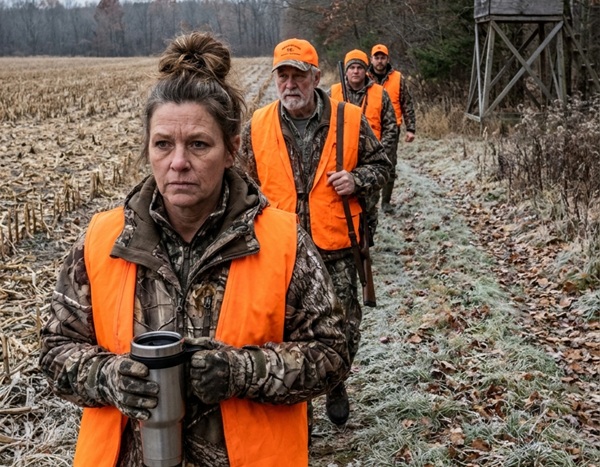
We were standing at the edge of my grandfather’s old cornfield. The November air was bitterly cold, and frost covered the ground beneath our boots. Behind Kurt stood Mike Pruett and Russ Lindahl, their rifles slung over their shoulders. Their eyes moved between me, Dale, and the three orange hunting hats visible among the trees.
Dale remained beside me near the old wooden ladder stand. At fifty-eight, with his tall frame, gray beard, and quiet manner, he carried himself like someone who had experienced things most people could never imagine.
Kurt stopped a few feet away. His attention settled on the faded military patch sewn onto Dale’s hunting coat. It showed a black horse’s head on a yellow shield.
“First Cav,” Kurt said quietly.
Dale nodded. “That’s right.”
“Desert Storm?”
“Desert Storm. Then Iraq twice.”
Kurt stood silently for a moment. Then he removed his right glove and extended his hand.
“Twenty-fourth Infantry,” he said. “Ninety-one. I was nineteen.”
Dale removed his own glove and shook his hand.
For a few seconds, nobody spoke. Somewhere across the hills, another hunter fired a shot.
Then Kurt turned toward me. His face was red, although the cold wasn’t responsible.
“Amy, what do you mean you didn’t cool off? Brad told us you were fine with it. He said you agreed.”
“Agreed to what?” I asked.
Kurt reached inside his blaze-orange vest and pulled out a folded document. The paper was worn along the creases, as though it had been carried around for quite some time.
I opened it.
At the top, in bold letters, were the words HUNTING LEASE AGREEMENT.
The document described my eighty acres using the exact legal wording from the deed. It listed me, Amy L. Halvorsen, as the property owner and Kurt Ostrowski, representing his hunting group, as the person leasing the land.
The agreement covered the November 2026 gun season and stated that $4,000 had been paid in cash.
At the bottom were two signatures.
One belonged to Kurt.
The other was supposed to be mine.
But it wasn’t.
Someone had copied my name in a slanted, looping handwriting that looked nothing like the signature I had used since I was twelve years old, when my grandfather taught me to write it on the back of a savings bond.
“I never signed this,” I told him. “I’ve never even seen it before.”
Kurt looked stunned.
“Brad gave it to us in August. He said you signed it when you picked up the rest of your things. He told us you were happy to get the money because of the property taxes.”
My hands began shaking.
I explained that I hadn’t visited Brad since the divorce. The only conversation we had in August was a phone call in which he told me I didn’t even hunt and then hung up.
Mike muttered something under his breath.
Russ looked at the paper. “Then where did our four thousand dollars go?”
Nobody needed to answer.
To understand how I ended up in that frozen field with three Army veterans and a forged hunting lease, you need to understand what that land meant to my family.
The land my grandfather never charged anyone to use
My grandfather, Arvid Halvorsen, was born in 1932 in the farmhouse that still stands at the bottom of the property, about a mile and a half outside Elk Mound, Wisconsin.
He served in Korea with the Second Infantry Division. When he returned home in 1953, he carried a Purple Heart and a permanent limp in his left leg.
He married my grandmother, Ingrid, in 1955. For the next fifty years, they worked that land together, growing corn and soybeans, raising a few beef cattle, and bringing up three children.
But Grandpa’s favorite part of the property was always the ridge.
The northern forty acres were covered in hardwood trees, including enormous white oaks, red oaks, and a creek bottom surrounded by thick cedar. Every autumn, deer came down from the ridge to feed in the harvested cornfields.
Grandpa always said it was the finest deer hunting ground in Dunn County.
He never charged anyone to hunt there.
From 1961 until the year before he died, Grandpa personally walked his hunters onto the property every opening morning. Many were veterans, from Korea and Vietnam to the Gulf War, Iraq, and Afghanistan.
He kept a small green ledger in the kitchen drawer. Inside were the names of everyone who hunted, the year they came, and whether they harvested a deer.
Sometimes he added a personal note.
One entry read:
“Jim Haugen, Vietnam, 1969. First hunt since he came home. Didn’t shoot. Sat all day. Said it was the first time he slept since Khe Sanh.”
When I was little, I followed Grandpa along the field edge, carrying his enormous steel thermos and trying to step exactly where he stepped so I wouldn’t make noise in the leaves.
One morning, I asked him why he didn’t charge the hunters. Other landowners made money by leasing their property, and I couldn’t understand why he didn’t do the same.
He stopped and looked down at me.
“Some things you don’t sell, Amy,” he said. “These men already paid.”
I never forgot those words.
Grandpa passed away three years ago, at the age of eighty-nine. His will, prepared by Harold Brekke, a Menomonie attorney who had served our family since the 1960s, left the farmhouse and all eighty acres to me alone.
At the time, I was married to Brad Kessler.
The marriage that ended, but the trouble didn’t
Brad and I had been married for nine years. He worked as a sales manager at the John Deere dealership in Menomonie. He was charming, easygoing, and so good at selling things that people sometimes bought equipment they didn’t need.
When Grandpa’s will went through probate, Brad sat beside me in Harold Brekke’s office. As the attorney read the section leaving me the land, Brad squeezed my knee.
Outside, in the parking lot, he smiled and said, “That’s our land now, babe.”
“It’s my land,” I replied, half joking. “Grandpa left it to me.”
Brad laughed.
“Same thing, right? We’re married.”
It wasn’t the same thing. I would eventually learn that the hard way.
Our marriage didn’t end with a dramatic affair or some enormous argument. We simply reached a point where we had been living more like roommates than husband and wife for years.
Brad wanted to move to Madison and sell the farmhouse. I wanted to remain where my grandfather had lived. He saw the land as money that could be turned into something else. I saw it as part of my family.
“It’s just dirt, Amy,” he told me once. “Eighty acres of dirt and some old trees.”
“It’s Grandpa’s,” I replied.
“Your grandpa’s dead.”
That was when I knew our marriage was over.
During the divorce, Brad’s attorney, Darren Fiske, argued that the inherited property should be treated as marital property or that Brad deserved part of its increased value.
He claimed Brad had improved the property by building four deer stands, maintaining trails, and paying half the property taxes in 2024.
My attorney, Patricia Haugen, calmly explained that inherited property in Wisconsin generally remains individual property unless it has been mixed with marital assets in a way that makes it impossible to trace.
The deed was in my name alone. The property had never been retitled or refinanced. Even the tax bills were in my name.
Brad had contributed $930 toward one year’s property taxes.
Patricia offered to reimburse him.
Brad’s attorney continued arguing over the value of the hunting stands, but a local appraiser, Gordon Lund, gave his professional opinion that four homemade wooden deer stands added approximately nothing to the value of the eighty acres.
The divorce became final in October, two years before the events in the field.
I kept the farmhouse and the land. Brad kept his truck, bass boat, half of our joint savings, approximately $23,000, and his 401(k).
I sent him the $930 reimbursement from my Royal Credit Union account. On the check’s memo line, I wrote two words:
“Paid in full.”
I believed the matter was settled.
I was wrong.
Brad hadn’t kept a key to the property. He had kept something much worse: the belief that the ridge still belonged to him.
The secret hunting business Brad had been running
I first learned about the arrangement in August at the Cenex station in Elk Mound.
I was filling my truck when Kurt pulled up beside me in his black Silverado.
After exchanging greetings, he casually mentioned that he and his friends were paid up with Brad for the upcoming hunting season.
Four thousand dollars in cash.
The same arrangement as the previous year.
I stood there holding the gas nozzle.
“Same as last year?” I asked.
Kurt shrugged and explained that Brad had told them I was fine with him continuing to organize the hunting. According to Brad, I didn’t hunt and didn’t care about the property.
I had never agreed to anything.
For two seasons after our divorce, Brad had been collecting $4,000 annually from his friends to hunt on land that no longer belonged to him.
And I had been sitting in the farmhouse every November, hearing gunshots from the ridge, assuming they came from neighboring properties.
That night, I called Brad.
He answered after several rings. I could hear a television and a woman laughing in the background.
When I asked about the hunting money, he chuckled.
“Come on, Amy. You don’t even hunt. It’s wasted on you. Those guys love it out there. They’ve been hunting that ridge for years.”
“With my grandfather’s permission,” I reminded him. “And then mine, when we were married. Not yours. You don’t own that property.”
Brad insisted that he had built the hunting stands.
I told him they were four plywood boxes on my land.
He remained calm, almost amused, and told me not to make a big deal out of a few weeks in November.
Then he hung up.
That was always Brad’s way. He rarely raised his voice. Instead, he stayed perfectly calm until the other person began feeling unreasonable for being upset.
I sat at Grandpa’s kitchen table, looking at the green ledger.
Fifty-nine years of names and memories filled those pages.
And Brad was selling those hunting days for cash.
The legal danger I hadn’t realized
The following morning, I drove to Menomonie and met Patricia.
I told her I didn’t want to sue anybody. I simply wanted the arrangement stopped.
She explained that the deed was clear. I was the owner, and I had every right to prevent unauthorized people from entering my property.
She advised me to post signs along the boundaries and gates and send Brad a certified letter formally revoking any permission he believed he had.
Then she brought up something I hadn’t considered: liability.
Wisconsin has a recreational-use law that generally protects landowners who allow people to use their property for activities such as hunting, fishing, and hiking without charging them.
But accepting payment can change the situation.
Brad had been collecting $4,000 each season while people hunted on my property. If someone fell from one of his homemade stands and suffered a serious injury, an attorney could argue that the arrangement was a commercial hunting lease.
That could leave me facing a legal and financial problem, even though I had never authorized the arrangement.
I immediately called Lyle Swenson at the Farm Bureau office. He had handled my grandfather’s farm insurance for thirty years.
Lyle explained that the existing liability policy covered ordinary recreational use by friends, family, and neighbors hunting for free. It did not cover commercial hunting leases.
A paid arrangement would require proper notification, additional insurance coverage, written documentation, proof of the hunters’ own insurance, and inspections of the stands.
Without those precautions, an accident could put the entire farm at risk.
The property was worth approximately $640,000 at the going rate in Dunn County, not including the farmhouse.
I wasn’t going to let Brad put everything my grandfather had built in danger.
That afternoon, I went to Fleet Farm and bought eighty orange signs reading:
PRIVATE PROPERTY – NO TRESPASSING – NO HUNTING.
I also bought aluminum nails and a staple gun.
Over the next two weekends, I walked the entire property, putting up signs along the boundaries, at the corners, and on both sides of the field gate.
My neighbor, Earl Nygaard, who had farmed the adjoining land for forty years, saw me working and stopped his tractor.
“Brad’s crew?” he asked.
“Brad’s crew,” I answered.
Earl told me he had noticed the trucks parked at my gate the previous November. He had wondered why Brad’s friends were hunting there while I wasn’t with them.
He offered to help with the northern boundary, where the fence near the creek was in poor condition.
We finished that section together.
Then I wrote a formal letter to Brad. Patricia reviewed it before I mailed it.
The message was simple: any permission Brad believed he had to enter, use, or grant hunting rights on my property was immediately revoked. That applied to anyone to whom he had sold or promised access.
I sent it by certified mail with a return receipt.
Four days later, the green card arrived, bearing Brad’s familiar handwriting.
He had received the notice.
I assumed he would tell his friends.
I was wrong again.
The veterans I met at church
In September, I attended the harvest potluck at Our Savior’s Lutheran Church in Elk Mound.
I brought my grandmother Ingrid’s scalloped potatoes, a recipe people had been asking me to make for years.
Across the table sat Dale Moody, a man I had seen around church but never really gotten to know. He had a short gray beard, a quiet manner, and a way of looking at people that made it seem as though he wanted to be certain they were all right.
He recognized the potatoes and remembered my grandmother bringing them to his father’s funeral in 1999.
That started our conversation.
Dale had grown up in Colfax, joined the Army at eighteen, and served for twenty-four years. His service included Desert Storm with the First Cavalry Division and two tours in Iraq. After retiring as a first sergeant, he returned to Dunn County and began driving a delivery truck for the Menomonie co-op.
I asked whether he still hunted.
He shook his head.
He had spent decades hunting public land but had stopped about five years earlier. The crowded opening mornings had become difficult for him. People would walk behind his stand in the darkness, shine flashlights into the woods, or suddenly appear nearby.
After Iraq, unexpected movement behind him in the dark could make his heart race. Hunting had stopped being peaceful.
A younger man sitting beside him introduced himself as Tim Seger.
Tim had served two tours in Afghanistan, including Kandahar. His uncle had taken him hunting as a child near Chippewa Falls, but after Tim joined the Army, his uncle passed away and the family land was sold.
He had not hunted since.
His father’s old .30-06 rifle was still sitting in his closet, untouched for fifteen years.
The third man was Wes Hanna, a member of the Army National Guard who had served in Iraq in 2007.
Wes explained that finding affordable hunting land had become almost impossible. Large outfitters and wealthy out-of-state hunters leased much of the available property.
A man he knew paid $6,000 annually for access to 120 acres near Durand.
Wes had two children and a mortgage in Boyceville. He couldn’t afford that kind of money simply to sit in a tree stand.
As I listened, I thought about Grandpa’s green ledger and the words he had spoken to me as a child.
“These men already paid.”
The words came out before I had even planned what to say.
Dale looked up.
I told the three men about my grandfather’s eighty acres, the hardwood ridge, the creek bottom, and the deer that came down to feed in the cornfields.
Then I offered them the property for the entire hunting season.
“You can hunt there this fall. All season.”
Dale immediately asked what it would cost.
“Nothing,” I told him.
He reached for his wallet and offered me a thousand dollars for opening weekend alone.
I covered his wallet with my hand.
“My grandfather walked veterans up that ridge for free from 1961 until the year before he died. If I took a dime from you, Grandpa Arvid would haunt us both.”
Dale slowly put his wallet away.
Then he mentioned something I hadn’t known.
His father had hunted with Grandpa in the 1970s.
That evening, I opened the ledger and searched through the old entries. There it was, written in Grandpa’s slanted handwriting:
“Roger Moody, Vietnam, 1974. Big 10-pointer, north ridge. Cried when he shot it. Said it was the first good thing since he got back.”
Dale’s father had been there.
The tradition was coming full circle.
Preparing the ridge for opening morning
During two Saturdays in October, we worked together to prepare the old hunting stands.
I personally dismantled Brad’s four plywood structures with a pry bar and cordless drill. Patricia had told me it wasn’t necessary, but I didn’t want anyone climbing into something he had built.
The plywood was rotting, and one ladder rung had been repaired with duct tape.
Twelve feet above the ground.
Grandpa’s stands were much better. He had built three sturdy ladder stands in the early 1980s using white oak cut and milled on the farm.
One overlooked the woods where deer descended toward the corn. Another stood near the creek crossing, and the third was positioned above the cedar bottom.
After more than forty years, the oak had weathered to silver-gray, but the wood remained remarkably solid.
The stands needed new straps, bolts, and a few replacement rungs.
Dale knew carpentry. Wes arrived with a truck full of tools, and Tim worked quietly, carrying lumber and helping wherever he was needed.
At one point, Tim stood beneath the creek-crossing stand and stared up at it.
“My uncle’s stand looked just like this,” he said.
I bought new ratchet straps and safety harnesses at Fleet Farm for $340. Lyle had recommended the safety equipment, and I wanted everything properly inspected.
Wes checked the bolts twice. Dale climbed each stand and tested its stability.
During that second Saturday, a black Silverado slowed as it passed my gate on County Road H.
It was Kurt’s truck.
I watched it drive away, but I didn’t think much about it.
Opening morning was approaching.
The morning everything came to a head
Wisconsin’s gun deer season opened on the Saturday before Thanksgiving.
I set my alarm for 3:45, although I had been awake since three.
At 4:30, I filled Grandpa’s old green Stanley thermos with coffee. It still had the dent it had received when he dropped it from the tailgate in 1987.
I tucked my auburn hair into a low ponytail, put on a blaze-orange hat, and took Grandpa’s tan canvas hunting coat from the hook beside the back door.
It had hung there for three years.
The coat was too large in the shoulders, and its sleeves covered my fingertips. I rolled them up twice.
It still carried the faint smell of pipe tobacco, wood smoke, and cold November air.
Dale, Tim, and Wes arrived at 4:45 in Dale’s pickup. They wore their orange vests and hats, with their rifles still cased.
Grandpa had always walked his hunters onto the ridge on opening morning.
So I did the same.
I led the way along the edge of the harvested cornfield, carrying the thermos beneath one arm and a small red-lens flashlight pointed toward the ground.
Behind me walked three veterans. Their rifles were slung over their shoulders and unloaded.
That had always been Grandpa’s rule: nobody loaded a rifle until reaching the stand and securing the safety harness.
The frozen corn stalks crunched beneath our boots. Somewhere in the creek bottom, a barred owl called into the darkness.
I took Wes to the upper stand overlooking the cedars. He climbed up, secured his harness, and gave me a thumbs-up.
Then I led Tim to the creek crossing.
He stopped at the bottom of the ladder and stood quietly.
“My uncle used to walk me in like this,” he whispered. “In the dark. He’d go first, and I’d step where he stepped.”
His voice grew thick.
“I forgot that until right now.”
“You can remember it every year now, if you want,” I told him.
He nodded, climbed into the stand, and clipped in.
Dale’s stand was the last one. It was Grandpa’s own stand at the corner of the woods, where the ridge met the cornfield.
I opened the thermos and poured him some coffee.
“Your father sat right here,” I told him. “In 1974. He shot a ten-pointer from this stand.”
Dale held the warm cup in both hands.
He had just placed one boot on the bottom rung when we heard voices.
Flashlights appeared at the gate. Heavy boots crunched across the frozen field.
Three men were walking onto my posted property.
Kurt, Mike, and Russ.
They stopped about thirty feet away. Kurt pointed his flashlight toward me, then lowered it.
“Amy,” he said. “Brad told me you’d cool off.”
“I didn’t.”
He looked toward the orange hats in the trees, then at Dale.
“Who are these guys?”
“Army,” I replied. “All three. They hunt here now.”
A shot echoed across the hills.
Kurt looked down at the frost, took a slow step toward Dale, and recognized the military patch on his coat.
That was when the conversation about the First Cavalry and the Twenty-fourth Infantry took place.
Then Kurt showed me the hunting lease.
The forged signature.
The $4,000 payment.
And the question that changed everything: where had their money gone?
The truth about the money
I asked Kurt whether Brad had told him about the certified letter.
He looked confused.
I pulled out my phone and showed him a photograph of the green return receipt card. Brad had signed for it in August.
I also reminded him that the entire property had been posted.
Mike admitted that they had seen the signs the previous week. Brad had told them the signs were intended for other trespassers and that their lease protected them.
“Paper beats signs,” Brad had apparently told them.
They had believed him.
Russ explained that they had paid Brad $4,000 each year, in cash, at the Legion Hall.
Then Kurt revealed something even worse.
They had been paying for three seasons, not two.
The first payment had come before my divorce was finalized. Brad had told them he was separating from me and needed money for his lawyer. He said I was going to make things difficult about the property, so they felt sorry for him and paid.
Over three years, they had handed him $12,000.
He had sold them hunting rights that he never owned.
And for three years, he had exposed my grandfather’s farm to potential liability.
Dale had listened quietly.
Now he spoke.
“Sounds to me like you three got robbed.”
Kurt looked at him.
“Your buddy sold you something he didn’t own. That’s not on her, and it’s not on you. That’s on him.”
Kurt removed his hat and rubbed his head.
He apologized to me and promised they would leave immediately. He also apologized to Dale for arriving noisily on opening morning.
Dale told him he understood. The men had been misled.
As Kurt, Mike, and Russ walked back toward the gate, Kurt stopped and turned around.
“Your grandpa walked me in once,” he called. “Nineteen ninety-two. The year after I got home. Brad never knew that. I was too embarrassed to tell him.”
His voice wavered.
“He told me I’d already paid.”
Then he turned and continued toward the gate.
I walked back to the farmhouse while the three veterans settled into their stands.
The morning had become bright and clear. Frost shimmered across the cornfield, and gunshots echoed throughout the township.
At 7:15, I called Patricia.
I told her Brad had forged my signature and collected money for three years.
She instructed me to put the document in a plastic sleeve and avoid folding it or allowing anyone else to handle it.
She explained that forging someone’s signature on a document to obtain money could constitute forgery under Wisconsin law, and collecting money by falsely claiming rights to property could potentially amount to theft by fraud.
The district attorney could decide whether to pursue charges.
I told her I didn’t know whether I wanted Brad to go to prison. I just wanted the behavior to stop.
Patricia reminded me that Kurt, Mike, and Russ also had claims against Brad. They were the ones who had paid him $12,000.
She advised me to let the trespassing issue involving the three hunters go because they believed they had permission and immediately left when I told them otherwise.
Brad, however, had received written notice that he was no longer allowed on the property.
If he returned, I should contact the sheriff or conservation warden rather than confront him myself.
I asked whether she thought he would come back.
She replied that a man who forged his ex-wife’s signature might not react well to being caught.
She was right.
Brad returned that afternoon
At 2:40 p.m., Brad’s red Ram pickup came speeding down County Road H.
It skidded on the gravel before stopping at my gate.
He stepped out with the engine still running and the driver’s door open.
I watched from the porch as he read the orange sign:
PRIVATE PROPERTY – NO TRESPASSING – NO HUNTING.
Then he reached for the gate latch.
At that exact moment, a green Department of Natural Resources truck came around the bend and stopped behind him.
The conservation warden was Ray Lindqvist, a lanky man in his fifties who had served Dunn County for twenty-two years. He had known my grandfather well.
Earl Nygaard had called him that morning after hearing about the men who had entered the property.
Ray approached Brad.
“Afternoon, Brad.”
Brad turned and tried to smile.
“Ray. Just stopping by to see Amy.”
Ray looked at the posted sign and then toward me.
“Amy tells me she sent you a certified letter in August revoking any permission you had to be on this property.”
Brad insisted there had been a misunderstanding and that he and I had an arrangement regarding the hunting.
Ray reached into his jacket and produced the hunting lease, which I had given him earlier that morning.
“Is this the arrangement?”
Brad saw the document and went pale.
“Where’d you get that?”
Ray explained that Kurt had given it to me that morning and had also contacted him. Mike had provided a statement as well.
Ray had known my grandfather and had seen my signature on numerous landowner forms.
He knew the signature on the lease wasn’t mine.
Brad looked toward the porch.
For the first time I could remember, his usual calm expression disappeared.
“Seriously, Amy? You’re going to do this over some deer?”
“It was never about the deer, Brad,” I told him. “It was always about the ridge.”
He started talking about the hunting stands he had built and the work he had supposedly put into the land.
I reminded him that I had removed those stands because one had a ladder rung held together with duct tape.
He had allowed Kurt to climb that thing.
Brad had nothing to say.
Ray opened his citation book and informed him that he was issuing a trespass citation because Brad had come to the gate and attempted to enter after receiving written notice.
He would also forward the lease and witness statements to the district attorney’s office.
Ray advised Brad to return to his truck and stay away from the property.
Brad accepted the citation. He looked at it, then toward me, as though he might finally say something meaningful.
Maybe something cruel.
Maybe even an apology.
He said nothing.
He got into his truck and drove away.
Ray watched him leave before walking up the porch steps and removing his hat.
“Your granddad would’ve had me out here at six this morning,” he said. “Arvid didn’t wait on anything.”
“I know,” I answered. “He’d have walked down to that gate himself.”
Ray smiled and glanced at my coat.
“In that coat.”
I looked down at Grandpa’s old tan canvas coat. The sleeves were still rolled up twice.
The first deer in fifteen years
That afternoon, at 3:52, Tim Seger harvested his first deer in fifteen years.
It was a healthy six-pointer coming up from the cedar bottom near the creek crossing.
From the farmhouse, we heard one clean shot from his father’s old .30-06.
A little later, my phone buzzed.
Wes had sent a message from his stand.
“Tim got one. He’s sitting next to it. I think he’s crying. Should I go down?”
I replied:
“Give him a few minutes.”
When we finally reached him, Tim was sitting among the fallen leaves with his back against the oak. One hand rested on the deer’s neck.
His eyes were red, and he made no attempt to hide it.
“My uncle would’ve liked this,” he said.
Dale knelt beside him and placed a hand on his shoulder.
He didn’t need to say anything.
Wes took a photograph of Tim with the buck beside Grandpa’s old oak stand. Tim later had the picture printed and framed, giving me a copy.
Today, it hangs in the farmhouse kitchen beside a photograph of Grandpa in 1974 with Roger Moody and his ten-pointer.
Dale didn’t shoot anything that day.
He spent the entire day in Grandpa’s corner stand, watching eleven deer come down from the ridge into the corn.
He never raised his rifle.
That evening, he explained why.
“I didn’t need to. I just sat there. Nobody came up behind me. Nobody walked in on me in the dark. For the first time in about twenty years, I just sat there and watched the world wake up.”
He shook his head.
“I’d forgotten what that felt like.”
After everyone left, I opened Grandpa’s green ledger and took out his old fountain pen.
I wrote three new entries beneath his last one:
“Dale Moody, Army, Desert Storm and Iraq. 2026. Didn’t shoot. Sat all day. Said nobody came up behind him.”
“Tim Seger, Army, Afghanistan. 2026. Six-pointer, creek crossing. First hunt since he was a boy. Remembered his uncle.”
“Wes Hanna, Army National Guard, Iraq. 2026. Saw a big one, couldn’t get a shot. Says he’ll get him next year.”
Grandpa’s handwriting ended on one line.
Mine began on the next.
The ledger was still the same, and the ridge was still the same.
Brad finally faced the consequences
The legal matters moved slowly.
In December, Kurt, Mike, and Russ filed small claims cases against Brad in Dunn County Circuit Court. Each sought $4,000, representing his share of the money Brad had collected, along with filing fees.
They presented the forged lease, the envelope receipts from the Legion Hall, and their statements to Ray Lindqvist.
Brad did not contest the claims.
His attorney, Darren Fiske, contacted Patricia and asked whether I would consider not pursuing the forgery matter with the district attorney if Brad repaid everyone.
Patricia called me to discuss the request.
She explained that the district attorney was still reviewing the case. In some first-offense situations, repayment might be considered when deciding how to proceed, but the charging decision belonged to the prosecutor, not to me.
I spent three days thinking about it.
I thought about the forged signature, the dangerous stands, and the way Brad had dismissed my grandfather’s memory.
I also thought about the man I had married when I was twenty-six. He had once carried me over the farmhouse threshold and promised my grandfather he would take care of me.
But I couldn’t keep carrying the consequences of his choices.
I told Patricia to give the district attorney the complete truth and let the authorities decide what to do.
I wasn’t going to beg them to charge Brad, and I wasn’t going to beg them to spare him.
In January, Brad repaid the entire $12,000 to Kurt, Mike, and Russ. He sold his bass boat to do it.
The district attorney’s office charged him with a misdemeanor and offered a deferred prosecution agreement. Under its terms, Brad had to stay out of trouble for a year, pay court costs, and remain off my property.
He signed the agreement in February.
He also paid the $263 trespass forfeiture.
That winter, another letter arrived at the farmhouse.
It was addressed to me in Brad’s familiar handwriting, without a return address.
Inside was a single sheet of notebook paper.
Brad admitted that he had convinced himself the ridge belonged partly to him because he had spent nine years there.
But he acknowledged that it had never been his.
First it belonged to Arvid.
Then it belonged to me.
He apologized for forging the document, for the hunting stands, and for saying my grandfather was dead as though that somehow made his land unimportant.
I read the letter twice.
Then I folded it and placed it inside the back of Grandpa’s green ledger.
I didn’t write back.
Maybe someday.
The following hunting season
The next October, Kurt called me.
He explained that he, Mike, and Russ had been talking. They wanted to pay for hunting access and were willing to sign proper paperwork and meet the insurance requirements.
I told him no.
He quickly accepted my answer.
Then I explained what I meant.
“I’m not saying no to the hunting. I’m saying no to the money.”
There was silence on the other end.
I reminded Kurt that Grandpa had walked him onto the ridge in 1992, shortly after he returned home. Kurt had told me that himself in the cornfield.
Grandpa had told him he had already paid.
I told Kurt that the ridge had room for six hunters.
Dale, Tim, Wes, and Kurt could all return. Mike and Russ could hunt the creek bottom on the second weekend if they wanted.
But opening morning would remain dedicated to the veterans.
“You’re one of them, Kurt,” I told him. “You just let Brad make you forget it.”
For a long moment, he didn’t speak.
Then his voice became rough.
“Thank you, Amy.”
The tradition continues
The following year, opening morning arrived on the Saturday before Thanksgiving once again.
I set my alarm for 3:45, but I was already awake.
At 4:30, I filled Grandpa’s dented green thermos with coffee, tucked my auburn hair beneath my blaze-orange hat, and took his tan canvas coat from the hook beside the back door.
Four trucks arrived at 4:45.
Dale’s, Wes’s, Tim’s, and Kurt’s black Silverado.
Four men stood in the farmhouse yard beneath the light, their breath rising into the cold air.
Kurt stood slightly apart from the others, holding his hat in his hands.
Dale walked over and rested a hand on his shoulder.
“First Cav and Twenty-fourth,” he said. “Good to have you.”
Kurt nodded. He seemed unable to find the words.
I led the way along the field edge, just as Grandpa had done for so many years.
The frost covered the corn stubble, and the first gray light appeared behind the oaks.
Four men followed me with their rifles slung over their shoulders, all unloaded.
Nobody spoke.
Down in the creek bottom, the barred owl called into the darkness.
I took Wes to the upper stand and Tim to the creek crossing. Kurt was assigned a new stand that Dale and I had built that summer from white oak, just like Grandpa’s. It stood halfway up the ridge where the old logging trail crossed.
Kurt stopped at the bottom of the ladder.
I looked at him and whispered the words Grandpa had always used:
“Step where I step.”
“I remember,” Kurt whispered. “I remember now.”
Finally, I led Dale to the corner of the woods, to Grandpa’s own stand where his father had harvested that ten-pointer in 1974.
I opened the thermos, poured him a cup of coffee, and handed it over.
Dale held it between both hands as steam rose into the cold morning air.
“Your grandpa would be proud of you,” he said quietly.
“He’d tell me I rolled the coat sleeves wrong,” I answered.
Dale laughed softly, careful not to frighten the deer.
Then he returned the cup, secured his safety harness, and climbed into the stand.
I walked back down the field edge alone as the sun rose over the ridge and turned the frost golden.
Somewhere in the distance, the first shot of the season echoed across the hills.
I didn’t flinch.
I simply kept walking, following the same path my grandfather had taken so many times before, wearing his old coat and standing on the land he had loved.
My land.
When I returned to the farmhouse, I took out the green ledger and uncapped Grandpa’s fountain pen.
On a fresh line beneath the previous year’s entries, I wrote:
“Kurt Ostrowski, Army, Desert Storm. 2027. Walked in by Arvid’s granddaughter. He’d already paid.”
And that was how the tradition continued.
Because my grandfather had always understood something Brad never did: some things are worth far more than money. The ridge was never meant to be a business. It was a place where veterans could find peace, remember the people they had lost, and enjoy a morning without fear or interruption.
The land had been passed down to me.
But the promise behind it had been passed down too.
And I intended to keep it.