 By Admin
I Thought My Grandson Had Forgotten About Me — But His Graduation Speech Left Me Crying in Front of Everyone
Part One: Four Years Old
I raised my grandson, Kevin, after his parents were killed in a car accident.
He was only four years old.
It happened on a Tuesday in February. The roads outside Dayton, Ohio, were covered in ice. My son, Michael, and his wife, Rachel, were driving home from a church potluck along Route 35. Kevin was staying at my house that evening because I had offered to watch him so his parents could enjoy a little time together.
A tractor-trailer jackknifed on a bridge near Xenia.
At eleven-thirty that night, a state trooper knocked on my front door. He had a little girl of his own. I could see it in his eyes, in the way he looked past me toward the living room, where Kevin was sleeping on the couch beneath my old afghan, a coloring book resting on his chest.
“Mrs. Haley,” he said softly. “I’m so sorry.”
I was fifty-eight years old.
My husband, Harold, had died three years earlier from a heart attack while shoveling snow from our driveway.
I was a widow with a modest little house in Kettering, a job in the cafeteria at Fairmont High School, and a painful hip that my doctor had warned would eventually need replacing.
And now I had a four-year-old boy asleep on my couch who had no idea that his entire world had just fallen apart.
Part Two: Too Old
Some people thought I was too old to raise a child.
They whispered about it at the funeral, believing I couldn’t hear them. They said it at church. Even my own sister, Doris, said it directly to my face two weeks later while washing casserole dishes in my kitchen.
“Jo,” she said, “you have to be realistic. You’ll be seventy-two by the time he finishes high school. Seventy-two! What happens if something happens to you?”
“Then something happens to me,” I replied.
“Rachel’s sister in Phoenix offered to take him,” Doris continued. “She’s only thirty-four. She has a husband, a big house, and two children of her own.”
I knew about Rachel’s sister.
I’d met her once, at the wedding. She had spent nearly the entire reception staring at her phone.
“Doris,” I said, drying my hands on a dish towel, “he’s Michael’s son.”
I looked at her.
“Kevin is staying with me.”
And that was that.
Kevin became my whole world.
My name is Josephine Haley, although everyone calls me Jo.
I’m seventy-six years old now.
Part Three: Two Jobs
I worked two jobs to make sure we had enough to get by.
During the day, I worked in the cafeteria at Fairmont High School. My shift started at six in the morning and ended at two in the afternoon. I served pizza, tater tots, and chicken nuggets to teenagers who rarely remembered to say thank you.
I’d been working there for twenty-two years.
At night, I cleaned offices.
A company called Midwest Building Services had contracts with three office buildings in downtown Dayton. There was an insurance company, a law firm, and a dentist’s office on the ground floor.
My shift ran from six until eleven, Monday through Friday.
I emptied trash cans, vacuumed carpets, and scrubbed bathrooms on floors full of lawyers who went home every evening to houses I could only imagine.
My neighbor, Mrs. Ortiz, watched Kevin while I worked. She was a widow herself and refused to accept any money from me. She said having someone to cook for made her evenings less lonely.
I usually got home around eleven-forty.
Every single night.
And every single night, Kevin was waiting for me.
He wasn’t supposed to be awake. Mrs. Ortiz gave him his bath, put him in his pajamas, said his prayers with him, and tucked him into bed by eight-thirty.
But whenever I opened the front door, there he was.
Curled up on the couch beneath my old green afghan. The one my mother had crocheted in 1962.
His eyes would be half-closed, and his little hair would be sticking up in every direction.
“Grandma,” he’d whisper. “I saved you the warm spot.”
Then he’d scoot over.
And there it was: the place on the couch where his small body had been lying, still warm from the heat of his little frame.
I’d sit down beside him in my work clothes, smelling of Pine-Sol and floor wax. He’d climb into my lap, and I’d pull the afghan around both of us.
We’d sit quietly together in the dark for five minutes.
We didn’t need to say anything.
Then I’d carry him to bed.
He did that every night for six years.
When he turned ten, he had grown too big for me to carry. After that, he walked to bed by himself.
But he never stopped saving me the warm spot.
Part Four: We Never Had Much
We didn’t have much money.
We ate plenty of spaghetti and grilled cheese sandwiches. We also ate leftovers I brought home from the school cafeteria in plastic containers, even though I wasn’t technically supposed to take them.
Most of Kevin’s clothes came from Goodwill. His toys came from garage sales. His bicycle was an old one that had belonged to Michael back in 1990, which Harold had kept in the garage.
We never went on vacations.
There were no trips to Disney World, no beach holidays, and no visits to Kings Island.
For his tenth birthday, Kevin asked for a PlayStation.
All his friends had one.
I checked the price at the Walmart on Wilmington Pike.
Two hundred and ninety-nine dollars.
I went home, sat at the kitchen table, and worked through the numbers.
There was simply no way I could afford it.
Instead, I bought him a used Game Boy from a pawn shop. It cost forty dollars and came with three games.
He opened it at the kitchen table.
He looked at the Game Boy, then looked at me.
“It’s great, Grandma,” he said.
He didn’t complain. He didn’t cry. He didn’t ask why his friends had better things.
He simply played that little Game Boy until the buttons became smooth from so much use.
But we had each other.
We had Sunday afternoons at the library. Friday-night pizza from the little place on Far Hills Avenue, where we’d split one large pepperoni pizza between us. And summer evenings at Dayton Dragons baseball games, sitting in the cheap seats with a bag of peanuts I’d brought from home.
We had our little traditions.
And we had the warm spot.
Part Five: Smart
Kevin was a bright child.
Not just a little clever. He was genuinely gifted, the kind of student teachers noticed and remembered.
He read all the Harry Potter books when he was seven. He was doing long division in second grade.
In fifth grade, his teacher, Mrs. Lindqvist, called me in for a meeting.
“Mrs. Haley,” she said, “Kevin is testing at a high-school level in mathematics. I believe he should be placed in the gifted program.”
So he was.
He made the honor roll every semester, joined the National Honor Society, and eventually became captain of the school’s academic team.
On weekends, he worked at the Kroger grocery store. At first, he bagged groceries. Later, he started stocking shelves.
Every week, he gave me half of his paycheck.
I put the money into an old coffee can in the kitchen cabinet.
I never spent a single cent of it.
When Kevin was a junior in high school, he began talking seriously about college.
“Ohio State,” he told me one evening. “I want to study engineering. Mechanical engineering.”
He was sitting at the kitchen table surrounded by college brochures while I stood at the stove making grilled cheese sandwiches.
“Ohio State is expensive, sweetheart,” I said.
“I know,” he replied. “I’ll get scholarships. Maybe take out some loans. I’ll work, too.”
I didn’t answer.
I simply turned over the sandwiches.
I’d been thinking about his college education for years.
Ever since he was four.
Ever since that terrible night when the state trooper knocked on my door.
Part Six: The Acceptance
Kevin got into Ohio State.
The acceptance letter arrived on a Saturday in December, during his senior year.
It came in a large envelope decorated in scarlet and gray.
He opened it at the kitchen table, his hands trembling.
He read the first line.
Then he looked up at me.
He couldn’t seem to find the words, so he simply held the letter out for me to see.
“Congratulations! On behalf of The Ohio State University, I am delighted to offer you admission to the College of Engineering—”
I cried harder than he did.
I sank into the chair at the kitchen table, covered my face with my hands, and sobbed until I could hardly catch my breath.
Kevin hurried around the table and knelt beside me.
He wrapped his arms around my shoulders.
“Grandma,” he said. “Grandma, it’s okay. This is good news.”
“I know,” I managed to say through my tears. “I know it is.”
But I couldn’t explain why I was crying so hard.
I couldn’t tell him that I was thinking about Michael and Rachel.
About the icy bridge.
About the tractor-trailer.
About how they should have been sitting at that very kitchen table, celebrating their son’s acceptance into college.
Kevin held me for a long time.
Then he said something I’ll never forget.
“One day, Grandma, you’ll sit in the front row and watch me graduate.”
He pulled back and looked directly into my eyes.
“Promise?” he asked.
I wiped my cheeks with a dish towel.
“Wouldn’t miss it for the world, sweetheart,” I told him.
Part Seven: The Scholarship
In March, another letter arrived.
This one came in a thick white envelope. It wasn’t from Ohio State.
It was from a Dayton law firm called Brennan, Walsh & Associates.
Kevin opened it at the kitchen table.
As he read, the color slowly drained from his face.
“Grandma,” he said. “You have to look at this.”
He handed me the letter.
Dear Mr. Haley,
We are pleased to inform you that you have been selected as this year’s recipient of the Michael and Rachel Haley Memorial Scholarship.
This scholarship, established through a private endowment, will cover full tuition, fees, room, and board at The Ohio State University for four years, provided that you maintain a minimum GPA of 3.0.
The selection committee was particularly moved by your essay.
Kevin stared at the page.
“The Michael and Rachel Haley Memorial Scholarship,” he repeated slowly.
Then he looked at me.
“Grandma. That’s Mom and Dad.”
“I know, honey,” I said quietly.
“I applied for twenty different scholarships,” he said. “I wrote an essay about you. About everything we’ve been through. About the warm spot.”
He looked back at the letter.
“But I don’t remember applying for this one. I didn’t even know there was a scholarship in their name.”
“Maybe your guidance counselor submitted your essay,” I suggested. “Mrs. Patterson sent it to all sorts of places.”
Kevin studied me for a moment before looking down at the letter again.
“Full tuition,” he whispered. “Room and board. All four years.”
He brought a hand to his mouth.
“Grandma, I won’t have to take out student loans.”
I smiled at him.
“No, sweetheart,” I said. “You won’t.”
Part Eight: Four Years
For the next four years, Kevin called me almost every evening.
Sometimes he called from his dorm room in Columbus. Sometimes from the engineering library. Other times, he called while riding the bus to his internship.
Seven-thirty.
Every night.
Usually just after I returned home from my cleaning job.
By then, I’d left the cafeteria. My hip had become too painful for me to stand all day.
But I still cleaned offices three nights a week: Tuesday, Wednesday, and Thursday.
Sometimes Kevin called just to wish me good night.
Other times, he wanted to tell me about an exam he’d passed, a professor he liked, or a girl named Priya whom he’d met in his thermodynamics class.
And sometimes, he called because he needed advice about something ordinary.
Like laundry.
“Grandma,” he said one evening during his sophomore year, “I got spaghetti sauce on my good white shirt. The one I need for my interview tomorrow.”
“Use cold water,” I told him. “Not hot. Hot water will set the stain. Put some dish soap on it, the blue Dawn, and scrub it gently with an old toothbrush.”
“I don’t have blue Dawn.”
“Then ask the girl down the hall,” I said.
“Which girl?”
“Priya,” I replied.
There was a pause.
“How do you know about Priya?” he asked.
“Because you talk about her every night, sweetheart.”
He came home for Christmas every year, for Thanksgiving, and for a week during the summer.
Whenever he was home, he’d sit on the couch in the evenings beneath my mother’s green afghan.
And when I came through the front door at eleven-forty after cleaning the offices, he’d move over to make room.
“Saved you the warm spot, Grandma,” he’d say.
He was twenty years old by then.
Six feet one.
And he still saved me that spot.
Part Nine: The Silence
Then, about a month before graduation, everything changed.
It was April, near the end of spring break. Kevin had come home for a week.
The week had seemed perfectly normal. He was cheerful and helpful. He cleaned out the gutters, repaired the leaky bathroom faucet, and took me out for our usual Friday-night pizza on Far Hills Avenue.
One large pepperoni. Split between us.
Just like always.
On Saturday, he told me he needed his birth certificate.
“For my job,” he explained. “They’re doing the background check at Honda.”
He’d been offered a position as a mechanical engineer at the Honda plant in Marysville. He was due to start in July.
“It’s in the closet in my old bedroom,” I told him. “Inside the cedar box, on the top shelf.”
He went upstairs to look for it.
I stayed in the kitchen, preparing a pot roast for Sunday dinner.
He was in my bedroom for quite a while.
When he finally came back downstairs, something about his expression had changed.
He didn’t say anything. He walked straight past me, went into the kitchen, poured himself a glass of water, and drank it standing at the sink.
He wouldn’t look at me.
“Did you find it?” I asked.
“Yeah,” he answered.
The next morning, he left.
A day earlier than he’d planned.
He said he had a project to finish.
At the front door, he gave me a quick hug. It wasn’t like his usual hugs. He didn’t hold on, and he barely looked at me.
Then he was gone.
Part Ten: He Stopped Answering
Kevin stopped answering my calls.
At first, I told myself he was busy with finals. It was his last month of college. He had projects, exams, presentations, and all the pressure that came with graduating.
I called at seven-thirty on Monday.
Voicemail.
I tried again on Tuesday.
Voicemail.
Wednesday.
Voicemail.
I sent him a text.
Hope finals are going well, sweetheart. Love you.
Nothing came back.
By the end of the first week, I was worried.
By the end of the second, I could barely sleep.
At night, I’d lie in bed staring at the ceiling, replaying every moment of his visit.
The pot roast. The gutters. The faucet. Friday-night pizza.
Had I said something wrong?
Had I done something to upset him?
I went over every conversation, searching for an answer.
Then, on a Sunday evening, I called one more time.
It was seven-thirty.
This time, he answered.
“Kevin?” I said, relief flooding through me. “Honey, thank goodness. Are you all right? I’ve been so worried about you.”
There was silence.
“Kevin, sweetheart,” I continued. “Did I do something wrong?”
Another long pause.
I could hear him breathing. There were voices in the background, people laughing, and music playing somewhere nearby.
Finally, he spoke.
“Grandma.”
His voice sounded flat and distant. It was nothing like the warm voice I knew.
“I don’t want to talk to you anymore,” he said.
I grabbed the edge of the kitchen counter.
My knees felt weak. I had to hold on to keep myself standing.
“What?” I whispered. “Sweetheart, why?”
“Please,” he said. “Just leave me alone.”
Then he hung up.
Part Eleven: The Package
I sat at the kitchen table for hours.
I stared at my phone without moving.
The clock ticked on the wall. The refrigerator hummed. Outside, a car drove along Stroop Road, its radio playing as it passed.
I barely noticed any of it.
All I could hear were his words.
I don’t want to talk to you anymore.
Just leave me alone.
At nine o’clock, I called again.
Voicemail.
At ten, I tried once more.
Voicemail.
At eleven, I called again.
Voicemail.
Around midnight, I finally went into the living room.
I wrapped my mother’s green afghan around my shoulders and sat on the couch in the dark.
For the first time in eighteen years, there was no warm spot waiting for me.
The following week, I baked cookies.
Oatmeal raisin. His favorite.
I used the recipe printed on the back of the Quaker Oats container, the same recipe I’d made hundreds of times.
I baked four dozen and carefully packed them into a shoebox, placing wax paper between each layer, just as I’d done every month while he was away at college.
Then I wrote a note.
Kevin — I don’t know what I’ve done, but whatever it is, I’m sorry. I love you more than anything in this world.
Love, Grandma.
I mailed the package on a Tuesday.
The following Monday, it came back.
Unopened.
A label had been stamped across the box:
RETURN TO SENDER. REFUSED.
I sat on my front porch with the shoebox in my lap and cried until Mrs. Ortiz came over from next door to find out what had happened.
Part Twelve: Graduation Morning
Even so, on the morning of graduation, I put on my best dress.
It was navy blue, decorated with tiny white flowers. It fell just below my knees and had a little white collar.
Kevin had helped me choose it four years earlier, when he graduated from high school.
We’d gone to the Kohl’s on Wilmington Pike. I tried on six different dresses while he waited outside the fitting room, sitting in a chair and giving each one a score from one to ten.
This one had received a ten.
“You look like a grandma in a movie, Grandma,” he’d told me.
“Is that a good thing?” I’d asked.
“It’s a really good thing,” he said.
I hadn’t worn the dress since that day.
I put it on in my bedroom, fixed my hair, and applied a little coral lipstick. It was the shade I usually saved for church.
Then I put on my best shoes. Flat ones, because of my hip.
Mrs. Ortiz offered to drive me to Columbus.
I no longer felt safe driving on the interstate. My eyesight wasn’t what it used to be.
She didn’t ask questions. She simply packed a thermos of coffee and two egg-salad sandwiches, then drove me seventy miles up I-70 while Frank Sinatra played on the radio.
The College of Engineering graduation ceremony was being held at Mershon Auditorium on the Ohio State campus. It was a large, modern building on High Street, with glass doors and scarlet banners hanging outside.
When we arrived, I stood in the parking lot for a long time.
I held a small bouquet I’d bought at Kroger on the way. Daisies and baby’s breath, wrapped in green tissue paper.
Nine dollars and ninety-nine cents.
“Jo,” Mrs. Ortiz said gently, “are you going inside?”
“He told me to leave him alone,” I replied.
She looked at me for a long moment.
“Josephine,” she said, “you raised that boy. You worked two jobs for eighteen years. You promised him you’d be there.”
She reached for my hand.
“Go inside,” she said. “And if he doesn’t want you there, he can tell you that himself.”
Part Thirteen: The Back Row
So I went inside.
Mershon Auditorium could hold around three thousand people, and nearly every seat was taken.
Parents, grandparents, brothers, sisters, and friends filled the room. There were balloons, flowers, cameras, and people talking excitedly as they searched for their seats.
The graduates were seated in the front sections, hundreds of young men and women wearing scarlet gowns and black caps.
I didn’t walk toward the front.
I didn’t take the seat I’d once promised myself I would occupy.
I’d made a promise four years earlier.
One day, Grandma, you’ll sit in the front row and watch me graduate.
Wouldn’t miss it for the world, sweetheart.
But Kevin had asked me to leave him alone.
So I found a seat near the back.
Row Z. The second-to-last row, tucked into a corner near the exit, where he was unlikely to notice me.
Mrs. Ortiz sat beside me.
I held my little Kroger bouquet in my lap.
The ceremony began at ten o’clock.
First, the dean of the College of Engineering delivered a speech. Then the university president spoke. After that, a well-known engineer from NASA, who had graduated from Ohio State in 1985, addressed the audience.
I couldn’t have repeated a single word.
I was searching the rows of graduates for Kevin.
And then I spotted him.
He was sitting in the third row, near the aisle. Scarlet gown. Black cap.
Even from the back of the auditorium, I recognized the way he held his shoulders and tilted his head when he listened.
He looked so much like his father.
Then the dean returned to the microphone.
“And now,” he announced, “it is my pleasure to introduce this year’s student speaker. He was selected by his classmates and faculty and is graduating summa cum laude with a degree in mechanical engineering.”
The dean glanced down at his notes.
“Kevin Haley,” he announced.
Part Fourteen: On Stage
I had no idea.
Kevin had never told me he would be giving the graduation speech. Not once during all those phone calls over the years.
The student speaker.
Graduating summa cum laude.
Kevin rose from his seat in the third row and walked toward the stage.
As he climbed the steps, my heart felt as though it might burst.
He looked so grown up.
Twenty-two years old. Six feet one. Wearing his scarlet graduation gown, gold honor cords, and black cap with its tassel.
For a moment, I could almost see Michael standing there instead.
Kevin walked to the podium and placed a folded piece of paper on it. I assumed it was his prepared speech.
He looked out over the audience.
Three thousand people.
Then his eyes moved toward the front row of the family section, where seats had been reserved for the graduates’ loved ones.
One seat stood empty.
It was right in the middle, near the aisle, directly in front of the stage.
I could see something resting on it. A small piece of paper. Something else had been draped over the back of the chair.
I couldn’t make out what it was.
Kevin stared at that empty seat for several seconds.
Then he picked up his prepared speech, folded it, and slipped it into his pocket.
He reached for the microphone.
Part Fifteen: My Grandma Is Here Today
“My grandma is here today,” he began.
My hands started trembling.
The little bouquet of daisies rattled in my lap.
Mrs. Ortiz reached over and gently gripped my arm.
“I don’t know where she’s sitting,” Kevin continued. “But I know she’s here. Because she made me a promise. And my grandma has never broken a promise in her life.”
The auditorium grew quiet.
“About a month ago,” he said, “I told her I didn’t want to speak to her anymore.”
The room fell completely silent.
“I told her to leave me alone. I hung up on her. And I sent back a box of oatmeal cookies without even opening it.”
His voice began to crack.
“She baked those cookies for me every month for four years,” he said. “And I sent them back.”
People shifted in their seats. Someone in the audience coughed.
“She still doesn’t know why,” Kevin said.
He looked out across the auditorium.
“And Grandma,” he continued, “if you’re listening, you deserve to know the truth.”
He swallowed hard.
“So does everyone in this room.”
I had no idea what he was about to say.
Tears were already streaming down Kevin’s face.
The giant screen above the stage showed a close-up of him. I could see every tear running down his cheeks.
“I found something you had hidden from me,” he said. “For twenty years.”
Part Sixteen: The Envelope
“And when I found out,” Kevin continued, “I was so angry.”
He reached inside his graduation gown and slipped his hand into the inner pocket.
Then he pulled out a small envelope.
I recognized it immediately.
It was plain white, the kind used for business letters. The paper had yellowed with age, and the return address in the corner belonged to a law firm.
Brennan, Walsh & Associates. Attorneys at Law. Dayton, Ohio.
On the front, written in my own handwriting with blue ink, were the words:
For Kevin. Open when you’re 25.
My stomach dropped.
I’d placed that envelope inside the cedar box on the top shelf of my bedroom closet back in 2008.
It was tucked beneath my wedding photographs, Harold’s Navy discharge papers, and Michael’s baby book.
And beneath Kevin’s birth certificate.
I’d told him his birth certificate was in that box.
I’d completely forgotten the other envelope was there.
Kevin stepped away from the podium and descended the stairs at the side of the stage.
He was still wearing his scarlet gown, and the envelope was still in his hand.
Then he started walking down the center aisle.
People moved aside to let him pass.
He walked past the graduates, past the first rows of families, and past the empty seat near the aisle with the paper resting on it.
But he kept going.
Row M.
Row P.
Row T.
He was scanning the faces in the audience, searching.
Row X.
Row Y.
Then he saw me.
Part Seventeen: What Was in the Envelope
Kevin stopped at the end of Row Z.
He looked directly at me.
I was sitting there in my navy dress with the little white flowers, the one he’d given a perfect score four years earlier.
The little Kroger bouquet rested in my lap.
Three thousand people began turning around to see where he was going.
The camera operator controlling the giant screen followed him. A moment later, my face appeared above the stage, thirty feet tall.
I didn’t care.
Kevin stepped into the row.
Mrs. Ortiz stood up and moved aside to make room for him.
He came toward me and knelt in front of my seat.
There he was, in his scarlet graduation gown, kneeling on the floor of Mershon Auditorium.
“Grandma,” he said.
He was still holding the microphone, so his voice echoed through every speaker in the building.
“I found this in April,” he continued. “In the cedar box. When I was looking for my birth certificate.”
He held up the envelope.
“I didn’t open it. I knew I wasn’t supposed to. It says twenty-five.”
He reached inside the envelope.
“But it wasn’t sealed,” he said quietly. “And there was another envelope inside. One from the law firm.”
He pulled out a folded sheet of paper.
It was yellowed with age, with the law firm’s letterhead printed at the top.
“I read that one,” he said.
Then he unfolded it and began reading aloud.
His voice carried through the microphone to every person in the auditorium.
Dear Mrs. Haley,
This letter confirms that the wrongful death settlement in the matter of Haley v. Midwest Freight Lines, in the amount of $186,000, has been deposited in full into the Michael and Rachel Haley Education Trust, as per your instructions.
As requested, the trust will be administered by this firm and disbursed as a private scholarship to your grandson, Kevin Michael Haley, upon his admission to an accredited four-year university.
Also as requested, the source of the scholarship funds will remain confidential. Your grandson will be informed only that he has been selected as the recipient of a private memorial scholarship.
Please let us know if you wish to draw any funds from the trust for household or living expenses. As discussed, you are legally entitled to do so as his guardian.
Sincerely,
Thomas Brennan, Esq.
March 14, 2006.
Part Eighteen: Twenty Years
The auditorium was utterly silent.
Kevin lowered the letter and looked at me.
“There was no scholarship committee,” he said. “There was no essay competition. There was no private endowment.”
His voice broke.
“It was you,” he said. “It was Mom and Dad’s settlement money. One hundred and eighty-six thousand dollars.”
He looked down at the letter again.
“You had a hundred and eighty-six thousand dollars in 2006,” he said. “When I was four years old.”
“And you never touched it.”
He lifted his eyes toward me. His face was wet with tears.
“Not one dollar,” he said. “For eighteen years.”
“You worked two jobs,” Kevin continued. “You cleaned toilets in office buildings until midnight. You served chicken nuggets in a school cafeteria. You stood on that bad hip for eighteen years.”
He was crying so hard that he struggled to get the words out.
“I ate grilled cheese for dinner three nights a week,” he said. “For my tenth birthday, I got a forty-dollar Game Boy from a pawn shop because we couldn’t afford a PlayStation.”
He paused, trying to catch his breath.
“And all that time, there was a hundred and eighty-six thousand dollars sitting in a bank in Dayton.”
“You could have used it,” he said. “The lawyer even told you that. It’s right there in the letter. You were legally entitled to use it as my guardian.”
He held up the paper.
“You could have paid off the house. You could have quit your night job. You could have had your hip fixed.”
He looked straight at me.
“Grandma,” he whispered. “Why didn’t you?”
Part Nineteen: Why
I couldn’t speak.
Three thousand people were watching me. My face was still thirty feet tall on the screen above the stage.
But I didn’t care about any of that.
I placed my little Kroger bouquet on the seat beside me.
Then I reached out and gently touched Kevin’s cheek.
His face was wet with tears.
For a moment, I saw my son Michael in him.
“Because it was theirs,” I said.
My voice trembled, and the microphone in Kevin’s hand carried every word across the auditorium.
“It belonged to your mother and father,” I continued. “It was the last thing they ever gave you.”
“The lawyer told me I could use it,” I said. “For the house, for groceries, for anything we needed.”
I shook my head.
“But every time I thought about spending it, I remembered that bridge. I remembered your daddy driving home on those icy roads. I remembered your mama sitting beside him.”
I wiped my eyes.
“That money came from the loss of their lives,” I said. “I couldn’t spend it on a new hip.”
“So I put it away,” I continued. “For the one thing I knew they would have wanted.”
I looked at Kevin’s scarlet gown and the gold honor cords around his neck.
“For this,” I whispered.
“And I didn’t tell you,” I said, “because I never wanted you to feel that you owed anyone anything. Not me. Not them.”
I gently touched his face again.
“I wanted you to believe you’d earned it yourself,” I said. “Because you had.”
“I planned to tell you when you turned twenty-five. When you were settled, when you had a job and a life of your own. When the truth wouldn’t feel like such a heavy burden.”
I glanced at the envelope in his hand.
“I forgot it was in that cedar box,” I said. “I’m sorry, sweetheart. I’m so sorry you found out that way.”
Part Twenty: Why He Was Angry
Kevin shook his head.
“Grandma,” he said, “I wasn’t angry because you didn’t tell me about the money.”
I stared at him, trying to understand.
“I was angry because you didn’t spend any of it on yourself.”
He was crying so hard that the microphone picked up every shaky breath.
“I sat on the floor of your bedroom closet in April,” he said. “I read that letter, and then I started doing the math.”
He swallowed.
“Eighteen years,” he said. “Two jobs. Coming home at midnight every night. Your hip getting worse year after year. The doctor telling you in 2015 that you needed surgery.”
He looked at me.
“And you said no.”
His voice trembled.
“You said you couldn’t afford to take time off work.”
“I remember that,” Kevin continued. “I was thirteen. You came home from the doctor’s office and said, ‘Maybe next year.’”
He shook his head.
“Grandma, it’s been ten years. And you still haven’t had the surgery.”
“I was angry,” he said. “I was angry with you for doing that to yourself. For my sake.”
His voice broke completely.
“And I was angry with myself, too. Because I never noticed. I ate the grilled cheese. I played the Game Boy. I sat in that warm spot every night, and I never once stopped to ask why you came home smelling of Pine-Sol at midnight.”
He lowered his eyes.
“So I stopped talking to you,” he said.
He looked down at the floor.
“Because every time I heard your voice, I started crying. I couldn’t help it. And I didn’t want you to know. Not yet.”
“Not yet?” I whispered.
Part Twenty-One: What He Did
Kevin reached into his graduation gown again.
This time, he pulled something from the other pocket.
It was another envelope. New, crisp, and white. It came from a different law firm.
Then he took out a second envelope.
This one was from Kettering Health.
“The trust still had money in it,” Kevin explained. “There was some left after paying for four years of college.”
He held up the first envelope.
“Thirty-nine thousand dollars,” he said. “Mr. Brennan’s son runs the law firm now. His name is Thomas Brennan Junior. I called him in April, the day after I found the letter.”
“The trust says the remaining money belongs to me when I graduate. Today.”
He handed me the envelope.
“I signed it over to you.”
I stared down at it in my lap.
“Kevin,” I said. “No.”
“Yes, Grandma.”
Then he handed me the second envelope.
The one from Kettering Health.
With trembling hands, I opened it.
Dear Mrs. Haley,
This letter confirms your scheduled surgery: Total Right Hip Arthroplasty, with Dr. Anil Mehta, at Kettering Health Main Campus.
Date: Monday, June 9.
Pre-operative appointment: Tuesday, May 27.
Your out-of-pocket costs have been paid in full.
I looked up at him.
For a moment, I couldn’t find my voice.
“I called Dr. Mehta,” Kevin explained. “I spoke to him in April. I told him I was your grandson and that I’d cover whatever Medicare didn’t pay.”
He smiled through his tears.
“He told me you’ve been on his waiting list for ten years. He said he’d been wondering what happened to you.”
He took a breath before continuing.
“The rest of the money will pay off your house. Mr. Brennan is sending a check to the bank on Monday.”
Then he looked straight at me.
“And you’re quitting the night job. Starting today. I already called Midwest Building Services. I told them you won’t be coming in on Tuesday.”
“Kevin,” I began. “How did you manage to—”
“I spent the last month making phone calls,” he said. “Filling out paperwork. Meeting with lawyers. Going to the hospital billing office.”
He lowered his head.
“Every night at seven-thirty, when you called, I was either sitting in a lawyer’s office or talking to someone at the hospital. And I couldn’t answer.”
He swallowed.
“Because if I heard your voice, I knew I’d tell you everything. And then you’d say no.”
He shook his head.
“You would have said no, Grandma. You’d have told me to keep the money. You’d have said, ‘Buy yourself a house, honey. Get a car. Save it for your future.’”
He looked at me.
“You’ve been saying that to me my entire life.”
“And the cookies,” I whispered.
Kevin’s expression crumpled.
“I couldn’t open them,” he admitted. “I knew that if I opened the box and smelled those cookies, I’d get in my car, drive home that very night, and tell you everything.”
He looked down.
“So I sent them back. Then I sat in my dorm room and cried for two hours.”
Part Twenty-Two: The Front Row
Kevin slowly stood up.
Then he held out his hand to me.
“Grandma,” he said. “Come with me.”
I reached for his hand.
He helped me stand, carefully and patiently, knowing how much my hip hurt.
Then he led me out of Row Z.
We walked down the center aisle of Mershon Auditorium.
Three thousand people watched us.
Nobody spoke.
We passed Row Y.
Then Row T.
Row P.
Row M.
I held on to Kevin’s arm as we walked. My good shoes moved slowly over the carpet. My navy dress with its little white flowers brushed against my knees.
Mrs. Ortiz followed behind us, carrying my little Kroger bouquet.
We kept walking until we reached the front of the auditorium.
The front row of the family section.
Right in front of the stage.
Right beside the empty seat on the aisle.
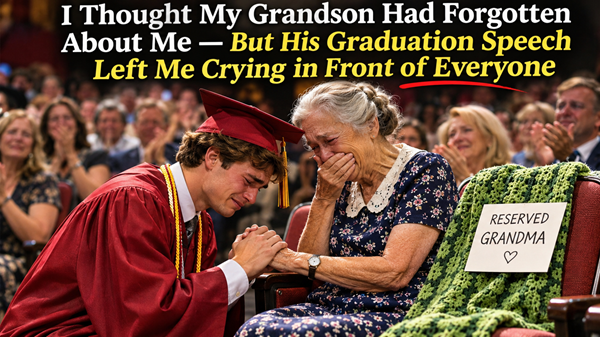
Now I could see what had been placed there.
A small piece of paper lay on the seat. It had been written by hand in thick black marker.
RESERVED — GRANDMA.
And hanging neatly over the back of the chair was something soft and green.
My mother’s afghan.
The very same one she’d crocheted in 1962.
The one I’d wrapped around Kevin when he was four, five, and six years old.
The one he’d waited beneath on the couch, night after night, for eighteen years.
He had taken it from my house in April.
I hadn’t even noticed it was missing.
Kevin stopped beside the chair.
He lifted the afghan and gently shook it out.
Then, wearing his scarlet graduation gown, he sat down in the seat for a moment.
After a few seconds, he stood again and carefully arranged the afghan over the back of the chair.
Then he turned toward me.
“I saved you the warm spot, Grandma,” he said.
Part Twenty-Three: People Were Crying
I sat down.
In the front row.
In the warm spot.
My mother’s afghan rested around my shoulders.
And that’s when I finally broke down.
But I wasn’t the only one crying.
The woman sitting next to me, someone else’s mother, covered her mouth with both hands and began to sob.
A father two seats away took off his glasses and wiped his eyes.
Several rows of graduates in scarlet gowns had turned around to watch us. They were crying, too.
Even the dean stood at the edge of the stage, wiping his face with a handkerchief.
The famous NASA engineer was crying.
Mrs. Ortiz sat beside me and handed back my little bouquet from Kroger.
She was crying just as hard as I was.
Kevin knelt in front of my chair.
He took both of my hands in his.
“Grandma,” he said softly into the microphone, “I’m sorry I told you to leave me alone.”
“You have nothing to apologize for,” I told him.
“Yes, I do,” he replied. “You promised you’d sit in the front row.”
He glanced toward the back of the auditorium, toward Row Z.
“And because of me, you almost didn’t.”
I reached up and rested my hand on his head, touching his black graduation cap.
It was the same gentle gesture I’d made every night when he was four years old, just before carrying him to bed.
“I would have watched you from the parking lot,” I told him. “I would have watched you from the moon if I had to.”
Part Twenty-Four: The Diploma
Then Kevin did something else I hadn’t expected.
He stood up and turned toward the stage.
The dean was still standing there, his handkerchief in one hand.
“Dean Morrison,” Kevin called. “Could I ask you something?”
The dean cleared his throat.
“Of course, Kevin.”
“When they call my name,” Kevin said, “would it be possible for my grandma to walk across the stage with me?”
The dean looked at Kevin.
Then he looked at me, sitting in the front row in my navy dress with my mother’s green afghan around my shoulders.
Finally, he looked out at the three thousand people watching him.
“Mr. Haley,” he said, “I’ve been doing this for nineteen years.”
A small smile appeared on his face.
“I don’t think there’s anyone in this room who would let me say no.”
Part Twenty-Five: Across the Stage
They called Kevin’s name about an hour later.
The graduates crossed the stage in alphabetical order. One after another, they shook the dean’s hand, received their diploma covers, and paused for photographs.
When they reached the letter H, Kevin stepped out of the third row.
He walked down toward the front row.
Then he held out his hand to me.
I stood up.
I left the afghan folded over the chair, right there in the warm spot.
Then I took his arm.
Together, we climbed the steps to the stage.
Slowly.
One step at a time.
My hip still hurt, and I needed to be careful.
The dean was waiting for us at the top.
He glanced at the card in his hand and read aloud.
“Kevin Michael Haley. Bachelor of Science in Mechanical Engineering. Summa cum laude.”
Then he looked up.
He saw me standing beside Kevin, wearing my navy dress, with one hand resting on my grandson’s arm.
He lowered the card.
“And Josephine Haley,” he said into the microphone, addressing the three thousand people in the auditorium. “Who worked two jobs for eighteen years. Who never spent a dollar on herself. Who made this degree possible.”
Then he held out the diploma.
Not to Kevin.
To me.
Part Twenty-Six: The Standing Ovation
I stood on the stage of Mershon Auditorium at The Ohio State University.
Seventy-six years old.
With a bad hip, a little bouquet from Kroger, and my grandson’s diploma in my hands.
Then three thousand people rose to their feet.
It wasn’t the polite kind of applause people give at the end of a long ceremony.
It was something much bigger.
The room erupted.
People clapped, cheered, and whistled. Graduates in scarlet gowns threw their caps into the air, even though they weren’t supposed to do so until the end of the ceremony.
The noise filled the entire auditorium.
I could feel the floor trembling beneath my feet.
I stood there crying.
Kevin wrapped his arm around me and leaned down toward my ear.
He spoke softly, so the microphone wouldn’t pick up his words.
“Mom and Dad would be so proud of you,” he whispered.
Part Twenty-Seven: Mrs. Ortiz
After the ceremony, we went outside.
The sun was shining over the lawn in front of Mershon Auditorium, and people began approaching us from every direction.
Parents, grandparents, students, and complete strangers.
They hugged me, shook Kevin’s hand, and asked to take photographs with us.
An elderly man in a wheelchair rolled over to where I was standing.
He took both of my hands in his.
“I raised my granddaughter, too,” he said quietly. “Her mother died when she was young. She graduated today. Nursing school.”
He glanced at Kevin.
“Nobody ever thanked me like that,” he said. “Not in front of everybody.”
He gently squeezed my hands.
“Thank you for letting him thank you.”
Then Priya came over.
The girl from thermodynamics.
She was wearing her own scarlet graduation gown, and she wrapped her arms around me in a long hug.
“He’s talked about you every single day for four years,” she told me. “Every day.”
Mrs. Ortiz was standing a little way off, holding the green afghan folded over her arm.
When the crowd finally began to thin, she walked over.
“Jo,” she said, “are you ready to go home?”
Kevin took the afghan from her.
“Mrs. Ortiz,” he asked, “would you mind if I drove her?”
Mrs. Ortiz looked at him, then at me.
A smile spread across her face.
“I’ll follow you,” she said.
Part Twenty-Eight: The Drive Home
Kevin drove me home to Kettering.
We were in his old Honda Civic, the used car he’d bought during his sophomore year with the money he’d earned working at Kroger.
It was about seventy miles down I-70.
The windows were open, and the radio was playing.
Somewhere near Springfield, I turned toward him.
“Kevin,” I said, “can I ask you something?”
“Anything, Grandma.”
“Back in April,” I began, “when you found that letter in the closet…”
He nodded.
“Why didn’t you just come downstairs and tell me what you’d found? We could have sat at the kitchen table and talked about it.”
Kevin was quiet for a long time.
Then he said something I don’t think I’ll ever forget.
“Because you never let anybody do anything for you, Grandma,” he said. “Not once in eighteen years.”
He kept his eyes on the road.
“Every time somebody tried to help, you refused. Mrs. Ortiz offered to help pay for your hip surgery in 2018. You wouldn’t accept it. Aunt Doris tried to send you money, and you mailed it right back.”
He glanced at me.
“I knew that if I told you about the letter at the kitchen table, you’d say no. You’d tell me to keep the money because it belonged to me.”
He smiled faintly.
“So I had to do it somewhere you couldn’t refuse.”
He looked at me.
“In front of three thousand people.”
I started laughing.
I laughed so hard that I had to hold my side.
“You’re your father’s son,” I told him. “Michael used to pull things like that.”
“Like what?” Kevin asked.
“He proposed to your mother at a Reds game,” I said. “Right there on the Jumbotron, in front of forty thousand people.”
Kevin laughed.
“So she couldn’t say no?”
“Exactly,” I replied. “So she couldn’t say no.”
Part Twenty-Nine: June
I had my hip replacement on June 9.
The surgery took place at Kettering Health, with Dr. Mehta.
Kevin took a week off from his new job at Honda and drove down from Marysville. He slept on the couch in my living room.
He drove me to the hospital at five in the morning and waited for three hours while I was in surgery.
When I woke up from the anesthesia, he was sitting beside my hospital bed.
My mother’s green afghan was folded in his hands.
He stayed with me for two weeks after I came home.
He cooked for me. Mostly grilled cheese and spaghetti, the meals I’d taught him to make when he was little.
He helped me use my walker, drove me to physical therapy, and cleaned the house.
He wouldn’t let me lift a finger.
At night, I’d slowly make my way out of the bedroom with my walker.
Kevin would be sitting on the couch, reading beneath the afghan.
He’d look up when he heard me.
Then he’d move over to make room.
“Saved you the warm spot,” he’d say.
Part Thirty: Now
It’s been a year since graduation.
My hip is doing wonderfully. Better than wonderfully.
I walk two miles every morning around the neighborhood with Mrs. Ortiz. Dr. Mehta says I have the hip of a sixty-year-old.
I don’t clean offices anymore.
The house is paid off, and I no longer owe anybody a thing.
Kevin works at the Honda plant in Marysville, designing transmissions. He loves his job.
He’s bought himself a little house in Marysville, with three bedrooms and a big backyard.
He calls me every night at seven-thirty.
Every single night.
Sometimes he just calls to say good night.
Sometimes he tells me about work, a new project, or something his boss said.
And sometimes he calls because he wants to know how to get a stain out of a shirt.
Last month, though, he called on a Sunday afternoon.
Not at seven-thirty.
“Grandma,” he said, “there’s something I need to ask you.”
“What is it, honey?”
He went quiet for a moment.
“Priya and I are getting married,” he said. “In October.”
I sat down right there on the kitchen floor.
“Grandma? Are you okay?” he asked.
“I’m fine,” I said, although I was already crying. “I’m fine, sweetheart. Oh, Kevin.”
“There is one more thing,” he said.
He paused.
“Priya and I want you to come live with us. In Marysville. There’s a third bedroom, and Priya has already painted it yellow.”
He chuckled.
“It’s the same shade as your kitchen.”
I couldn’t say anything.
“Grandma,” Kevin continued, “please don’t say no.”
I sat there on the kitchen floor in Kettering, in the little house I’d lived in for forty-six years.
The house where I’d raised my son.
The house where I’d raised my grandson.
The house where a state trooper had knocked on my door at eleven-thirty on a Tuesday night in February.
I thought about his offer for a long time.
Then I finally spoke.
“Kevin,” I said, “can I bring the afghan?”
He laughed, and I could hear the tears in his voice.
“Grandma,” he said, “that’s the whole point.”
Part Thirty-One: The Wedding
The wedding is in October.
It will take place at a little church in Marysville, followed by a reception at a barn just outside town.
Kevin told me about the seating arrangements last week.
He’s put me in the front row.
On the aisle.
There will be a small piece of paper on the seat, written by hand in black marker.
RESERVED — GRANDMA.
And hanging over the back of the chair, neatly folded, will be something soft and green.
My mother’s afghan.
The one she crocheted in 1962.
Priya says it doesn’t match the wedding colors.
Kevin says he doesn’t care.
“She saved me the warm spot for eighteen years,” he told her. “Every night, when she came home from cleaning offices at midnight.”
He looked at Priya.
“The least I can do,” he said, “is save her one at my wedding.”
Priya cried.
Then she hugged me.
After that, she went to the craft store and bought green ribbon to use on the wedding bouquets.
People sometimes ask me whether I regret it.
The two jobs.
All those nights coming home at midnight.
The ten years I went without fixing my hip.
The hundred and eighty-six thousand dollars I never touched.
I always tell them no.
Because this is what I’ve learned.
When you raise a child, you spend every day giving something of yourself.
Your time.
Your money.
Your sleep.
Your strength.
Sometimes even your health.
You give without keeping score. You give without expecting anything in return.
You do it because you love them.
And then, if you’re lucky, one day they turn around.
They finally understand what you gave.
And they save you the warm spot.