 By Admin
I Found My 82-Year-Old Mother Sleeping in Her Winter Coat After We Had Been Sending Money for Her Heat
Part One: The Coldest Night
The cold arrived in North Dakota in the middle of January.
It came sweeping down from Canada, bringing temperatures of thirty-one degrees below zero. With the wind chill, it felt closer to fifty-five below. It was the kind of weather that made your skin sting within seconds and turned an ordinary trip outside into something dangerous.
On Wednesday evening, I tried calling my mother.
She was eighty-two and lived alone on our family’s old farm outside Harvey. Sometimes she fell asleep in her favorite chair while watching television and didn’t hear the phone. So when she didn’t answer the first time, I wasn’t especially worried.
I called again at nine.
Then again half an hour later.
Still nothing.
The following evening, she didn’t answer either.
By then, I had called so many times that I couldn’t remember the exact number. I even tried reaching the Schmidt family, who lived a couple of miles down the road. Their phone line was busy.
My stomach tightened.
My husband, Steve, was working long shifts operating a snowplow for the county. During storms like this, the crews often stayed near the road department because the roads needed constant attention.
I called him.
“Something’s wrong with Mom,” I told him.
“Then go check on her,” he replied. “Take the Suburban. Fill up in Washburn, bring the emergency supplies, and don’t forget the extra blanket.”
“Are you sure?”
“Connie, go. I’ll be thinking about you the whole way.”
I left Bismarck alone.
The drive was about 115 miles. The highway stretched ahead beneath a dark sky, and the snowbanks on either side reflected the headlights like pale blue walls. I saw only one other vehicle during the entire trip.
I kept thinking about Mom.
And I kept hoping she was simply asleep.
Part Two: The Old Farmhouse
Our family farm sits twelve miles east of Harvey, down a gravel road that becomes especially difficult during winter.
My grandfather settled there in 1912. The property includes 320 acres of farmland, an aging red barn, a white two-story farmhouse with green shutters, and a row of trees my grandmother planted decades ago to protect the house from the wind.
Beside the farmhouse stands a large propane tank.
There is no natural gas service out there. Like many rural homes in the area, our house depends on propane to keep the furnace running.
When the tank gets low, someone has to arrange a delivery. If the fuel runs out during a severe cold spell, the house can become dangerously cold in a very short time.
I reached the farm shortly after eleven at night.
The yard light was shining, but the kitchen window was dark.
I parked near the back entrance, grabbed my flashlight and the blanket, and stepped into the freezing air.
The cold was so intense that my eyes began watering almost immediately.
The kitchen door was unlocked, just as it had always been.
I opened it and walked inside.
Something was missing.
The furnace.
For as long as I could remember, that old heating system had made noise throughout the winter. It rumbled in the basement, switched on, and sent warm air through the floor vents.
Now there was nothing.
The only sound was the ticking of the old clock above the kitchen table.
I could see my breath.
And that was when I knew something was terribly wrong.
Part Three: What I Found in the Living Room
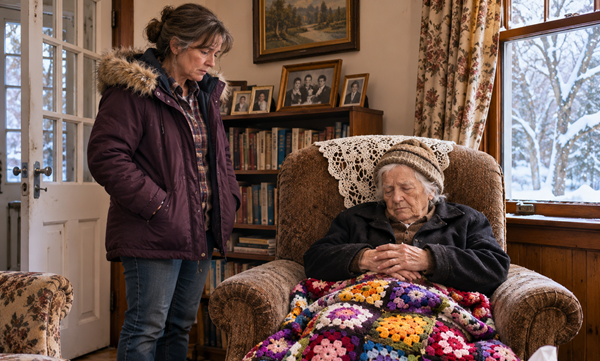
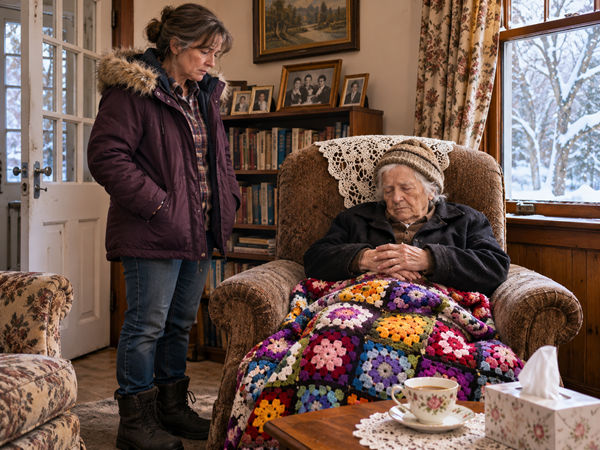
I walked into the living room and saw Mom sitting in Dad’s old recliner.
She was asleep.
It was the same brown La-Z-Boy where Dad had spent countless evenings before he passed away. After his death, Mom had made it her favorite place to sit.
But that night, she wasn’t wearing her usual house clothes.
She had on her heavy brown winter coat, buttoned all the way up. A knitted hat covered her white hair, and she was wearing gloves.
The colorful crocheted blanket Grandma had made years earlier was spread across her legs.
Her hands rested quietly on top of it.
Behind her, frost had formed on the inside of the large living-room window. The ice was so thick that the yard light outside was barely visible.
I stopped in the doorway.
For a moment, I couldn’t move.
I stared at Mom, trying to tell whether she was breathing.
Then the blanket shifted slightly.
She was alive.
I finally let out the breath I had been holding.
I looked at the thermostat.
It was set to fifty-eight degrees, but the thermometer showed that the actual temperature inside the house was only fifty-one.
My mother was eighty-two years old, sitting in a freezing living room wearing the same coat she used to go to church.
She had lived in that farmhouse most of her life. She had raised four children there and refused to move after Dad died.
She always said she wanted to remain in the place where her memories were.
Standing there that night, I made myself one promise.
I wasn’t going to let her spend another night like that.
Part Four: The Money We Had Been Sending
My name is Connie Weber. I’m fifty-four, and I’m the second of four children.
My older sister is Pam. Then there’s me, followed by our brothers Rob and Dean.
Pam lives in Harvey, only twelve miles from Mom. She has always been the one nearby. She takes Mom to appointments, brings her groceries, picks up prescriptions, and checks on her regularly.
I live in Bismarck. Rob has a farm near Rugby, and Dean lives in Fargo.
After Dad died, we agreed that all four of us would help pay for Mom’s propane.
Every October, Rob, Dean, and I sent Pam $250 each. Pam was supposed to contribute the same amount.
That gave her $1,000 to arrange the fall propane delivery and another fill-up later in the winter if necessary.
We had followed that arrangement for four years.
I never asked to see the receipts.
Why would I?
Pam was the one doing the work. She was the one making the trips and handling the arrangements. The rest of us believed that sending money was our way of helping.
But standing in that cold living room, I realized that something had gone badly wrong.
I didn’t call Pam immediately.
I didn’t want an argument. I didn’t want her driving across dangerous roads in the middle of the night. Most importantly, I needed to get Mom warm before anything else.
So I went outside to check the propane tank.
Part Five: The Gauge
The snow in the yard was nearly up to my knees.
The propane tank stood beside the house, covered with snow and ice. I brushed away the snow around the small gauge and wiped the glass with my glove.
Then I pointed my flashlight at it.
The needle was sitting at five percent.
Five.
On a tank that normally holds hundreds of gallons, that meant there was almost nothing left.
In those temperatures, the remaining propane might not last much longer.
I went back inside and searched the refrigerator for delivery paperwork.
Mom kept everything there: photographs of her grandchildren, church notices, grocery coupons, and calendars from the local farm supply store.
Under a magnet, I found a pink delivery slip.
It was dated October 19.
The ticket showed that 200 gallons of propane had been delivered. The account was listed under Pam’s name, and the tank reading afterward was forty-seven percent.
I read it again.
Then I started doing the math.
We had sent Pam $750 between the three of us. With her promised contribution, the total should have been $1,000.
At the prices we had been paying, that money should have covered a substantial delivery and another top-off later in the season.
But the paperwork showed only one delivery of 200 gallons.
I searched through the other papers on the refrigerator.
There was no December receipt.
No January receipt.
Nothing showing that the tank had been filled again.
I stood in the kitchen holding that pink slip, trying to understand what had happened.
Part Six: Mom Explains
I returned to the living room and knelt beside Mom’s chair.
“Mom,” I whispered, touching her knee. “Wake up. It’s Connie.”
She slowly opened her eyes.
“Connie? What are you doing here so late?”
“You haven’t answered your phone. I got worried.”
She looked around the room, then noticed my expression.
Her eyes moved toward the paper in my hand.
Before I could say anything, she reached for my wrist.
“Don’t you go blaming your sister,” she said.
I was surprised.
“Mom, the house is freezing. The tank is almost empty.”
“I’m all right.”
“No, you’re not. You’re wearing your winter coat inside.”
She held my hand.
Then she told me something I hadn’t expected.
Pam’s husband, Mark, had suffered a serious back injury the previous September. He had needed surgery and hadn’t been able to return to work.
His employer didn’t provide disability pay, so Pam had been supporting their household on her clinic salary.
“Things have been difficult for them,” Mom explained. “Pam has enough to worry about.”
She paused.
“She says propane costs a lot this year.”
Then she gave me a small, tired smile.
“I don’t mind keeping the house a little cooler.”
I looked at her gloves.
Her hands were cold even through the knitted material.
I wanted to argue, but there wasn’t time.
The furnace wasn’t working, and the tank was almost empty.
Part Seven: Calling the Co-op
I called the after-hours number for the Harvey Farmers Co-op.
At first, all I got was a recording.
I tried again.
And again.
Finally, a man answered shortly before one in the morning.
“This is Connie Weber,” I explained. “My mother is Elsie Heinz. She lives east of Harvey. Her propane tank is nearly empty, and the furnace has stopped working. She’s eighty-two years old.”
There was a brief silence.
“Elsie Heinz? Art Heinz’s wife?”
“Yes.”
The man’s name was Duane Kessler. He had been delivering propane in the area for more than twenty years and remembered my father.
His voice immediately became serious.
“Is your mother safe?”
“She’s alive, but it’s only fifty-one degrees inside. She’s sitting in her coat and hat.”
Duane told me the roads were too badly drifted for him to bring the truck out that night. He promised to come as soon as the county cleared the road in the morning.
In the meantime, he suggested that I close off unused rooms, keep Mom in the warmest part of the house, and look for an electric heater.
He remembered that Dad had kept one in the basement.
I went downstairs and found it behind the water softener.
It was dusty, but it still worked.
I carried it upstairs, plugged it in near Mom’s chair, and closed the doors to the rooms we didn’t need.
Then I put my own parka over her blanket.
I sat on the floor beside her recliner.
That night, I barely slept.
Part Eight: A New Account
By morning, a county snowplow had finally reached the road.
I called the co-op again and spoke with Marlene, a woman who had worked there for decades.
She confirmed that Mom’s propane account was registered under Pam’s name.
I asked whether I could change it.
Marlene explained that I could open a separate account in my own name and arrange for future deliveries to be billed directly to me.
“That’s what I want,” I told her. “Let’s open a new account today.”
She didn’t ask for an explanation.
She had probably seen enough family situations over the years to understand that some conversations were best left private.
I knew Mom had asked me not to confront Pam.
But I also knew that the heating situation couldn’t continue.
The account was going to be in my name.
Part Nine: The Propane Truck
Duane arrived that afternoon.
His white propane truck pulled into the farmyard, and he backed it toward the tank beside the house.
He walked to the back door and knocked.
Mom opened it wearing the same brown coat and red-and-green knitted hat.
Duane removed his cap.
“Mrs. Heinz, I’m sorry I couldn’t get here last night.”
“Oh, Duane,” Mom replied. “You shouldn’t have come all the way out here in this weather.”
He glanced toward the frosted kitchen windows.
He didn’t argue with her.
He simply went back outside and began filling the tank.
When he finished, the gauge showed eighty percent.
The delivery ticket listed 375 gallons at $2.09 per gallon.
The total was $783.75.
I paid the bill with my credit card.
Then I asked Duane about automatic deliveries.
He explained that the co-op could install a small monitor on the tank. When the propane level dropped to a certain point, the office would receive a signal and arrange another delivery.
No one would have to remember to check the gauge or make a phone call.
“Sign Mom up,” I said. “Put the account in my name.”
Duane nodded.
“Absolutely.”
From that day forward, someone else would be watching the tank.
Part Ten: Seventy Degrees
After the truck left, I walked over to the thermostat.
I placed my thumb on the small adjustment lever and turned it to seventy.
A few moments later, I heard the furnace start downstairs.
First came a click.
Then a pause.
Then the burner caught, and the familiar rumble filled the basement.
Warm air began moving through the vents.
It was a sound I had heard throughout my childhood, but that afternoon it meant more to me than I could explain.
Mom was still sitting in Dad’s chair.
She heard the furnace too and closed her eyes.
Within an hour, the house had warmed considerably. The frost on the windows began melting, leaving thin trails of water running down the glass.
Mom slowly stood up.
She removed her gloves, took off her knitted hat, and unbuttoned her heavy coat.
Then she walked to the back door and hung it on its usual hook.
She stood there for a moment, looking at it.
“I had almost forgotten what this feels like,” she said softly.
I didn’t know what to say.
I just watched her stand in her warm house without needing to wear her winter coat.
Part Eleven: Telling My Brothers
That evening, after Mom had gone to bed, I sent a message to Rob and Dean.
I told them the tank was full and that future propane deliveries would be handled through my new account.
I also told them we needed to talk in person at Easter.
Dean called almost immediately.
“Is Mom okay?”
“She’s warm now,” I answered.
“Was she cold?”
I paused.
“Yes. She was sleeping in her coat. The house was only fifty-one degrees.”
He went quiet.
I told him I would explain everything when we were together.
Rob called later that night.
He didn’t say much. He simply asked how cold the house had been.
When I told him, he was silent for a long time.
“All right,” he finally said. “We’ll talk at Easter.”
I didn’t mention Pam.
Not yet.
Part Twelve: Pam Calls
Five days later, Pam called me at work.
She didn’t even say hello.
“The co-op told me Mom’s propane account was taken out of my name.”
“That’s right,” I replied.
“You moved it to your account?”
“Yes.”
There was a long silence.
“You went behind my back,” she said.
Her voice sounded strained.
I explained that I had found Mom sitting in her winter coat, that the house was freezing, and that the propane tank was almost empty.
I told her the delivery record showed only 200 gallons had been ordered in October.
She didn’t answer.
I could hear the clinic working in the background, phones ringing and people talking.
“Pam,” I said again.
Then she ended the call.
We didn’t speak for eleven weeks.
Part Thirteen: The Questions I Couldn’t Answer
Those eleven weeks were difficult.
I called Mom every evening. She was warm, the automatic delivery system was working, and Duane had already made another visit to the farm.
But I couldn’t stop thinking about the money.
The three of us had sent Pam $750.
The October delivery had cost about $400.
Where had the remaining money gone?
And had Pam ever contributed her own $250?
I kept doing the calculations.
I was angry because I believed my sister had taken money meant for Mom’s heating.
But I was also hurt because she hadn’t told us what was happening.
Steve listened to me talk about it night after night.
One evening, he asked whether I had considered calling Pam.
“She hung up on me,” I replied.
“That was weeks ago.”
“She let Mom sit in a freezing house.”
Steve looked at me.
“Do you know that for certain?”
I started to answer, then stopped.
The truth was that I didn’t.
I knew what I had found. I knew what the delivery ticket said. But I didn’t know the entire story.
Still, I couldn’t bring myself to call her.
I decided to wait until Easter.
Part Fourteen: Everyone Comes Home
Easter was always a family occasion at the farm.
Even after Dad died, we continued gathering there every year.
By the time Steve and I arrived, most of the snow had melted. The fields were damp and brown, and geese were flying north across the wide spring sky.
The propane tank stood beside the house, clean and white. Its monitor was blinking green.
Mom greeted us at the back door.
She was wearing a blue cardigan, an apron, and house slippers.
No winter coat.
No hat.
The kitchen was warm, and the smell of food filled the house. A ham was cooking in the oven, potatoes were ready, and Mom had made two of her traditional German kuchen pies.
Rob and Dean were already sitting at the kitchen table.
Their wives were there too, and the grandchildren were visiting in the living room.
Mom was in Dad’s old recliner by the window, with the colorful blanket resting over her knees.
She looked comfortable.
Then Pam arrived.
Part Fifteen: The Box on the Table
I heard Pam’s car pull into the yard.
A moment later, the back door opened.
She stepped into the kitchen wearing her church clothes. Her gray hair was neatly cut, and she looked more exhausted than I had ever seen her.
Mark wasn’t with her.
She was carrying a cardboard box.
In her other hand was an old, faded coffee can.
She walked to the kitchen table and placed both items in front of us.
Everyone became quiet.
Dean put down his fork.
Rob set aside his coffee.
Mom turned toward her oldest daughter.
Pam took a deep breath.
“Before we eat,” she said, “there’s something I need to explain.”
She looked at Rob and Dean.
“Connie has been waiting a long time to tell you what happened in January. But I want to tell you myself.”
Nobody interrupted her.
Part Sixteen: The Money
Pam picked up the old coffee can and removed the lid.
Inside were bundles of cash.
She took the money out and placed it on the table.
“Seven hundred and fifty dollars,” she said.
She explained that this was the money Rob, Dean, and I had sent her the previous October.
She had used $400 to pay for Mom’s propane delivery.
The rest had gone toward their mortgage, electricity, and Mark’s medication.
Then she admitted something else.
She hadn’t contributed her own $250.
She simply hadn’t had the money.
Pam pushed the cash toward me.
“I’m giving it back,” she said. “Every dollar I have. I want you to be reimbursed for what you paid when you filled the tank.”
I asked where the money had come from.
She looked down.
“I sold some things.”
She had sold Grandma’s Bernina sewing machine, the old quilt rack Dad had made for her, and Mark’s deer rifle.
She had also started working Saturday shifts at the Cenex station in Harvey.
Her voice broke.
“You were right to take over the account,” she told me. “Mom needed heat, and I didn’t make sure she had it.”
Part Seventeen: The Green Notebook
Then Pam opened the cardboard box.
Inside were receipts, pharmacy bills, delivery slips, handwritten notes, and papers collected over several years.
At the top was a green spiral notebook.
She opened it and placed it in front of Rob.
It was a detailed record of everything she had spent on Mom since Dad’s death.
There were entries for prescriptions, groceries, medical appointments, repairs, hearing aid batteries, and all the little expenses that come with caring for an elderly parent.
Some entries were small.
Others were hundreds of dollars.
There were payments for roof repairs, a well pump, new glasses, dental work, and furnace maintenance.
The notebook covered four years.
At the bottom of the final page, Pam had written a total.
$14,860.
Rob looked at the number.
Then he turned back through the pages.
“Pam, is this all money you spent on Mom?”
She nodded.
“That’s what I’ve paid out of my own pocket. It doesn’t include the propane.”
Dean leaned closer to read the receipts.
Pam quickly explained that she wasn’t asking anyone to repay her.
“That’s not why I brought this,” she said. “I just wanted you to understand how much there has been to take care of.”
Part Eighteen: Why She Used the Money
Pam finally told us what had happened.
When Mark injured his back, everything changed.
He needed surgery and couldn’t return to his job at the grain elevator. Their income dropped, but the mortgage, electricity, and medical expenses didn’t disappear.
By October, they were already behind on their mortgage payments.
When the $750 arrived from the three of us, Pam sat at her kitchen table looking at the money and the bills.
She knew the money was supposed to go toward Mom’s propane.
But she was frightened.
She had never been behind on her bills before, and she didn’t know how she was going to keep their home.
She ordered 200 gallons of propane instead of the larger delivery Mom needed.
She thought it would last until January.
She believed Mark might be working again by then, or that she could earn enough extra money to arrange another delivery.
But the severe cold arrived earlier and used up the remaining fuel much faster than she expected.
“Why didn’t you tell us?” Dean asked.
Pam gave a short, painful laugh.
“What was I supposed to say? That I couldn’t pay my mother’s heating bill? That I had used some of her money to keep my own house? I was ashamed.”
She admitted that she had planned to order another delivery once the cold weather arrived.
She had even considered putting it on a credit card.
But before she could do that, Mom called her.
And that was when we learned something none of us had expected.
Part Nineteen: The Secret Mom Had Kept
Everyone turned toward Mom.
She had been sitting quietly in Dad’s recliner, looking out at the fields.
“Mom?” I said.
She took a moment before answering.
“I told Pam not to order more propane.”
We stared at her.
She explained that she already knew about Mark’s surgery and the problems Pam was having with money.
She knew their mortgage payments were behind.
She knew her daughter was struggling.
Before the cold snap became severe, Pam had called and told her she wanted to arrange another delivery.
Mom refused.
She told Pam to use the money for her own household.
She promised that she could manage with blankets and her winter coat.
“I’ve lived through cold winters before,” Mom said. “I grew up in a house with a coal stove. I thought I could handle it.”
She had also made Pam promise not to tell the rest of us.
I looked at my mother, remembering her sitting in that freezing living room.
“You knew how cold it was getting?”
Mom looked at me.
“I knew it wasn’t comfortable.”
“Mom, the windows were frozen on the inside.”
She was quiet.
Then she said something that broke my heart.
“My daughter was afraid of losing her home. Her husband was hurt, and she was trying to hold everything together. I would rather wear a coat for a while than watch my girl lose everything.”
That was why she had grabbed my wrist that night and begged me not to blame Pam.
She hadn’t been protecting a secret about money.
She had been trying to protect her daughter.
Part Twenty: What We Had Failed to See
For a long time, nobody spoke.
The Easter meal was waiting, but no one seemed interested in eating.
Rob picked up the green notebook and looked through it again.
He reached the final page and stared at the total.
“Almost fifteen thousand dollars,” he said quietly. “And we thought sending a few hundred dollars each year was enough.”
Pam didn’t respond.
Rob pulled his checkbook from his pocket.
He wrote a check and placed it on the table.
It was for $3,715.
He explained that he wanted to contribute toward the expenses Pam had covered over the years.
Dean immediately reached for his phone and asked Pam for her payment information.
Pam tried to stop them.
“I didn’t bring all this here because I wanted money,” she said.
Rob stood up and walked over to her.
Then he put his arms around his older sister.
“I’m sorry, Pammy,” he whispered. “I’m sorry we left you carrying all of this by yourself.”
I watched them, thinking about the eleven weeks I had spent being angry.
I had believed I understood what happened.
But I had only seen one small part of the story.
Part Twenty-One: My Turn to Apologize
Then I stood up.
I walked around the table and stopped in front of Pam.
I had imagined this moment many times, but now I couldn’t find the right words.
“Pam,” I began.
She looked at me with red eyes.
“I’m sorry I went behind your back.”
She shook her head.
“You didn’t do that. You went to the co-op because Mom needed help.”
“I should have called you that night.”
“Why didn’t you?”
I thought about the freezing farmhouse, the frost on the windows, and Mom asleep in Dad’s chair.
“Because I was scared,” I admitted. “I thought calling you would turn into an argument, and Mom would still be sitting there cold while we fought.”
I paused.
“And because I had already decided you were responsible before I knew everything.”
Pam looked at me for a moment.
Then she nodded.
“I understand.”
She stepped forward and hugged me.
It was the kind of hug she used to give me when we were children. Back then, she was always the one who came running when I fell or got hurt.
I held on to her.
“Thank you for going out there,” she whispered.
Part Twenty-Two: A Family Plan
We didn’t eat Easter dinner until the afternoon.
By then, the food had been sitting around for hours, but nobody cared.
Instead, we gathered around the kitchen table and made a plan.
The propane account would remain in my name, and the automatic delivery system would stay in place.
Every bill would be divided among the four of us.
Until Mark was back on his feet financially, Pam’s share would be covered by the rest of us.
We also divided the visits.
Rob would come on the first Sunday of every month.
Dean would take the third Sunday and bring his children along.
I would visit on the second and fourth Sundays with Steve whenever possible.
Pam could visit whenever she wanted, but nobody expected her to carry the entire responsibility anymore.
We also opened a shared bank account for Mom’s everyday expenses.
All four children would contribute $100 each month.
Pam would continue managing the account because she knew Mom’s needs best.
But now every one of us would receive a monthly statement.
Dean explained it simply.
“It’s not because we don’t trust you, Pam. It’s because you shouldn’t have to keep track of everything alone.”
For the first time in years, caring for Mom became a family responsibility instead of one person’s burden.
Part Twenty-Three: Mom’s New Rule
Before we finally sat down to eat, Mom cleared her throat.
She had been listening to all of us make plans.
Now she wanted to say something.
“I made a mistake too,” she began.
She admitted that she had told Pam not to order the propane and had insisted that the rest of the family didn’t need to know about their financial difficulties.
She thought she was helping.
But she realized that hiding the problem had made everything worse.
“So I have one rule from now on,” she said.
We all looked at her.
“No more secrets about money in this family. Not about heating bills, not about mortgages, and not about medical expenses.”
She continued.
“If someone is struggling, they have to say so. And if somebody needs help, the rest of us need to know.”
I smiled.
“Understood, Mom.”
Then she stood up and walked toward the back door.
Her old brown winter coat was still hanging on the hook.
She took it down and handed it to Pam.
“Take this to the church rummage sale,” she said. “I don’t want to wear it anymore.”
Pam looked surprised.
“You’ve had that coat for thirty years.”
“I know,” Mom replied. “And I spent part of January wearing it inside my own house. I’d rather not be reminded of that every time I see it.”
She gently touched Pam’s cheek.
Part Twenty-Four: Grandma’s Sewing Machine
In May, Mark returned to work at the grain elevator.
He couldn’t do heavy lifting yet, but he was able to handle lighter duties in the scale house.
Pam eventually stopped working her extra Saturday shifts at the Cenex.
Then, in July, something unexpected happened.
A large package arrived at her home.
Inside was Grandma’s old Bernina sewing machine.
It was the same machine Pam had sold when money became tight.
She called me that evening, crying.
“Connie, did you send this?”
I told her I hadn’t.
She explained that someone had bought the machine back from the woman in Minot who had purchased it and arranged to have it delivered to Pam.
There was a small note inside.
It contained only two words:
Keep-full.
Pam had no idea who had sent it.
I asked Rob.
He denied knowing anything.
Dean said the same.
Even Steve insisted he hadn’t arranged it.
When I asked Mom, she acted as though she had no idea what I was talking about.
I didn’t discover the truth until September.
Duane was filling the propane tank when he casually mentioned that Mom had contacted him earlier in the summer.
She had asked whether he knew the woman in Minot who had bought Pam’s sewing machine.
As it turned out, Duane’s wife’s cousin was the buyer.
Mom had paid $400 to get the machine back and arranged for it to be sent to Pam.
“She wanted her daughter to have it again,” Duane explained.
Then he smiled.
“She told me that keeping the tank full was important, but so was keeping the family full.”
Part Twenty-Five: Another October
By October, the harvest was finished.
The fields had turned gold and brown, and the geese were beginning their journey south.
The propane tank beside the farmhouse was sitting at seventy-eight percent.
Its little monitor continued blinking green.
One afternoon, while I was working in Bismarck, my phone showed three payment notifications.
Rob had sent me $250.
His note simply said, “Propane.”
Dean had sent the same amount, with a message that read, “Mom’s warm.”
Then I saw Pam’s name.
She had sent $250 too.
Her note said:
“My share. Finally.”
I stared at the message for a long time.
Then I sent her $250 of my own.
I wrote:
“Your Sundays. Four years’ worth. A little at a time.”
She called almost immediately.
“Connie, what is this?”
I smiled.
“Keep-full. It works both ways.”
She laughed.
It was the same laugh I remembered from when we were little girls, sharing a bedroom in the old farmhouse and whispering long after we were supposed to be asleep.
Part Twenty-Six: Thanksgiving
That Thanksgiving, all of us returned to the farm.
The turkey was cooking, Mom’s pies were on the counter, and the house smelled just as it had when we were children.
Outside, the temperature had dropped below zero. The wind swept across the harvested fields.
But inside, the furnace was running.
The thermostat read seventy-one degrees.
Pam arrived with Mark, who was walking slowly with a cane but was getting stronger.
She carried a case containing Grandma’s sewing machine.
“I’m going to make Mom a new blanket this winter,” she announced. “Using Grandma’s machine.”
Mom was sitting in Dad’s old recliner by the window.
She wore her blue cardigan, and the colorful afghan rested across her knees.
She looked at the sewing machine, then at Pam.
She didn’t need to say anything.
Later, after dinner, I found Mom standing near the back door.
Her new navy winter coat was hanging on the hook. It had been a Christmas present from all four of us.
The old brown coat was gone. It had been sold at the church rummage sale.
“Mom, are you all right?” I asked.
She turned toward me.
“I’m warm,” she said.
She sounded almost surprised by the words.
Then she looked through the kitchen window toward the propane tank in the yard.
Its little monitor was blinking green.
“Nobody has to remember anymore,” she said quietly.
And she was right.
The co-op monitored the tank. Duane arranged deliveries before the fuel ran low. I handled the bills and divided the cost among the family.
But the propane wasn’t the only thing keeping Mom warm.
It was the shared bank account.
It was the schedule of Sunday visits on the refrigerator.
It was the green notebook that Pam no longer had to manage alone.
And it was the promise we had made around that kitchen table: nobody in our family would ever have to struggle in silence again.
That night, after everyone had gone to bed, I sat alone at the kitchen table.
The old clock was ticking above me.
And beneath the floor, the furnace rumbled softly as it pushed warm air through the house.
I listened to it for a long time.
Because that sound meant something different now.
It meant Mom was safe.
It meant we were paying attention.
And it meant that, after years of letting one person carry too much, our family had finally learned how to take care of one another.
Sometimes keeping a home warm takes more than fuel. It takes honesty, shared responsibility, and a family willing to show up before it’s too late.