 By Admin
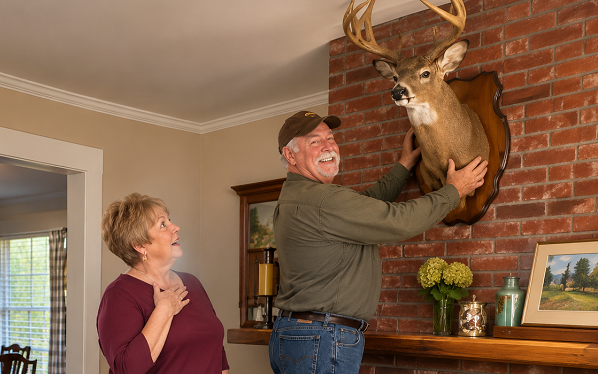
My new husband put his late father’s deer head above my fireplace and announced that his mother and sister would be moving into my home on Sunday.
When I refused, he looked me straight in the eyes and said, “A man decides who gets to live in his house.”
There was just one detail he seemed to have forgotten.
It wasn’t his house. I had worked for decades to pay for it, and the deed carried my name alone.
So I smiled and told him his family would receive a welcome they would never forget.
But when his mother stepped out of that old pickup truck on Sunday, she looked at my porch, spotted the deer head through the window, and asked her son a question that made his smile disappear.
It all began on an ordinary Tuesday.
I had just returned from the Piggly Wiggly with my groceries when I heard the unmistakable sound of a power drill coming from my living room.
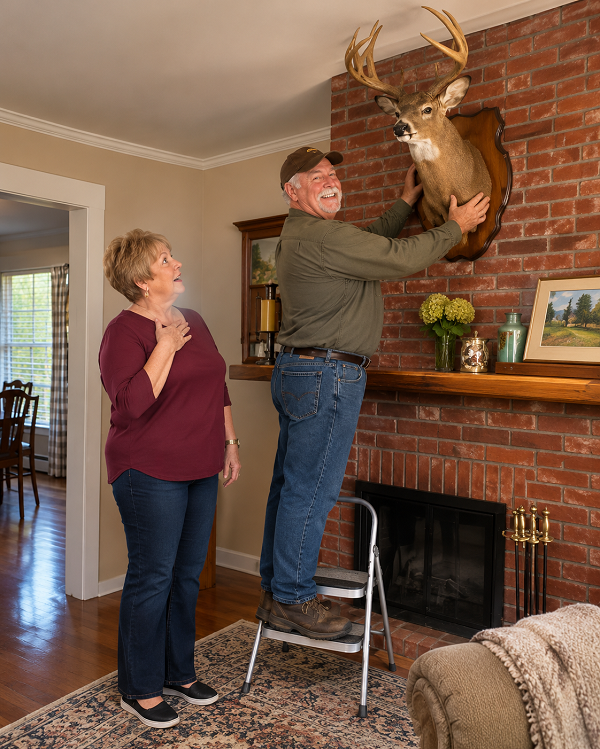
I walked in and found my new husband, Lamont, standing on a step stool. He was holding something large and awkward.
“Look what I brought home for you, sweetheart!”
It was his father’s old mounted deer head. Eight points, dusty antlers, and one glass eye that seemed ready to fall out.
The first thing I noticed was that my wedding-ring quilt, the one that had hung above the fireplace for years, was no longer there. Lamont had taken it down and left it folded carelessly on the couch.
“Lamont, why would you do that?”
He barely looked at me.
“Mama and my sister are moving in this Sunday. Mama will have the big bedroom, and Patricia can use your sewing room.”
I put my shopping bags on the floor.
“Excuse me? We never discussed anyone moving into this house.”
He shrugged as if the matter had already been settled.
“There’s nothing to discuss.”
“Yes, there is. I’m not agreeing to this.”
He climbed down, placed his hands on his hips, and spoke in a tone I had never heard from him before.
“Darlin’, we’re married now. This is my house too. A man has the right to decide who lives under his roof.”
I stared at him, then at that ridiculous deer head.
I was sixty-seven years old. My first husband, Wardell, had died six years earlier. I had spent thirty-one years working in the laundry department at the county hospital, taking extra shifts, working holidays, and saving whatever I could.
That little white house in Madison, Georgia, was the result of all those years of hard work. I had paid the mortgage off myself. Nobody had handed it to me.
Three weeks earlier, I had married Lamont, a widower who lived down the road. He used to bring me tomatoes from his garden and make me laugh. He seemed thoughtful, charming, and kind.
When he proposed, he promised to take care of me.
He sold his trailer and moved into my house after our wedding.
Now he was behaving as though marrying me had made him the owner.
I felt like throwing his drill through the window. Instead, I took a breath and gave him a pleasant smile.
“Well, then, I’ll make sure your mama and sister get a welcome they won’t forget.”
He kissed my cheek, completely satisfied with himself.
“That’s my girl.”
Not long afterward, my neighbor Nedra Pope called.
“Dorinda, please tell me that isn’t a deer head hanging in your front window.”
“It certainly is.”
“Oh, Lord, have mercy!”
I stepped outside and explained everything. By the time supper was ready, Lamont had already started giving me instructions about his family’s preferences.
His mother liked soft eggs and expected coffee at five in the morning. Patricia needed the best towels because her skin was sensitive.
Then, while eating the pot roast I had prepared, he made another suggestion.
“You ought to put Wardell’s pictures away in the attic. Mama will feel more comfortable if the house looks like a fresh start.”
I put down my fork.
“You want me to hide my first husband’s photographs?”
“It’s a new family now, sweetheart.”
The next morning, he asked me to prepare a big Sunday dinner.
“Fried chicken, and don’t forget that coconut cake. Mama loves it.”
“Don’t worry,” I told him. “I’ll have something special ready.”
That night, I lay beside him, listening to his snoring.
I had married Lamont because I missed having someone around. After Wardell died, the silence in the house had become difficult to bear. I had mistaken companionship for love and attention for genuine care.
I cried quietly into my pillow.
Maybe I should have known better. Maybe at my age I should simply have stayed alone.
But Saturday morning brought a discovery I never expected.
Lamont had gone to the hardware store, so I found his mother’s telephone number in the address book beside the coffee maker.
Her name was Clementine Sizemore. She was eighty-nine, and I remembered her as a sharp, observant woman from our wedding day.
“Miss Clementine, this is Dorinda. I wanted to make sure you knew we’re expecting you and Patricia tomorrow.”
She went quiet.
Then she said, “Expecting us? Honey, Lamont told me you were the one begging him to bring us. He said you couldn’t manage that big house he bought for you.”
I nearly dropped the phone.
“He bought my house?”
“That’s what he told me.”
I sat down at the kitchen table and began explaining the truth. I told her about the house, the deer head, the bedrooms, the sewing room, and the way Lamont had been making decisions without asking me.
She listened for nearly twenty minutes without interrupting.
When I finally stopped, she asked one question.
“Is his father’s deer head hanging above your fireplace?”
“Yes, ma’am.”
“Then leave it there. I’ll see you tomorrow.”
On Sunday morning, I didn’t prepare a single piece of fried chicken.
Nedra came over in her housecoat to help me straighten the porch. Lamont was still in the shower, singing as though he were expecting the happiest day of his life.
Just after lunchtime, we heard tires rolling over the gravel.
An old blue pickup entered the driveway. Patricia was driving, and Miss Clementine sat beside her.
There were no suitcases or moving boxes in the truck.
Lamont hurried outside, buttoning his shirt.
“Mama! You’re here!”
His mother opened the passenger door slowly. She wore a blue Sunday dress, white gloves, and a little hat decorated with flowers. Despite her age, she stepped out with remarkable dignity.
Patricia climbed out behind her, wearing oversized sunglasses.
Lamont reached out to help his mother, but she ignored his hand.
Instead, she looked at the porch, the rocking chairs, and the flowers. Then she noticed the deer head through the living room window.
Her expression changed immediately.
“Lamont, what in the world have you done?”
He laughed nervously.
“What do you mean, Mama?”
She pointed toward the window.
“That ugly thing! You put your daddy’s deer head in this woman’s home?”
He tried to laugh it off.
“Well, it’s our house now, Mama.”
Miss Clementine turned toward me.
“Is that what he told you?”
I greeted her and thanked her for coming. She took both my hands.
“Before anyone brings a suitcase into this house, I believe we need to talk.”
Lamont rolled his eyes.
“Mama, we already discussed this.”
“No, son. You spoke. I listened. Those are two different things.”
Patricia looked confused.
“I thought we were moving in. What’s happening?”
I invited everyone onto the porch. Lamont was clearly becoming uncomfortable.
He leaned toward me and whispered, “Don’t embarrass me in front of my family.”
I smiled.
“Then you shouldn’t have made promises using my home.”
Miss Clementine settled into one of the rocking chairs and ordered her son to sit down. He hesitated, but one look from her was enough.
She asked me to explain exactly what had happened.
So I told them everything.
I explained how Lamont had removed my quilt, assigned my bedrooms to his family, demanded that I change my daily routine, and suggested putting Wardell’s photographs away.
Patricia looked shocked.
“You told her I was getting the sewing room? Where is Dorinda supposed to sew?”
Lamont shrugged.
“She can find somewhere else.”
Patricia stared at him.
Miss Clementine closed her eyes.
“Lord, help me.”
Then she turned to her son.
“Did you tell me Dorinda begged you to bring us here?”
Lamont shifted in his chair.
“I just wanted you to feel welcome.”
“Did you tell me she couldn’t afford to keep this house?”
He didn’t answer.
“And did you tell me you had bought it for her?”
Lamont finally snapped.
“We’re married! What’s mine is hers and what’s hers is mine!”
His mother shook her head.
“That isn’t what I asked.”
She reached into her purse and removed a folded document.
“There’s something you should have remembered before making all these promises.”
Then she looked at me.
“Dorinda, do you know how my husband died?”
I told her that Lamont had said his father passed away twelve years earlier.
“That part is true,” she replied. “But he left Lamont some money. Enough to help him buy a home and finally become settled.”
Lamont rubbed his forehead.
His mother explained that he had spent the inheritance within two years on trucks, hunting equipment, vacations, and failed business ideas. Afterward, he had repeatedly asked her for more money.
Then she told me something that made my stomach tighten.
“Six months before your wedding, Lamont came to my house. He told me he had found a woman with a beautiful home, a good pension, and enough money to take care of him.”
The porch became completely silent.
Lamont jumped up.
“That’s a lie!”
Miss Clementine calmly pulled another paper from her purse.
“I brought the letter you wrote me.”
She looked directly at her son.
“I didn’t raise you to marry a woman because of her house.”
Patricia whispered in disbelief.
I turned toward Lamont.
“Is there anything you’d like to tell me?”
He stared at the ground.
For the first time since our wedding, he had no answer.
But his mother wasn’t finished.
She handed me a small envelope containing a photograph. It showed Lamont standing outside my house with a man I immediately recognized.
It was Curtis, the real estate agent who had helped Wardell and me purchase the property decades earlier.
The photograph had been taken four months before Lamont and I ever met.
I turned it over. A handwritten note on the back explained that Lamont had contacted Curtis to ask about the property because he intended to marry its owner.
I looked at my husband.
“Why were you meeting with the real estate agent before you even knew me?”
Lamont claimed he had only been asking about property values.
Miss Clementine told me the rest.
He had wanted her to help him get money to purchase my home. His plan, she said, was to marry me, move into the house, persuade me to put his name on the deed, and eventually convince me to sell it.
He wanted to use the money from the sale to start his own hunting equipment business.
I could hardly believe what I was hearing.
Patricia then revealed that Lamont had borrowed seven thousand dollars from her the previous year, claiming he had a business opportunity. She later discovered that he had spent the money on a used truck.
Lamont ordered her to stay out of it, but she refused.
“I’ve covered for you long enough,” she told him.
Miss Clementine added that she had kept records of the money he had borrowed from her over the years. The total came to $18,450.
Not one dollar had been repaid.
I looked at Lamont.
“You were planning to sell my home and use the money for your business?”
He became defensive.
“I thought things would be different after we got married! I thought you’d want to help me build something!”
“Build what, Lamont? You didn’t ask me to create a future with you. You simply announced that you were taking over my home.”
He pointed toward the house.
“Dorinda, you’re sixty-seven! What do you need all those rooms for?”
His words hurt more than I expected.
Before I could answer, Miss Clementine stood up.
“That’s enough. Your father spent his life teaching you that respect is earned. He never taught you that you could demand it from people.”
Lamont asked whether she was taking my side.
She answered without hesitation.
“I’m standing with what’s right.”
Then she explained why she had really come.
She hadn’t arrived to move into my house. She wanted to meet the woman her son had described and find out whether his version of events was true.
Lamont had told her I was generous, easily persuaded, and so afraid of being alone that I would do anything to keep a husband.
But when I called her on Saturday, she heard something different. She heard a woman trying to remain polite while someone was taking advantage of her kindness.
“Sometimes keeping the peace only gives another person permission to disturb yours,” she told me.
Then she said something that brought tears to my eyes.
“Your first husband may be gone, honey, but that doesn’t mean you have to settle for another man who doesn’t know how to love you.”
Lamont suddenly announced that he was leaving.
He went inside, packed his suitcase, and returned to the porch.
“You’re making a mistake, Dorinda.”
I shook my head.
“No. I made one three weeks ago.”
He threw his suitcase into his truck and drove away.
For several moments, nobody spoke.
Patricia eventually sat down on the porch steps and apologized. She explained that she had lost her apartment after the building was sold. She had been staying with her mother, and Lamont had told her I had invited them both to live with me.
She hadn’t known he intended to take my bedroom or that he had made promises on my behalf.
I felt sorry for her. I understood how embarrassing her situation must have been.
But I also knew that I wasn’t responsible for solving it.
Patricia admitted she should have contacted me herself instead of simply believing her brother.
Nedra finally broke the silence.
“Well, at least somebody in this family has some sense.”
Despite everything, I laughed.
Then Miss Clementine opened a small leather notebook. It contained dates, amounts, and records of the money Lamont had borrowed from her.
The total was $18,450.
She explained that she had wanted to believe her son was simply unlucky. But now she understood that he had become accustomed to treating other people’s generosity as something he was entitled to.
I asked what she wanted to do next.
She smiled.
“First, I’d like some coconut cake.”
I laughed through my tears.
“I didn’t bake one.”
“Then we’ll have to go buy one.”
And just like that, we went inside.
The deer head was still above the fireplace, but I knew it wouldn’t stay there.
Miss Clementine suggested leaving it until Lamont returned for his belongings. She wanted him to see it one last time.
I smiled.
Something told me he would remember that house for a very long time.
The House Was Never His
The following morning, I woke up before sunrise.
For the first time in weeks, there was no one snoring beside me, no arguments, and no instructions about how I should arrange my own home.
I made coffee exactly the way I liked it: strong, with two sugars and a little cream.
Then I called my handyman, Mr. Ellis.
By nine o’clock, he had removed the deer head and wrapped it in an old blanket.
I hung Wardell’s wedding-ring quilt back above the fireplace and brought his photograph out of the closet. He was smiling in his favorite fishing shirt.
I placed the picture on the mantel.
“Well, old man,” I whispered, “I think I’ve finally got my house back.”
I spent the rest of the morning rearranging my living room.
Not for Lamont.
Not for his mother.
Not for his sister.
For myself.
Around noon, Lamont called.
He said he wanted to talk about our marriage and admitted that he shouldn’t have announced his family’s move without discussing it with me.
He also admitted that he shouldn’t have claimed a man had the final say about who lived in the house.
But he still insisted he had only been trying to help his family.
I explained that helping his relatives was not the problem. Making decisions about my property without my permission was.
Then he asked whether he could come home.
“No,” I replied.
He accused me of throwing away our marriage over a misunderstanding.
I reminded him that he had lied to his mother, claimed he bought my house, met with a real estate agent before we met, and planned to sell my property to finance his business.
He had no answer.
I ended the call and contacted my attorney, Rebecca Collins, who had helped me with my estate planning after Wardell died.
She advised me not to sign anything or agree to any financial arrangement until she had reviewed my documents.
That afternoon, she examined my deed, mortgage records, and estate papers.
The house was completely paid off. The deed was in my name alone, and Lamont had never contributed to its purchase.
She explained that the legal consequences of marriage and property ownership depend on the circumstances and state law, so we would handle everything carefully.
I also reviewed my estate plan and updated important contact information.
I wasn’t doing it out of fear. I was simply making sure that nobody could pressure me into giving away something I had worked my entire life to earn.
A few days later, Patricia sent me a message apologizing again. She and her mother hoped we could eventually sit down and talk.
I thanked her and wished them both well.
That evening, I made vegetable soup and ate at my own kitchen table.
The house finally felt peaceful.
But Lamont wasn’t ready to let go.
Two days later, he appeared at my front door holding yellow roses.
I opened it but kept the security chain in place.
He offered me the flowers and asked whether he could come inside.
I said no.
He suggested that we forget what happened and begin again.
I asked whether he could forget the plans he had made behind my back.
He said he hadn’t meant for things to go so far.
I told him that wasn’t the same as saying he hadn’t intended to do it.
He complained that his mother and sister were upset with him and that everyone was treating him like a villain.
I told him he needed to worry less about what people thought and more about what he had done.
His expression hardened. He threw the flowers onto the porch and warned me that I would regret losing him.
I looked at him and reminded him of the thirty-one years I had spent working in the hospital laundry. I had washed sheets and blankets, worked weekends and holidays, taken extra shifts, and come home exhausted.
I had saved my money because I wanted a home of my own.
Nobody had given me that house.
I had earned it.
“And if you believe I’ll hand it over just because you put a wedding ring on my finger, then you never understood the woman you married.”
I closed the door.
That evening, I placed the yellow roses in a vase. I didn’t want to remember Lamont, but I didn’t think flowers deserved to suffer because the man who brought them had disappointed me.
The Sunday Nobody Expected
The weeks that followed were surprisingly peaceful.
Miss Clementine began calling me every Sunday afternoon. Sometimes we discussed the weather or shared recipes. Other times, she told me stories about Lamont when he was a child.
She never excused his behavior, but she never stopped loving him.
Patricia eventually found a small apartment close to her workplace. It had a sunny living room and a little balcony.
I was glad she had found somewhere to live.
I didn’t blame her for her brother’s choices, but I also understood that I wasn’t obligated to give up my home to solve her problems.
One Saturday, Miss Clementine invited me to lunch.
She prepared fried catfish, collard greens, cornbread, and sweet tea. After we ate, she brought out an old family album.
There were photographs of Lamont as a baby, at school, and holding his first fishing rod.
Then she showed me a photograph of her late husband, Earl, standing beside an old pickup.
“He was a good man,” she said. “Not perfect, but good.”
She told me something Earl used to say: a person’s character becomes clear when they believe nobody has the right to tell them no.
Then she handed me a photograph of Wardell and me.
I was surprised to see it.
She explained that I had left it on her kitchen table the first time we met, and she had asked Patricia to make a copy.
She knew how much I had loved my first husband.
“Don’t feel guilty for wanting happiness again,” she told me. “But don’t mistake loneliness for needing somebody.”
Her words stayed with me.
About a month after Lamont moved out, a letter arrived from his attorney concerning the division of marital property.
My attorney handled the matter. We had no joint bank accounts, no shared mortgage, and no jointly purchased property.
After the necessary legal discussions, the house remained mine. We reached an agreement concerning the marriage, and eventually the divorce was finalized.
I didn’t want Lamont’s truck, furniture, or money.
All I wanted was my peace.
On the day the divorce papers arrived, I sat on my porch with a glass of lemonade. Nedra came over carrying a pie.
“Well?” she asked.
I held up the envelope.
“It’s official.”
She smiled.
“You’re free.”
I looked at the white porch, the flowerpots, the rocking chairs, and the front door Wardell and I had painted together.
“Yes,” I whispered. “I am.”
That Sunday, I invited Miss Clementine and Patricia to dinner.
This time, I made the fried chicken and coconut cake Lamont had once demanded.
Miss Clementine arrived in her blue Sunday dress. Patricia brought flowers, and Nedra brought potato salad.
We ate together at my dining table.
Nobody asked for my bedroom. Nobody demanded my sewing room. Nobody told me what to do with my furniture.
After dinner, Miss Clementine stood beside the fireplace and admired Wardell’s quilt and photograph.
“That was a beautiful man,” she said.
“He was,” I replied.
“Then let’s leave him his place.”
I nodded.
As we sat together that evening, I realized my home was more than a property I had paid for. It was a place where people could visit without trying to take control of my life.
It was somewhere I could finally be myself.
The Last Thing Lamont Said
Six months later, I was watering the flowers when a familiar truck pulled into my driveway.
Lamont stepped out.
He looked older, and the confident smile I once found charming had disappeared.
I remained on the porch.
“What do you need?”
He took a breath.
“I wanted to apologize.”
I didn’t say anything.
He admitted he had spent a lot of time thinking about what happened. Then he asked whether I had taken his father’s deer head down.
“Yes,” I answered.
He looked disappointed.
He told me his mother no longer spoke to him the way she used to and that she had insisted he needed to change.
I agreed with her.
Then he said he had lost a good woman.
I corrected him.
“You lost a woman who trusted you.”
He nodded.
“I never thought you’d actually leave,” he admitted.
I looked at him.
“That’s because you believed my fear of being alone was stronger than my love for myself.”
He lowered his eyes.
I reminded him that I had loved the man who brought me tomatoes, made me laugh, and promised to take care of me.
But I couldn’t spend my life with someone who believed he could decide who belonged in my home simply because we were married.
He said he understood.
I hoped he would learn from what happened.
Then he wished me happiness, climbed into his truck, and drove away.
I watched until he disappeared down the road.
I didn’t cry or feel angry.
I simply went back inside.
The deer head was gone. The quilt was back where it belonged, and Wardell’s photograph rested on the mantel.
The house was quiet.
But this time, the silence felt like freedom.
The Welcome They Never Forgot
Almost a year after that Sunday, Miss Clementine called me early one morning and invited me to lunch.
When I arrived, Patricia was already there. She looked happier and healthier than she had in months.
Miss Clementine had prepared a wonderful meal, and right in the middle of the table sat a coconut cake.
I laughed.
“I thought I was supposed to bring the cake!”
She winked.
“Today, I wanted to surprise you.”
After lunch, she asked me to sit beside her.
She told me Lamont had started attending counseling. He had also found a job and was slowly trying to rebuild his relationships with his family.
He had even begun repaying some of the money he owed Patricia.
I was glad to hear that.
Miss Clementine studied my face.
“Do you ever miss him?”
I thought about it honestly.
I missed the beginning. I missed the laughter, the tomatoes on my counter, and the idea of having someone beside me in the evenings.
But I didn’t miss the man who believed marriage gave him control over my life.
“No,” I finally said. “I don’t miss what he became.”
She nodded and took my hand.
Then she thanked me for not allowing my hurt to turn into hatred. I could have blamed Patricia or rejected Miss Clementine, but I hadn’t.
I smiled.
“You came to my home and told me the truth. That’s more than I can say for the man I married.”
Before I left, she handed me a small wrapped package.
Inside was a framed photograph of the three of us sitting on my porch on the Sunday Lamont’s truck arrived.
Nedra stood behind us laughing. Miss Clementine held her coffee, Patricia was smiling, and I sat in my rocking chair.
On the back, she had written:
“To Dorinda, who taught us that a home isn’t something people take. It’s something they’re invited into.”
I held the photograph against my chest and cried.
Not because I was sad, but because sometimes the family we choose turns out to be kinder than the family we expected.
A House Full of Peace
Today, I’m sixty-eight years old, and I still live in that same little white house in Madison, Georgia.
The mortgage is paid. My flowerpots are full, my sewing room is exactly where I left it, and Wardell’s wedding-ring quilt still hangs above the fireplace.
Every morning, I make coffee and sit by the front window.
Nedra visits. Patricia stops by from time to time, and Miss Clementine calls me every Sunday.
She has become one of my closest friends.
Last Christmas, we celebrated together at my house. There were presents beneath the tree, laughter in the kitchen, and enough food to feed the whole neighborhood.
At one point, Miss Clementine glanced at the fireplace.
“Do you remember that deer head?”
I laughed so hard I nearly spilled my tea.
“How could I ever forget?”
She shook her head.
“That was the ugliest thing I’ve ever seen.”
Patricia joined in.
“I thought it looked like it was judging everybody!”
We laughed until our stomachs hurt.
Then Miss Clementine became serious.
“You know, Dorinda, I think that Sunday was the best thing that could have happened to you.”
I asked her why.
“Because you discovered who Lamont really was before you spent another thirty years trying to make him happy.”
She was right.
For years, I had believed being a good wife meant being patient, making compromises, and putting other people’s needs first.
Those things can matter in a marriage.
But there’s a difference between compromise and surrender.
Marriage should be a partnership, not a contest over who gets to control the other person. Love should never require someone to give up everything they worked so hard to build.
I looked around my living room.
The quilt. The photographs. The flowers. The little wooden sign above the door.
Everything was exactly where I wanted it.
Then I remembered Lamont’s words:
“A man decides who lives in his house.”
He had been wrong.
The person who owns a home has the right to decide who is welcome inside. And nobody should ever be treated as less deserving of respect because they are older, widowed, or afraid of being alone.
I learned that lesson at sixty-seven.
As for Lamont, I hear that he is doing better. He works regularly, visits his mother, and is slowly repairing his relationship with Patricia.
I genuinely hope he becomes a better man.
But I don’t wait for him.
I don’t wonder what might have happened if I had kept quiet, and I don’t regret taking off my wedding ring.
The biggest mistake would have been staying in a marriage where my own home no longer felt like mine.
Every time I enter my living room, I see Wardell’s photograph smiling back at me. I remember the life we built and the work we did together.
And I remember that I was capable of standing on my own long before Lamont came along.
Exactly one year after that unforgettable Sunday, a small delivery truck pulled into my driveway.
The driver handed me a package. There was no return address, just my name written neatly on top.
Inside was a wooden plaque.
It read:
“A HOUSE IS MADE OF BRICKS AND WOOD. A HOME IS MADE OF RESPECT, LOVE, AND THE PEOPLE WHO NEVER ASK YOU TO GIVE UP YOURSELF.”
Beneath it was a note from Miss Clementine.
“Dear Dorinda, thank you for showing my son that a good woman isn’t someone who allows a man to walk all over her. She is someone who knows her worth, even when the person beside her forgets it. May your home always be filled with peace. With love, Clementine.”
I carried the plaque inside and hung it above the fireplace, exactly where the deer head had once been.
That evening, Nedra came over with two slices of pie.
She noticed the new decoration and smiled.
“Now that’s a whole lot prettier than that dead animal!”
I burst out laughing.
And for the first time in a long while, I laughed without worrying whether anyone else approved.
My house was mine.
My life was mine.
And my future belonged to me.
If anyone ever asks what happened on the Sunday my new husband’s mother arrived to move into my paid-off home, I’ll tell them this:
His mother stepped out of that pickup, looked at my porch, and said:
“Honey, I hope you haven’t prepared a bedroom for me, because I came to help you get rid of the man who thinks he owns it.”
And she did.
Not by taking my house.
Not by giving me money.
Not by fighting my battles for me.
She simply told the truth.
And sometimes, the truth is the greatest welcome a person can receive.
THE END.