 By Admin
My Daughter Whispered, “I Stopped Telling Dad When It Hurt” — And Then I Discovered What He Had Been Hiding
I reached for Emma’s hand and gently squeezed it.
“You can tell me anything,” I whispered. “You’re not going to get into trouble. I promise.”
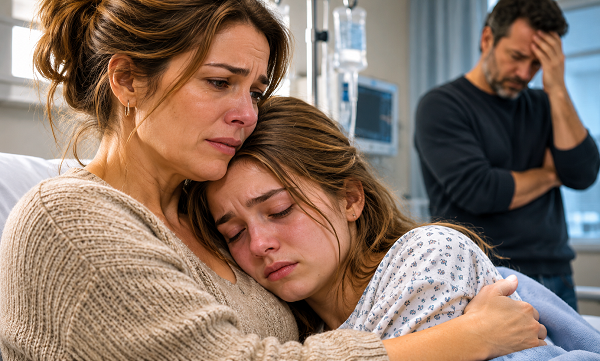
Her fingers felt cold.
“Dad said you already had too much to worry about,” she replied.
I tried to keep my voice calm. “What else did he say?”
She hesitated before answering.
“He said you would think he was a terrible father if you found out.”
I felt my stomach tighten.
Then she added something that hurt even more.
“He said you always make things sound worse than they really are.”
I looked down at the floor.
I had heard those words before. Not necessarily in exactly the same way, but often enough to recognize them.
When our son broke his arm during a football game, Daniel accused me of overreacting because I wanted him checked immediately. When our younger daughter struggled with anxiety before starting high school, he said I was making her unnecessarily fearful. Even when our refrigerator stopped working, he laughed at my suggestion that we replace it before all the food spoiled.
I had always brushed his comments aside.
That was just Daniel, I told myself.
But now I was beginning to wonder how many times Emma had heard the same things when I wasn’t around.
The doctor gently interrupted my thoughts.
“Before we go any further, I want you both to understand that we don’t have a definite diagnosis yet. We need additional tests before we can say exactly what’s happening.”
I nodded and listened carefully.
He explained that Emma needed more blood work, additional imaging, and an appointment with a specialist. He also wanted to know more about her pain, appetite, tiredness, and the changes we had noticed over the past few months.
I wrote everything down.
Every instruction mattered.
After a while, Emma leaned toward me.
“Mom?”
“Yes, sweetheart?”
“Are you angry?”
I put my pen down.
“No, honey.”
“Not even at Dad?”
I took a breath.
“I am upset about some things, but I am not angry with you. And I will never make you choose between your father and me.”
She stared at me as if she hadn’t expected that answer.
Then she whispered something I will never forget.
“I thought if I told you, you would leave him.”
My eyes filled with tears.
“Why would you think that?”
She shrugged.
“Because sometimes you look sad.”
I didn’t have an answer.
I simply pulled her carefully into my arms and let her cry.
For the first time in what felt like months, she wasn’t pretending everything was fine.
We spent several more hours at the hospital. By the time all the tests were finished, it was already evening.
My phone had been vibrating inside my purse for quite some time.
I finally checked it.
Daniel had sent several messages.
Daniel: Where are you?
Daniel: Why did you take Emma out of school?
Daniel: She’s not answering me.
Daniel: Call me immediately.
Emma noticed the phone in my hand.
“Does Dad know where we are?”
“No, not yet.”
Her expression changed.
“Please don’t tell him.”
I turned toward her.
“Why not?”
She looked frightened.
“He’ll get angry.”
I didn’t understand.
“Why are you so sure?”
She lowered her eyes.
“Because he always gets angry when doctors tell him something is wrong.”
That sentence stayed with me all the way home.
When we walked through the front door, Daniel was waiting in the kitchen.
He didn’t ask Emma how she felt.
He didn’t ask what the doctors had discovered.
Instead, he looked straight at me.
“What happened?”
“We went to the hospital.”
His expression changed immediately.
“Why?”
“She was in pain.”
“I know she was in pain.”
I stared at him.
“You knew?”
For a moment, he seemed caught off guard.
Then he quickly answered, “Of course I knew. She told me.”
“How long has she been telling you?”
He sighed.
“Several weeks, I guess.”
“Did you take her to a doctor?”
His expression became tense.
“Yes.”
“When?”
“I don’t remember.”
“Was it five weeks ago?”
He suddenly went quiet.
Emma stood beside me, and I noticed her shoulders stiffen.
Daniel noticed it too.
“She told you about that?”
I felt a chill run through me.
“You took her to the doctor five weeks ago. What did they tell you?”
“Nothing serious.”
“That isn’t what the medical records say.”
His eyes narrowed.
“What records?”
“The hospital records.”
He stepped closer.
“You went through her records?”
“She is fifteen years old, Daniel. I’m her mother.”
He gave a short, irritated laugh.
“You’re turning this into something it isn’t.”
There it was again.
The same sentence I had heard countless times whenever I questioned his decisions.
I turned toward Emma.
“Sweetheart, go upstairs for a little while.”
She looked uncertain, but eventually went to her room.
Once I heard her bedroom door close, I faced my husband again.
“What exactly did the doctor recommend at that first appointment?”
Daniel rubbed his forehead.
“I don’t remember.”
“You were the parent who took her.”
“Yes.”
“You received the instructions?”
“Yes.”
“Then why didn’t she have the follow-up appointment?”
“Because she seemed better.”
“She has been hurting for weeks!”
“She exaggerates sometimes. You know that.”
I stood there, struggling to believe what I was hearing.
I thought about the heating pad she had been using, the dinners she had barely touched, and the mornings when she walked slowly down the stairs.
All those little details suddenly made sense.
“What kind of additional scan did the doctor recommend?”
“I don’t know.”
“Did you schedule it?”
“No.”
“Why?”
“Because I didn’t think it was necessary.”
I could feel my hands trembling.
“You decided that on your own?”
“I’m her father. I know my daughter.”
I looked directly at him.
“No, Daniel. I don’t think you understand what she’s been going through.”
He became defensive.
“What is that supposed to mean?”
“It means our daughter was afraid to tell me she was sick because she thought you would get angry.”
He dismissed the idea immediately.
“That’s ridiculous.”
“Is it? She told me you said I would think you were a bad father. She said you made her feel as though she was causing trouble by asking for help.”
He remained silent for a moment.
Then he said something that changed everything.
“She shouldn’t have told you.”
I stared at him.
He wasn’t worried about why his daughter had been frightened.
He wasn’t asking whether she was okay.
He was upset that she had told me the truth.
“You’re going to stay somewhere else tonight,” I said.
He looked at me in disbelief.
“What?”
“You heard me.”
“This is my home too.”
“I know. But our daughter should not be afraid to tell her mother when she’s in pain.”
He called me unreasonable, accused me of making a huge issue out of nothing, and insisted I would regret my decision.
But I didn’t change my mind.
Eventually, he grabbed his keys and walked out.
When the front door closed, the house became completely silent.
I went upstairs to check on Emma.
She was sitting on her bed with her knees pulled against her chest.
“Is Dad gone?” she asked.
“Yes.”
“Is he angry?”
“Yes,” I answered honestly.
She nodded as though she had expected that.
I sat beside her and took her hand.
“Emma, I need you to remember something. You never have to hide your pain to protect me. You never have to pretend you’re okay because you are afraid someone might get upset.”
She began to cry.
“I didn’t want you two to fight.”
“I understand.”
“He said you already had too much going on. He said doctors only recommend more tests because they want to make money.”
I closed my eyes.
“I wish you hadn’t been put in that position.”
She leaned against me, and for a little while neither of us spoke.
Then she whispered:
“Mom, there’s something else.”
I turned toward her.
“What is it?”
“Dad told me not to tell you about a phone call from the doctor’s office.”
My heart began beating faster.
“What phone call?”
“He answered it. It was about two weeks ago.”
“What did he say?”
“He told them you weren’t available. Then he said they didn’t need to call again.”
I stood up slowly.
A phone call. A missed follow-up. Information that had never reached me.
I began to wonder how much of Emma’s medical situation I had been kept away from.
The next morning, I contacted the hospital.
I asked for the records from her first visit and requested copies of any additional notes that I was legally allowed to receive.
The receptionist checked the file.
“There are several entries,” she explained.
Then she mentioned something that made my stomach drop.
The office had attempted to contact our family two weeks earlier.
I asked whether there was a note explaining what had happened.
After checking, she told me that Emma’s father had requested that future communications be directed to him.
I had never authorized that arrangement.
I immediately contacted the doctor’s office myself.
A nurse confirmed that Daniel had asked for all medical communication to go through him. He had explained that I was overwhelmed with work and family responsibilities.
I sat in silence.
He hadn’t simply forgotten to tell me about the follow-up.
He had deliberately placed himself between me and the information.
I opened my laptop and began recording everything I could remember.
Dates. Appointments. Symptoms. Phone calls. Messages. Conversations.
I wasn’t trying to prove that Daniel was a terrible person.
I needed to understand what had happened to my daughter, and I wasn’t going to allow anyone to convince me that I was imagining things.
Later that afternoon, the specialist’s office called.
They had scheduled an appointment for the following morning.
The woman on the phone explained that there were several possible causes for Emma’s symptoms. Some could be relatively manageable, while others might require more urgent treatment.
She advised me to bring someone along if possible because there could be several treatment options to discuss.
After I hung up, Emma looked at me from the kitchen table.
“Is something bad happening?”
“I don’t know yet,” I told her. “But we’re going to find out.”
She nodded.
Then she asked whether she could tell me something without making me angry.
“Always.”
“I don’t want Dad to come with us tomorrow.”
I sat beside her.
“Okay. I promise he won’t come unless you want him there.”
She looked relieved.
But then she reached into her backpack and pulled out a folded piece of paper.
“I found this in Dad’s car.”
I unfolded it carefully.
It was a printed medical report from the first hospital visit, dated five weeks earlier.
As I read through it, I noticed three handwritten words in the margin.
They weren’t part of the doctor’s report.
Someone had written them as a personal reminder.
Don’t scare her.
I looked at Emma.
“When did you find this?”
“Last week. It was in the glove compartment.”
“Why didn’t you tell me?”
She looked ashamed.
“Because I was scared.”
I put the paper down.
“Emma, do you think Dad knew more than he told us?”
She nodded slowly.
“I don’t think he told us everything.”
Neither did I.
And the next morning, I was determined to find out what had really happened.
The Appointment That Changed Everything
I barely slept that night.
Emma didn’t sleep much either.
The report remained on the kitchen table, and I kept looking at those three handwritten words.
Don’t scare her.
At first, I wondered whether Daniel had discovered something frightening and was trying to protect our daughter.
Perhaps he had been terrified.
Perhaps he hadn’t known how to tell me.
But even if that was true, it didn’t excuse keeping medical information from us or ignoring the doctor’s instructions.
Early the next morning, Daniel began calling.
I watched his name appear on my phone several times without answering.
Eventually, a message arrived.
“We need to talk before you take Emma anywhere today.”
Another followed.
“You’re making this much worse than it needs to be.”
Then another:
“Please don’t make decisions while you’re emotional.”
I turned my phone face down.
A few minutes later, Emma came downstairs.
She looked pale and nervous.
“I’m scared,” she admitted.
“So am I,” I told her.
She seemed surprised that I would say it out loud.
“But we’re still going?”
“Yes. We’re going.”
“And Dad isn’t coming?”
“Not unless you change your mind.”
She reached across the kitchen table and took my hand.
“Thank you.”
Those two words nearly broke my heart.
A child should never have to thank her mother for taking her to the doctor. That should be something she can count on without fear or hesitation.
At the specialist’s office, Emma sat quietly beside me with her backpack between her feet.
I had brought every document I could find: the original hospital report, the follow-up recommendation, the notes from school, and a list of every symptom I could remember.
The specialist entered carrying a tablet and sat across from us.
“I’ve reviewed the imaging from yesterday,” she began.
Emma immediately looked at me.
I squeezed her hand.
The doctor explained that the scans showed an abnormal area that needed further investigation.
“What does that mean?” Emma asked.
“It means we need more information before we can tell you exactly what it is.”
Emma swallowed.
“Could it be cancer?”
The doctor paused before answering.
“We cannot determine that from this scan alone. There are several possible explanations, and many of them are treatable. But given the location and the fact that your symptoms have continued, we don’t want to delay further testing.”
She explained that Emma would need more imaging and blood work. A biopsy might also be considered if the specialists decided it was necessary.
When Emma heard the word biopsy, she became very still.
I wrapped my arm around her.
“Whatever happens, sweetheart, we’re going through it together.”
The doctor nodded and then returned to the original report.
“There is something else I want to clarify,” she said.
I looked up.
“The first radiology report recommended additional imaging within a specific period.”
“How long?”
“Within two weeks.”
I felt my stomach tighten.
Daniel had waited five weeks.
The specialist continued.
“There was also a recommendation for a consultation with a specialist. It wasn’t classified as an emergency, but it was important that it be followed up.”
I struggled to find the right words.
“Could waiting five weeks have changed the outcome?”
The doctor answered carefully.
“We don’t know. We may never know.”
That uncertainty frightened me more than I could explain.
Then she turned toward Emma.
“I want you to understand something. You didn’t cause any of this by speaking up. You didn’t do anything wrong by asking for help.”
Emma’s eyes filled with tears.
The doctor looked at me too.
“And neither did you.”
I nodded, although I couldn’t stop thinking about how many signs I might have missed.
The following week was filled with appointments, scans, blood tests, phone calls, and long hours in waiting rooms.
Emma handled the uncertainty better than I did.
She joked with the nurses, complained about the hospital food, and even sent pictures of her uncomfortable hospital gowns to her best friend.
One afternoon, while we were waiting for another test, she looked at me.
“I think you’re more frightened than I am.”
I managed a small smile.
“Maybe I am.”
“Stop looking at me like I’m going to disappear.”
Her words caught me off guard.
“Do I really do that?”
“All the time.”
I looked away.
She leaned against my shoulder.
“Mom, I’m still here.”
I closed my eyes.
“I know, sweetheart.”
“And I’m not planning to go anywhere.”
I pulled her into a hug and held her a little tighter.
Meanwhile, Daniel continued trying to get involved.
He called repeatedly, sent messages, and eventually appeared outside the hospital.
I told him that Emma did not want him attending her appointments.
He became furious.
“You can’t keep me away from my own daughter!”
“I’m not keeping you away,” I answered. “I’m respecting what she has asked for.”
“You won’t even tell me what’s happening!”
I looked at him.
“You had access to her medical information for weeks.”
His expression changed.
“What are you talking about?”
“You asked the doctor’s office to communicate only with you. You also failed to tell me about the recommended follow-up.”
“I was trying to help.”
“You decided that the doctors were wrong without even completing the tests they recommended.”
He stepped closer.
“You’re acting as if I wanted this to happen.”
I shook my head.
“No, Daniel. I think you wanted it not to be happening. And when reality didn’t match what you wanted to believe, you ignored it.”
For the first time, he had no immediate answer.
After a moment, he asked quietly:
“Is she very sick?”
It was the first time I saw genuine fear in his eyes.
For a brief second, I remembered the man I had married twenty years earlier. The man who had held Emma on the night she was born, taught her to ride a bicycle, and spent hours building toy castles with her on the living room floor.
I wanted to hate him.
But I also remembered that people don’t always become strangers in one dramatic moment.
Sometimes it happens slowly, through one decision after another.
“No one knows yet,” I told him.
He lowered his eyes.
“Can I see her?”
I thought about Emma and everything she had told me.
“Not until she wants to see you.”
This time, he didn’t argue.
He simply nodded.
And for the first time since everything had begun, Daniel walked away without trying to change my mind.
The questions about Emma’s health were still unanswered. We still had tests to complete, and there was no diagnosis yet.
But one thing had become clear to me.
My daughter needed to know that her voice mattered, that her pain would be taken seriously, and that she would never have to stay silent just to keep the peace.
I couldn’t change what had already happened.
But I could make sure she never had to face something like this alone again.
Sometimes the most important thing a parent can do is listen — especially when a child is afraid to speak.