 By Admin
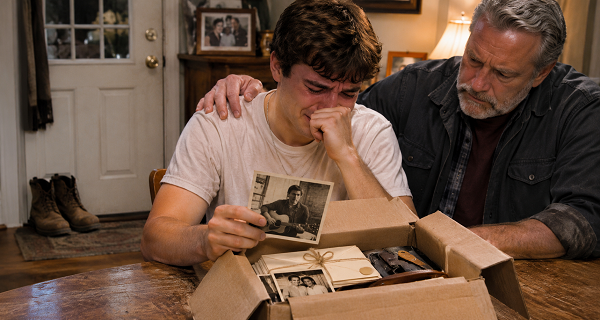
The day we buried my father, I returned home and found myself standing in the hallway, staring at his old work boots.
They were still sitting beside the front door, exactly where he had always left them. Brown leather, worn and cracked across the toes, with the laces still tied because he never bothered to untie them. He simply slipped his feet in and pulled them out whenever he came home from the factory. Dried mud covered the heels.
I stood there in my borrowed black suit, unable to look away.
For five years, I had imagined what life would feel like without him. I thought the house would finally feel peaceful. I imagined being able to breathe without the tension that followed us everywhere. No more awkward encounters in the hallway. No more envelopes of cash sitting on the kitchen table on the first day of every month.
But now that he was gone, the silence felt unbearable.
I bent down, intending to pick up his boots and put them away in the closet. It seemed like such a simple thing to do.
Yet my hands wouldn’t move.
Instead, I walked into the kitchen and sat at the same table where I had placed $250 every month for five years, like someone paying a bill to a landlord.
Our last proper conversation had been about the kitchen faucet. It had started leaking, and he promised he would repair it once he felt better.
He never got better.
The faucet was still dripping.
Plink. Plink. Plink.
That evening, someone knocked at the front door.
It was Frank Russo.
Frank had been my father’s closest friend for as long as I could remember. He was a large man with a thick gray beard, broad shoulders, and forearms that looked as though they had been carved from wood. He owned an auto body shop on Route 9.
He had also been one of the pallbearers that morning. I had watched him cry beside my father’s grave. It surprised me because I had never seen my father bring anyone to tears before.
Frank was carrying a cardboard box sealed with an extraordinary amount of packing tape. It had been wrapped again and again, as though whatever was inside needed to remain protected.
“Hey, Jamie,” he said.
“Hey, Frank.”
“Mind if I come in?”
I stepped aside.
He entered, glanced briefly at my father’s boots near the doorway, and continued toward the kitchen. He placed the box on the table.
“Your dad left this with me,” he explained. “He told me to give it to you, but only after he was gone.”
I stared at the box.
Then I let out a bitter laugh.
“What is it? All the rent money I paid him? Maybe a bill for the electricity I used when I was growing up?”
Frank didn’t laugh.
He simply looked at me with tired, sorrowful eyes.
“Don’t decide what’s inside before you’ve opened it,” he said quietly.
Before I explain what I discovered, you need to understand something about my father.
Because if you had only known him during the last fourteen years of his life, you would probably have believed he was always that way.
I certainly did.
Before my mother died, our home was full of music.
My father, Ray Collins, played guitar almost every evening. He would settle onto the living room couch with his old Gibson resting across his knees and play whatever came into his head.
Sometimes it was classic rock. Sometimes country music. Other times, he made up songs as he went along.
My mother, Annie, would sing from the kitchen.
She had the warmest voice I had ever heard. She wasn’t a professional singer, and she occasionally missed the high notes, but nobody cared. Her voice made the entire house feel alive.
Every now and then, she would pull a wooden spoon from the kitchen drawer and use it as a microphone. She would dance into the living room in her socks, singing as my father played louder.
I would laugh until my stomach hurt.
“Come on, buddy,” Dad would say, patting the empty cushion beside him. “Let’s hear what you’ve got.”
I would climb onto the couch holding my little red plastic guitar with yellow strings. It sounded like someone plucking a rubber band, but I didn’t care.
I would stand proudly and pretend I was performing in front of thousands of people.
“Thank you, Cleveland!” I would shout.
We lived in Ohio, but I didn’t know the names of many other cities back then.
My parents always applauded as though I had just performed at the biggest concert in the country.
Those were the happiest memories of my childhood.
Then my mother became sick.
I was eight when the headaches started. At first, we thought she was simply tired. But eventually, she began forgetting words in the middle of conversations.
The doctors discovered a brain tumor.
It was glioblastoma, a word I struggled to pronounce at the time and still find difficult to say.
Eleven months later, she was gone.
I was nine years old.
And somehow, the music disappeared with her.
Dad’s guitar remained on its stand in the living room for several weeks after the funeral. Sometimes I caught him staring at it.
One night, I woke up and heard music coming from downstairs.
He was playing quietly, repeating the same song over and over. It was an old Patsy Cline song my mother always sang before turning off the kitchen light at the end of the evening.
I crept toward the stairs and listened.
He made it halfway through the song.
Then he stopped.
I heard a strange sound, something like someone desperately trying not to cry.
The following morning, the guitar was gone.
A week later, I found it inside its case at the back of his bedroom closet.
He never played it again.
From that point forward, my father buried himself in work.
He took extra shifts at the factory where they manufactured automotive parts, including brake rotors. He left before I woke up and usually returned after dark, smelling of machine oil and metal.
He made sure there was food in the refrigerator. He signed my school paperwork, paid the bills, and drove me to appointments.
But he stopped asking how my day had gone.
He rarely laughed.
And he never called me buddy again.
When I was eleven, the soles of my sneakers began separating. There was a large split across the bottom of my left shoe, and whenever it rained, water soaked straight through.
I eventually gathered the courage to ask him for another pair.
“Dad, can I get new shoes? These are letting water in.”
He was eating spaghetti from a jar and didn’t even look up.
“Put on another pair of socks,” he answered.
So I did.
First two pairs. Then three.
I continued wearing those shoes until spring.
I had a father, technically.
But I never felt like I had someone who wanted to be my dad.
When I turned twelve, I discovered something that made me curious about the man my father had been before my mother died.
I was searching the hallway junk drawer for batteries when I found a collection of old photographs held together with a rubber band.
The band snapped as soon as I touched it, sending the photographs across the floor.
One picture caught my attention immediately.
It showed a young man who looked almost nothing like the father I knew. He was thin, with long dark hair, wearing a leather vest covered in patches and holding an electric guitar onstage.
Bright lights illuminated the crowd behind him.
I continued looking through the photographs.
There were pictures of him performing, laughing with three other musicians, and standing beside a van with a painted logo.
THE LOW LANTERNS.
My father was smiling in every picture.
Not the occasional polite smile I knew.
He looked genuinely happy.
I carried the photographs into the kitchen.
“Dad, you were in a band?”
He looked up from his newspaper.
The moment he saw the pictures, his expression changed.
“That was a long time ago.”
“What was the band’s name? The Low Lanterns? Were you famous? Did you record an album?”
He stood up and carefully took the photographs from my hands.
“That’s enough questions.”
Then he carried them into his bedroom and put them away.
But I couldn’t stop thinking about what I had discovered.
A few weeks later, I asked him another question while he was drinking coffee at the kitchen table after work.
“Dad, did you ever dream about becoming famous?”
He stared into his coffee for several seconds.
“It was a dream once,” he finally answered.
“What happened?”
He slowly turned his mug.
“My time passed. Maybe you’ll inherit that dream.”
Then he got up and went to bed.
I spent a long time wondering what he meant.
I wouldn’t understand those words for another eleven years.
By the time I was sixteen, I had taught myself to play guitar.
I bought a used black acoustic guitar from a pawn shop on Main Street using money I had earned mowing lawns.
It cost me eighty dollars.
There was a crack near the bridge and a small silver star sticker near the neck. The shop owner warned me that the crack might get worse.
I didn’t care.
I learned from online videos and practiced behind my bedroom door until my fingertips became sore and eventually developed calluses.
Before long, I started writing my own songs.
Most of the early attempts were terrible. I wrote about girls I had never spoken to and heartbreaks I had never experienced.
But eventually, I wrote something I genuinely loved.
I called it “Kitchen Light.”
It was about my mother, the wooden spoon she used as a microphone, and the Patsy Cline song she always sang before turning off the kitchen light.
She used to say, “Show’s over, folks.”
I played that song hundreds of times in my bedroom.
But I never played it for my father.
That autumn, I discovered a brochure in the school guidance counselor’s office.
It advertised a music production program at a community college in Columbus. The course lasted two years and offered practical training in recording, mixing, and mastering.
Students even had access to a professional recording studio.
I brought the brochure home and placed it on the kitchen table.
“I want to apply for this,” I told him.
He glanced at the paper for barely a moment.
“Music doesn’t pay the bills. Find a real job.”
“But you played music!”
He put down his fork.
“And look where it got me.”
Then he walked out.
Later that night, I went downstairs for water and noticed that the light was on in his bedroom.
The door was slightly open.
I looked inside.
He was standing in front of his open closet. His old guitar case was on the floor.
He wasn’t touching it.
He was simply staring at it.
For a moment, I thought he might finally open the case and play again.
But instead, he switched off the light and went to bed.
On my eighteenth birthday, I came downstairs hoping my father might acknowledge the occasion.
I didn’t expect a party or an expensive gift.
A birthday card would have been enough. Even a simple happy birthday.
Instead, he was sitting at the kitchen table with his coffee and a newspaper.
He pushed a small piece of paper toward me.
It had been torn from the corner of an envelope.
Written on it were five words:
$250. FIRST OF EVERY MONTH.
I stared at the paper.
“What’s this?”
“Rent,” he answered. “For your room.”
“You’re charging your own son rent?”
“You’re an adult now.”
“It’s my birthday, Dad.”
“Then consider it your first lesson in responsibility.”
I waited for him to smile.
He didn’t.
He simply picked up his coffee and continued reading.
I was already working part-time at Harmon’s Grocery, stocking shelves after school. Following that conversation, I accepted every additional shift I could get.
Evenings, weekends, and holidays.
Between rent, gas, groceries, car insurance, and other expenses, I barely had anything left.
Whenever I managed to save some money, something unexpected happened.
My car’s alternator failed, costing me four hundred dollars.
My hours were reduced when the store hired two additional employees.
My work shoes fell apart, forcing me to spend ninety dollars on another pair.
On one occasion, I had managed to save three hundred dollars toward a recording microphone. Then one of my teeth cracked, and the entire amount went toward dental treatment.
Meanwhile, my father regularly came home with new fishing equipment, beer, and expensive accessories.
He and Frank often went fishing on Saturday mornings.
They would leave early with their coolers and fishing rods loaded into Frank’s truck.
One evening, I watched Dad unpacking a new fishing rod.
“Must be nice having money for hobbies,” I muttered.
He heard me.
“Work hard enough, and you’ll have money too,” he replied.
At nineteen, I finally saved enough to purchase a secondhand microphone and an inexpensive audio interface.
I found them online from someone in Dayton who had abandoned his podcasting project.
I turned my bedroom into a makeshift recording studio.
I hung old blankets and comforters on the walls to reduce the echo and placed pillows around my amplifier.
Most nights, I recorded after finishing my shifts, even when I was exhausted.
I tried recording “Kitchen Light” eleven different times.
I couldn’t get it right.
Around midnight, during my twelfth attempt, my bedroom door suddenly opened.
My father stood in the doorway wearing a T-shirt and pajama pants.
“Turn that racket down. I have work at six.”
“I’m almost finished.”
“I said turn it down.”
I removed my headphones.
“You can’t stand it, can you?” I said. “You can’t stand seeing me doing something I actually love.”
For a moment, he stood silently.
His expression changed in a way I couldn’t understand.
Then he spoke quietly.
“I can’t stand watching you waste your life the way I wasted mine.”
The argument ended with me slamming my bedroom door so hard that a picture fell from the hallway wall.
The glass shattered.
It was an old photograph of the three of us at the lake, taken before my mother died.
Neither of us bothered cleaning it up for two days.
After that argument, I stopped recording regularly.
My guitar spent more time inside its case. Occasionally, I played when my father wasn’t home, keeping the volume low and the window open.
Then, when I was twenty, I noticed that my guitar had disappeared.
I searched my bedroom, the basement, the garage, and even my car.
Nothing.
I had been clearing out old belongings around that time, so I assumed I had accidentally thrown it away or left it somewhere.
I never asked my father about it.
By then, we barely spoke.
Frank continued visiting occasionally.
He and Dad would sit on the back porch drinking beer and talking quietly. Sometimes, they loaded equipment into Frank’s truck.
Old speakers. Boxes of cables. Large wooden objects wrapped in blankets.
I assumed they were working on something for Frank’s garage.
Once, I returned home early and saw Frank carrying a long object wrapped in a moving blanket through the front door.
“Hey, kid,” he said.
Then he continued walking.
I didn’t think much about it.
By the time I was twenty-three, my father and I had become little more than strangers sharing the same house.
Every month, on the first day, I left $250 on the kitchen table.
Two hundred-dollar bills and one fifty.
Folded once.
By the time I returned from work, the money was always gone.
Sometimes I caught him watching me during dinner or from the living room as I walked through the hallway.
It looked as though he wanted to say something.
But he never did.
When I was twenty-one, he told me he was sick.
We were sitting at the kitchen table when he delivered the news as casually as if he were discussing a broken appliance.
“I have cancer,” he said. “Pancreatic cancer. They’re going to try chemotherapy.”
I didn’t know what to say.
“Okay,” was all I managed.
“Rent is still due on the first.”
I stared at him.
“Are you serious?”
He was completely serious.
For the next two years, he attended chemotherapy appointments. He drove himself and refused to let me accompany him.
“I can manage,” he always said.
His weight dropped. His hair disappeared, and eventually he became too weak to continue working.
But he still collected the $250 every month.
I hated him for it.
Sometimes, I hated him so much that it frightened me.
Then, in March, five years after he first handed me that rent notice on my eighteenth birthday, he died.
It happened at four in the morning in the hospital.
Frank was sitting beside his bed.
I was asleep at home.
Frank called me at five.
“Jamie,” he said. “He’s gone.”
I sat on the edge of my bed, waiting for some feeling of relief to arrive.
It never came.
And that brings me back to the evening Frank placed the mysterious box on my kitchen table.
I thought I knew exactly who my father had been.
A man who had abandoned his music.
A man who had stopped being a father.
A man who charged his own son rent while fighting cancer.
I began tearing away the packing tape.
It took several minutes to open the box.
Frank pulled out a chair and sat quietly while I lifted the flaps.
The first thing I saw was an old leather vest.
It was covered in patches, including band names, a skull with a rose in its teeth, an American flag, and a red-stitched patch that read LOW LANTERNS.
Beneath it were faded backstage passes, old guitar picks, and dozens of photographs.
There was my father performing onstage, raising his guitar above his head, and singing with his eyes closed.
Then I picked up another photograph.
And everything inside me seemed to stop.
It was my mother.
She looked about twenty-two, wearing a sundress with her long hair falling over her shoulders. She was standing beside the stage, looking up at my father with the biggest smile I had ever seen.
And he was looking directly back at her.
Smiling.
Not the distant, polite smile I remembered from my childhood.
A real smile.
The kind that lights up someone’s entire face.
For the first time in years, I remembered what he had looked like before grief changed him.
I lowered myself into his chair at the head of the kitchen table.
Then I began sobbing.
It wasn’t ordinary crying.
It was the kind of crying that comes from somewhere deep inside, the kind you cannot control.
I hadn’t cried like that at the funeral, in the hospital, or during any of the fourteen years since my mother died.
Frank stood up and placed his large hands on my shoulders.
He didn’t say anything.
He simply stayed beside me until I could breathe normally again.
After a long time, he squeezed my shoulder.
“I’ll come back tomorrow,” he said. “If you want to talk.”
Then he quietly left.
I remained at the table, surrounded by photographs.
The kitchen faucet continued dripping.
Plink. Plink.
I began returning the pictures to the box, examining each one carefully.
As I lifted the leather vest, something metallic slipped from underneath it.
It was a brass key attached to a small paper tag.
An address was written on it in my father’s unmistakable handwriting.
1144 Kessler Industrial Road. Unit C.
I turned the tag over.
Nothing.
I searched the entire box again, checking the vest pockets and underneath the photographs.
There was no explanation.
Only the key.
After sitting there for several minutes, I grabbed my jacket and car keys.
Kessler Industrial Road was located on the outskirts of town, beyond the old railroad tracks and several abandoned warehouses.
I had lived in the area for twenty-three years and had never driven down that particular road.
The building at number 1144 was a low gray cinderblock structure with three loading doors and three regular entrances.
Unit C was on the far right.
There was no business sign and no visible activity.
My car was the only vehicle in the parking lot.
I sat behind the steering wheel for a while, staring at the entrance.
“What were you doing here, Dad?” I whispered.
Eventually, I stepped outside and walked around the building.
Every window was covered from the inside.
The place looked abandoned.
Except for one detail.
There was a welcome mat directly in front of Unit C.
It was clean, brown, and bordered in black. Someone had recently swept the entrance.
Not a single leaf was lying on it.
I stood there for a long time.
Part of me didn’t want to know what was inside.
I wondered whether my father had been hiding another life. Perhaps another family. Perhaps gambling debts or some other secret I would never have expected.
For a moment, I considered getting back into my car.
Then I inserted the brass key into the lock.
It turned easily.
I pushed the door open, reached for the light switch, and turned it on.
I stood frozen in the doorway.
The walls were covered with dark gray acoustic foam, the kind used in professional recording studios.
In one corner stood a large mixing desk covered with rows of knobs and faders.
Two computer monitors sat on top, with professional studio speakers positioned on either side.
There were microphones mounted on stands, three guitar amplifiers, and a keyboard.
At the back of the room, behind a thick glass window, was a separate space containing a complete drum kit.
It was a recording studio.
Not a small bedroom setup.
A real recording studio.
I stepped inside.
” Dad?”
My voice sounded strangely small. The acoustic foam seemed to swallow it.
I approached the mixing desk and ran my fingers along its edge.
Everything was spotless.
The cables were neatly organized. The microphones were lined up perfectly, and the equipment looked as though someone had cleaned it only days earlier.
There was even a coffee mug on a small side table.
It read: WORLD’S OKAYEST DRUMMER.
Then I noticed the photographs covering the back wall.
They were pinned between old concert posters and newspaper clippings.
I walked closer.
There was my father, thirty years younger, standing beneath bright stage lights with his guitar raised above his head.
Another photograph showed him standing at the edge of the stage while hundreds of people reached toward him.
I leaned toward a newspaper clipping protected by a plastic sleeve.
The headline read:
LOCAL ROCK BAND PACKS RIVERSIDE THEATER FOR THIRD CONSECUTIVE WEEKEND.
I read the article.
The Low Lanterns, a four-member band from Fairburn, had sold out all 900 seats at the Riverside Theater for another Saturday night.
The article identified my father as Ray Collins, a twenty-four-year-old guitarist and songwriter.
He had even been approached by two record labels.
I read the words again.
My father had been a songwriter.
People had purchased tickets to watch him perform.
Record companies had wanted to sign his band.
And he had never told me.
There were more articles.
LOW LANTERNS TO OPEN FOR NATIONAL ACT AT COLUMBUS ARENA.
LOCAL BAND TURNS DOWN TOUR, CITING “FAMILY REASONS.”
The second article was dated the same year I was born.
My father had turned down a national tour.
I stood there trying to understand the life he had once lived.
Then I turned toward the instruments.
Three electric guitars stood on their racks.
One was a Fender.
Another was a Gibson.
I recognized the third immediately.
It was my father’s old Gibson, with the finish worn away where his arm had rested for years.
Nearby was a keyboard and recording equipment I had spent countless hours watching online reviews about.
Some of the microphones cost more than I had earned in several months at Harmon’s.
But then something beside the keyboard caught my attention.
A battered black acoustic guitar.
With a small silver star sticker near the neck.
My guitar.
The same eighty-dollar instrument I had purchased from the pawn shop when I was sixteen.
The guitar I had played every day before my arguments with Dad became too painful.
The guitar I thought I had accidentally thrown away.
I picked it up carefully.
It had new strings.
I turned it over and examined the crack near the bridge.
It was gone.
Someone had repaired it professionally. The damage was almost impossible to see.
I stood there holding it, remembering Frank carrying that long object wrapped in a moving blanket out of our house.
“Hey, kid.”
My throat tightened.
For the first time, a thought crossed my mind.
What if my father hadn’t built this studio for himself?
What if he had built it for me?
But that seemed impossible.
He had always told me that music was a waste of time.
He had ordered me to get a real job.
He had complained whenever I played guitar.
I carefully returned my instrument to its stand.
Then I noticed a small black flash drive beside the computer keyboard.
A piece of masking tape was wrapped around it.
Two words were written on the tape.
OUR BAND.
The computer was already on, although the screen was sleeping.
I moved the mouse and the display came to life.
I inserted the flash drive.
There was only one video file.
I clicked it.
The screen flickered before displaying grainy footage of four young men rehearsing in a cramped garage.
There was my father, wearing a leather vest and playing guitar with a cigarette tucked behind his ear.
Behind him stood a large man with a thick black beard, playing drums.
It took me a moment to recognize him.
Frank.
A much younger Frank.
My father shouted over the music.
“Come on, Frank! My grandma could keep a better beat than that!”
Frank continued playing.
“Then invite her to join the band!”
Everyone burst out laughing.
My father laughed so hard he missed a chord and had to stop playing.
I found myself laughing too.
The video continued with old performances, backstage footage, rehearsals, and photographs of the band traveling in their van.
There was even a clip of Dad attempting to jump off a speaker at the end of a performance.
He landed flat on his back.
The audience went wild.
My father lay on the stage laughing with his guitar resting across his chest.
Another clip showed the bass player accidentally knocking over an entire tray of drinks backstage.
Everyone started shouting and laughing.
Then I saw my mother in the front row of a small concert venue.
She was singing every word.
My father pointed toward her from the stage and blew her a kiss.
She pretended to catch it and put it inside her pocket.
I was laughing so hard that tears were running down my cheeks.
Or perhaps I was crying again.
I couldn’t tell anymore.
I had never seen my father like this.
He was loud, funny, energetic, and completely alive.
Nothing like the silent man who had sat across from me at breakfast.
Nothing like the father who had handed me a rent notice on my eighteenth birthday.
How had that young musician become the man I knew?
Then the footage ended.
The screen went black.
A few seconds later, another image appeared.
My father.
Not the young musician from the old recordings.
The man I had buried that morning.
He was sitting in the exact chair I was sitting in now.
The same recording studio surrounded him.
He looked painfully thin. His cheeks were sunken, and the cancer had taken most of his hair.
He was wearing the gray flannel shirt he had worn almost every day during his final year.
For several seconds, he simply stared at the camera.
Then he spoke.
“Hey, son.”
I stopped breathing for a moment.
He looked down at his hands.
They were resting on his knees and trembling slightly.
“I’ve never been very good at this,” he said. “Talking about feelings. You know that better than anyone.”
He attempted a smile.
It didn’t quite reach his eyes.
“First, I want to tell you something. I’m sorry.”
I gripped the edge of the mixing desk.
“I spent so many years worrying about making sure you had a decent life that I forgot something important. Life is supposed to make you happy too. It’s not just about paying bills.”
He paused.
“When your mother died, I was terrified. I had never been that frightened before. I thought that if I worked hard enough, kept a roof over your head, put food on the table, and taught you to take care of yourself, I would be doing my job.”
He slowly shook his head.
“Somewhere along the way, I forgot how to be your father.”
My eyes filled with tears.
He continued.
“You probably want to know about the band. Why I left. Why I never told you about it.”
He glanced around the studio.
“We actually had two offers on the table. One record label wanted to sign us and take us on a national tour. Eight months on the road, opening for some pretty big names.”
He took a breath.
“Your mother found out she was pregnant with you that same week.”
I sat completely still.
“She told me to go. She said I would regret it if I didn’t take the opportunity.”
He paused.
“But I grew up with a father who was always away. He drove trucks and sometimes disappeared for three weeks at a time. I barely knew the man. I promised myself I would never make my own child grow up that way.”
He looked down.
“So I told the guys I was leaving. Without me writing the songs, the record label lost interest. The band broke up that spring.”
He rubbed his face.
“I took a job at the factory and told myself it was temporary. I thought I would return to music when you were older.”
He gave a small, sad laugh.
“But I never did.”
Then his expression softened.
“I still had music at home, though. With you and your mother. Those evenings on the couch were the best performances of my life. You were the best audience I ever had.”
His voice cracked.
“And then your mother got sick.”
He became silent for a long time.
“The last time she sang was in the hospital. Two days before she died. She could barely speak, but she sang that Patsy Cline song.”
He looked away from the camera.
“I played it on the guitar beside her bed. She made it halfway through.”
He covered his eyes.
“After the funeral, I tried playing it again. I couldn’t get past that same point. My hands just stopped.”
He took a shaky breath.
“So I put the guitar away. Every time I heard music, it reminded me of that hospital room.”
He looked back into the camera.
“And I became afraid that the same thing would happen to you. That you would love something so much and eventually lose it. Or give it up for someone else, just like I had.”
He shook his head.
“I thought I was protecting you by keeping you away from music.”
His voice became quieter.
“It was the biggest mistake of my life.”
He continued explaining that, after receiving his diagnosis, he had begun watching old recordings from the band.
Frank had kept the old tapes and helped put together the video I had just watched.
Watching those performances reminded my father of how much he had once loved playing.
It also reminded him of me.
“When you were little, you used to sit on that couch with your plastic guitar,” he said. “And when you were sixteen, I could hear you playing upstairs when you thought I wasn’t home.”
I covered my mouth.
“I heard every song, son. Every single one.”
He wiped his eyes.
“I used to sit on the back porch and listen through the floor. You were good. You’re still good. Honestly, you’re better than I ever was.”
I couldn’t stop crying.
“Then I realized something. I had spent years trying to protect you from the very thing that made my own life worth living.”
He paused before continuing.
“By then, we had barely spoken for years. I wanted to tell you everything. I tried so many times. But I was afraid it would look like I was trying to buy your forgiveness.”
He gestured toward the studio.
“Like I was saying, here’s a recording studio, so now we’re even.”
He shook his head.
“We weren’t even. And we never will be.”
Then he explained why Frank had been instructed to deliver the box only after his death.
“I don’t want you to feel like you owe me anything. Not forgiveness. Not gratitude. Not even a visit to my grave.”
He took another breath.
“This place belongs to you now. The lease is paid through the end of next year. After that, Frank can help you figure out what to do.”
He smiled faintly.
“You can make music here. You can sell everything and use the money for something else. Turn it into a woodworking shop if that’s what you want.”
He laughed softly.
“And I won’t be around to tell you you’re doing it wrong.”
Then he looked directly into the camera.
“One thing I want you to know is that my friends are going to help you if you want to give music a real chance.”
At that moment, someone stepped into the frame.
It was Frank.
He placed one large hand on my father’s shoulder.
“We’ve got your back, buddy,” Frank said.
Two other men appeared beside them.
I recognized them from the photographs.
Marty, the bass player, and Leon, the keyboard player.
They all looked older now, but their smiles were familiar.
Marty grinned.
“Besides, once Ray is gone, we’re going to need a new guitarist.”
Frank laughed.
“And a singer. Preferably one who can actually hit the high notes.”
My father burst out laughing.
“You hear that, son? Apparently, they’ve already decided to replace me.”
Leon shook his head.
“Nobody can replace you, Ray. We can only find somebody better.”
Everyone laughed.
My father then explained that the three men had been helping him build the studio.
Those mysterious Saturday fishing trips had actually been work sessions.
The coolers, the equipment in Frank’s truck, and the long objects wrapped in moving blankets had all been part of the project.
“We didn’t catch a single fish in two years,” Dad said proudly.
I couldn’t believe it.
Then he looked toward the camera again.
“One last thing. Open the drawer beneath the mixing desk. There’s something in there to help you get started.”
He paused.
“And there’s a project on the computer called ‘Kitchen Light.'”
I froze.
“I learned your song,” he explained. “I listened through the floor until I knew every chord. I hope you don’t mind.”
He swallowed.
“It’s a good song. Your mother would have loved it.”
Then he revealed that he had recorded the guitar part himself.
The vocal track had been left empty.
“That part is yours,” he said. “It was always yours.”
His eyes filled with tears.
“I wish I had been a better father. I wish we’d had more time. I wish I had bought you those shoes when you asked.”
He shook his head.
“I’ve thought about those shoes a thousand times.”
A tear rolled down his cheek.
“But more than anything, I wish I had told you how proud I am of you.”
He leaned closer to the camera.
“Every single day, I was proud of you. I just didn’t know how to say it.”
Then he spoke the words I had spent years wishing to hear.
“I love you, son. I always have.”
He reached toward the camera.
“Goodbye, buddy.”
The screen went black.
I sat motionless.
The studio was completely silent.
Then I leaned forward over the mixing desk and cried harder than I had ever cried in my life.
When I finally managed to compose myself, I remembered what he had said about the drawer.
I reached beneath the desk and pulled it open.
Inside was a shallow wooden box made of cedar.
I lifted the lid.
It was filled with white business envelopes arranged neatly in rows.
Each envelope had a month and year written across the front in my father’s handwriting.
June. Five years earlier.
July.
August.
Every month continued in order, all the way to the previous month.
I took the first envelope and opened it.
Inside were two hundred-dollar bills and one fifty-dollar bill.
Folded once.
I opened another.
The same amount.
Then another.
And another.
I counted the envelopes.
There were sixty.
Sixty months.
Five years of rent payments.
Every single $250 payment I had placed on the kitchen table.
I suddenly realized what I was looking at.
Fifteen thousand dollars.
My father had saved every penny.
On top of the envelopes was a folded piece of paper.
I opened it carefully.
It was written in his familiar handwriting, although the letters were shakier than I remembered.
“You earned every dollar of this. Don’t waste it the way I wasted my chance.
— Dad
P.S. The rent was never for me. I wanted you to know you could do it. You can do anything. Now go do the thing you love.”
I pressed the letter against my chest.
For five years, I had believed my father was taking away my future, $250 at a time.
All along, he had been saving it for me.
I looked toward the dark computer screen.
“Thanks, Dad,” I whispered. “I just wish you had told me while you were still here.”
Then I did something I hadn’t done in three years.
I opened the project file.
Kitchen Light.
The computer displayed several colored recording tracks.
One was labeled GTR — RAY.
Beneath it was another track.
VOX — JAMIE.
I pressed play.
My father’s guitar filled the studio.
It was my song.
He had learned every chord and every little musical detail. Even the mistake I always made in the second verse, where my fingers slipped and I played an A minor instead of a C.
He had included that mistake in his recording.
He had listened so many times that he had learned it exactly as I played it.
But something else had been added at the very end.
Four extra bars.
The opening melody of the Patsy Cline song my mother used to sing every night.
My father played it softly and slowly.
And this time, he didn’t stop halfway.
He played all four bars.
Then the recording ended.
I remained in that studio until sunrise.
The following afternoon, Frank came by the house as promised.
I was sitting on the front steps when his truck pulled into the driveway.
I hadn’t slept.
He walked toward me and stopped.
“You went there,” he said.
“I did.”
He sat beside me.
“You knew everything, didn’t you?” I asked. “All those years, you knew.”
Frank nodded.
“Why didn’t you tell me? Not even once?”
He stared toward the street.
“Because Ray asked me not to. He was my best friend for thirty-two years. He was dying, and he trusted me with something important.”
I looked at him.
“Did you think he was wrong?”
Frank didn’t hesitate.
“Every single day.”
Then he told me everything.
He explained how my father had called him at two in the morning after receiving his diagnosis.
Dad had been crying.
Frank had never heard him cry before.
“Frankie, I ruined everything,” he had said. “I was so afraid of my boy getting hurt that I ended up hurting him myself.”
Frank explained how they had found the industrial building.
His cousin owned it and offered them a good deal on the lease.
For two years, they worked on the recording studio every Saturday.
Marty handled the electrical work.
Leon, who worked at a lumber yard, built the drum booth.
Dad installed every piece of acoustic foam himself, even while undergoing chemotherapy.
Frank remembered finding him lying exhausted on the studio floor one afternoon.
My father had simply laughed.
“Frankie, I think I hung one of these panels upside down.”
Frank also explained what happened to my guitar.
When I was twenty, Dad had taken it out of my bedroom and asked Frank to find someone who could repair the damaged bridge.
It took a specialist in Columbus four months to complete the restoration.
“Your dad paid him six hundred dollars,” Frank explained. “He worked overtime for months to cover it.”
I looked down.
“And the rent? Why did he keep taking the money? Even when he was sick?”
Frank remained silent for a moment.
“Your dad said that if he suddenly stopped, you’d realize something was wrong.”
Then he added something I hadn’t expected.
“He also said it was the only regular conversation the two of you still had.”
I looked at him.
“Every first of the month, you left the money. He collected it. That was the one thing you still did together.”
I put my head in my hands.
“That’s the stupidest thing I’ve ever heard.”
Frank laughed quietly.
“Yep. That was your dad. The smartest man I ever knew when it came to music. The dumbest man I ever knew when it came to everything else.”
We sat there for a long time.
Eventually, Frank asked me what I planned to do.
I thought about the recording studio, the photographs, the mixing desk, and the empty vocal track.
“I honestly don’t know,” I admitted. “I’m not even sure I can go back in there.”
Frank nodded.
“Take your time. The lease is paid through December next year. Nobody’s going anywhere.”
He stood and brushed off his jeans.
“But there’s something else. Marty, Leon, and I have been practicing every Thursday evening. Seven o’clock. We’ve been using the studio for the past year. Your father played with us until he couldn’t hold a guitar pick anymore.”
He looked at me.
“We’ll be there this Thursday, whether anyone else shows up or not.”
He started walking toward his truck.
“Frank,” I called.
He turned around.
“Can your grandmother really keep a better beat than you?”
Frank burst out laughing.
“Better than me,” he said. “God rest her.”
That evening, I went back inside the house.
I stood in the hallway looking at my father’s work boots.
Then I knelt down and carefully untied the laces.
It took longer than I expected because they were stiff and double-knotted.
When I finally loosened them, I picked up the boots and carried them to the hall closet.
I placed them neatly beside his old guitar case.
Then I closed the door.
I walked into the kitchen, opened the drawer, and found the wrench.
The faucet took twenty minutes to repair, along with one YouTube tutorial.
When I finished, the dripping had stopped.
The house was silent.
But for the first time, it didn’t feel like the kind of silence I had hated for so many years.
The following Thursday, I drove to Kessler Industrial Road shortly before seven.
I sat in the parking lot for ten minutes.
Frank’s truck was already there, along with a blue Buick and a green minivan carrying a bumper sticker that read MY OTHER CAR IS A DRUM KIT.
Through the walls, I could faintly hear someone tuning a bass guitar and another person testing a cymbal.
I finally stepped outside.
I crossed the parking lot and stopped in front of the clean brown welcome mat.
Then I opened the door.
All three men stopped playing and looked toward me.
Frank was sitting behind the drum kit.
Marty held his bass guitar.
Leon was sitting at the keyboard, wearing his Cleveland Browns cap.
For a few seconds, nobody spoke.
Then Leon adjusted his glasses.
“Well, look who finally decided to come to rehearsal.”
I walked toward the instrument stand.
There was my black guitar with the silver star.
I picked it up.
It was already tuned.
I looked through the glass toward Frank.
He shrugged.
“Old habit,” he said into his microphone.
Marty smiled.
“So, kid. What are we playing?”
I stood there holding the guitar.
I thought about all the songs we could perform together.
Then I glanced toward the computer screen.
The project file was still open.
Kitchen Light.
“I’ve got a song,” I said. “My dad already recorded the guitar part, but it’s missing something.”
Frank looked at me.
“What’s missing?”
“The vocals.”
I walked toward the microphone in the recording booth.
My hands were shaking as I put on the headphones.
Frank raised his drumsticks.
One.
Two.
Three.
Four.
My father’s guitar began playing through the headphones.
It sounded as though he were standing right beside me.
And I started singing.
I wish I could say the performance was perfect.
It wasn’t.
My voice cracked during the second line.
I missed the high note in the chorus, just as my mother used to do.
During the bridge, I had to stop twice because the tears made it impossible to read the lyrics.
Nobody complained.
Frank simply counted the song in again.
Every time.
On the fourth attempt, I managed to sing the entire song.
When we reached the ending, those four additional bars my father had recorded began playing.
The Patsy Cline melody.
I closed my eyes and stopped singing.
I simply listened.
All the way through.
When the music ended, nobody moved.
Leon eventually removed his Cleveland Browns cap and held it against his chest.
Marty was the first to speak.
“Well, I think we’ve found ourselves a new guitarist.”
“And a singer,” Frank added. “Although he still can’t hit the high notes.”
I laughed through my tears.
“Apparently, it’s hereditary.”
It’s been eighteen months since that night.
I never used the fifteen thousand dollars my father saved to purchase studio equipment.
The studio already had everything it needed.
Instead, I used the money to finally pursue the education I had dreamed about since I was sixteen.
I enrolled in the music production program in Columbus.
The same program advertised in the brochure I had once placed on our kitchen table.
I drive there three days a week and continue working weekends at Harmon’s Grocery.
Old habits are difficult to break.
Besides, I actually enjoy stocking shelves at five in the morning when the store is empty. It’s quiet, and sometimes the best song ideas come to me during those early hours.
Every Thursday evening, I still play music with Frank, Marty, and Leon.
We decided to call ourselves The Low Lanterns.
Frank said my father would probably have been furious about three older musicians and a young guy using his old band’s name.
We agreed that was exactly why we should do it.
We’ve played four shows so far, all at a small bar on Main Street called the Blue Door.
Our biggest audience numbered sixty-three people.
Frank counted every single one.
It isn’t nine hundred people like my father once performed for.
But it is something.
At the end of every show, we play “Kitchen Light.”
And when we reach the ending, I play those four extra bars.
The Patsy Cline melody.
Softly.
Slowly.
I play them on my father’s old Gibson, the one with the worn finish where his arm rested for years.
And I always play the entire melody.
There is also a wooden spoon sitting on top of the mixing desk.
I placed it there the week after my first Thursday rehearsal.
It came from the kitchen drawer at our old house.
The same drawer my mother used to open whenever she wanted to sing.
Sometimes, late at night, when everyone has gone home and I’m alone in the studio finishing a recording, I look at that spoon.
Then I look at the photographs covering the wall.
My mother standing beside the stage in her sundress, looking up at my father as though he were the only person in the entire room.
I look at the computer screen, where the original project file is still saved.
Kitchen Light.
GTR — RAY.
And I remember the father I never truly understood.
Not the man who placed a rent notice on the kitchen table when I turned eighteen.
Not the man who refused to buy me new shoes.
But the young musician who never stopped loving music.
The man who sat on the back porch, listening through the floorboards while his son played guitar upstairs.
The man who had quietly built a place for me to follow the dream he once abandoned.
Sometimes, when I am sitting in the studio, I can almost imagine him beside me.
Patting the empty cushion on the couch.
Calling me by the nickname I hadn’t heard in years.
“Come on, buddy.”
“Your turn.”