 By Admin
I waited four hours for my six children to show up for my sixtieth birthday.
Four hours is a long time to sit in a silent house, looking at seven place settings and hoping that the people you love will walk through the door.
I had spent days planning the dinner and most of the day cooking their favorite foods. Mark’s pot roast with carrots cut into long pieces, just the way he liked them. Jason’s scalloped potatoes with extra cheese. Caleb’s green bean casserole topped with crispy onions. Sarah’s homemade rolls. Eliza’s macaroni salad. And Grant’s chocolate sheet cake with fudge frosting, the same kind he used to sneak a finger into when he was six.
I had set the dining room table for seven using my best china, the ivory plates with gold edges that my mother gave me when I got married. I washed and ironed the cloth napkins that morning because I wanted everything to feel special. Two tall white candles stood in the center of the table.
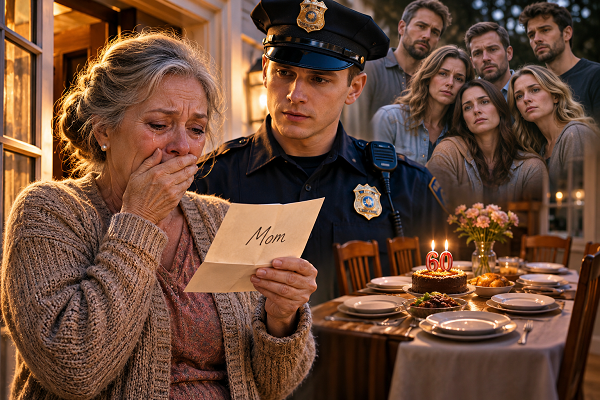
At four o’clock, I kept looking through the front blinds, waiting to see headlights in the driveway.
At five, I sent a message to our family group chat.
Drive safely, everyone! Love you!
At five-thirty, I saw the little typing dots appear beneath Sarah’s name. Then they disappeared. No message came.
At six, I called Mark. His voicemail answered.
Then I tried Jason, Caleb, and Eliza. All went straight to voicemail.
When I called Grant, it didn’t even ring. It went directly to voicemail, as if his phone were switched off.
By seven, the pot roast was cold.
By eight, the candles had burned halfway down.
At nine, I was still sitting at the head of the table, staring at six empty chairs.
I kept telling myself there had to be a reasonable explanation. Maybe there had been an accident on the road. Perhaps the weather was bad, or someone had misunderstood the time.
But all six of them? Not one phone call?
The silence began to feel personal.
I picked up one of the napkins I had carefully ironed that morning and pressed it against my face as I cried.
Then someone knocked on the front door.
It wasn’t the cheerful knock of my children arriving, laughing and calling out from the porch. It was firm and official. Three sharp knocks.
I quickly wiped my face and went to answer it.
A police officer was standing outside.
He looked young, perhaps in his late twenties, with short hair and a dark blue uniform. His expression was serious.
“Are you Linda?” he asked.
I nodded. I couldn’t seem to make my voice work.
He held out a folded piece of paper.
“This is for you, ma’am.”
My name was written on the outside. Beneath it was one word:
Mom.
I recognized the handwriting immediately. My hands went numb.
Grant.
I opened the note beneath the yellow light on the porch, while moths circled the bulb.
It said:
Mom. Don’t call anyone. Don’t ask questions. Just listen to him and get in the car.
For a moment, I couldn’t breathe.
Grant was my wild child. My fourth. The one who had caused me more worry than the other five combined. He was the reason I had spent so many nights jumping whenever my phone rang after midnight.
“I need you to come with me, ma’am,” the officer said.
I looked up at him, terrified.
“Is my son alive?”
His eyes moved away from mine for just a moment. It was a tiny movement, but it frightened me even more.
“Please,” I whispered. “Just tell me if Grant is alive.”
He swallowed.
“He’ll explain everything.”
That wasn’t an answer. Not even close.
But before I explain what happened next, you need to understand my family. You need to know who my children are and what their father did to us.
When I married Ray Henderson, I was twenty-three and working as a receptionist at a dentist’s office in Fort Wayne, Indiana. He was twenty-six and sold farm equipment. He had a loud laugh, strong hands, and enormous plans for the future.
“I want a big family, Linda,” he told me on our second date at a Pizza Hut on Coliseum Boulevard. “A noisy house. A table that’s never empty.”
I laughed because I thought he was joking.
He wasn’t.
We had six children in ten years.
Mark was first, followed by Jason sixteen months later. Then came Caleb, Grant, Sarah, and finally Eliza, our youngest. She was born when I was thirty-three, and I was so exhausted that I fell asleep in the hospital bed while holding her.
Four boys and two girls filled our little three-bedroom house on Wells Street with more noise than I ever imagined possible.
Ray had the big family he wanted.
For a while, he seemed happy. He would come home from work and wrestle with the boys on the living room carpet. He carried the girls on his shoulders and made Mickey Mouse pancakes on Sundays. They never really looked like Mickey Mouse, but the children loved them anyway.
Then, around the time Eliza turned six, something changed.
Ray began staying late at work. Soon he was spending his evenings downstairs in the basement, sitting at the family computer with the door closed.
Eventually, I discovered that he had met a woman online. She lived in the Philippines, and they had been communicating for eight months.
One Saturday morning in March, when Eliza was six and Mark was sixteen, Ray packed a suitcase and stood in the hallway.
“I need to find myself, Linda,” he said. “I can’t breathe in this house.”
“You have six children, Ray.”
“You’re better with them than I am anyway.”
Then he walked out, climbed into his truck, and drove away.
What I didn’t know at the time was that he had already emptied our joint savings account two days earlier. Fourteen thousand dollars. Every cent we had.
The years that followed were difficult, and I won’t pretend otherwise.
I found a lawyer through Indiana Legal Services. Her name was Monica, a kind young woman whose office was above a pawn shop. She handled my divorce without charging me.
She also got a judge to order Ray to pay $1,100 a month in child support for our six children.
He made exactly three payments.
Then he moved to Manila and stopped paying altogether.
Monica contacted the state child support enforcement office. They managed to intercept one of his tax refunds, but after that he stopped filing taxes in the United States. By the time Eliza turned eighteen, Ray owed more than $160,000 in unpaid child support.
I never received a single penny of it.
So I worked.
I left the dentist’s office because the pay wasn’t enough. I took a job as a cook in the cafeteria at Northrop High School so my schedule would match my children’s school hours. Eventually, I became the cafeteria manager.
Three nights a week, from six in the evening until midnight, I also handled medical billing for the hospital on Lake Avenue. I learned insurance codes, figured out how to argue with Medicaid representatives, and became very good at surviving on four hours of sleep.
When the furnace broke, I refinanced the house. When Caleb needed braces, I borrowed against my school district retirement account. When Jason broke his arm playing football, I arranged a payment plan and paid forty dollars every month for three years.
I never missed a mortgage payment. Not once in twenty-two years.
I attended every football game, every band concert, and every parent-teacher meeting. Every Saturday morning, I sat on the hard bleachers at Kingsland Community Center to watch basketball, volleyball, and school events. I even watched Sarah play a sheep in the Christmas pageant two years in a row.
Slowly, one by one, my children grew up.
Mark became an accountant. He is thirty-six now, married, with two children and a house in Huntertown. He’s serious and responsible. When Ray left, Mark was sixteen and took on the role of the man of the house. In many ways, he never stopped. Even now, he calls me every Sunday at four to make sure I’ve paid my property taxes.
Jason became an electrician. He’s the funny one, always telling stories that don’t make much sense but somehow leave everyone laughing. He drives a huge truck, has a thick beard, and a heart as big as his personality.
Caleb is quiet and thoughtful. He’s a physical therapist who reads during his lunch breaks and remembers nearly everything anyone tells him.
Sarah is strong-willed and fearless. She’s a nurse in the emergency department at Parkview and doesn’t let anyone push her around. If I ever needed someone beside me in a fight, she’d be the one I’d choose.
Eliza, my baby, is twenty-seven and teaches second grade. Even now, when she comes home for the weekend, she sometimes climbs into my bed just as she did when she was little.
And then there’s Grant.
Grant is twenty-nine. He was ten when his father walked out, and that abandonment affected him more deeply than any of the others.
Before Ray left, Grant had been a cheerful, silly little boy who followed his father everywhere. Afterward, his sadness turned into anger, and that anger stayed with him for years.
He got into fights at school and was suspended in seventh grade. At fifteen, the police caught him spray-painting the back wall of a Kroger. At seventeen, he crashed my car into a mailbox at two in the morning. He also dropped out of community college twice.
I spent more nights waiting for Grant to come home than I did for my other five children combined. I would lie awake listening for his key in the door and jump whenever the phone rang, afraid that a police officer or someone from a hospital was about to give me terrible news.
So when I opened my front door on my sixtieth birthday and saw an officer holding a note written by Grant, you can understand where my mind went.
I imagined the worst.
“Ma’am,” the officer repeated, “I need you to come with me.”
I looked over my shoulder at the house.
The table was ready. Seven places were set. The food was covered with foil, and the candles were nearly finished.
“My children were supposed to be here tonight,” I said. “It’s my birthday. I’m sixty today.”
He hesitated.
“I’m sorry, ma’am.”
I’m sorry.
Those are the words people say on television and in movies just before they deliver terrible news.
I should have called Mark. Or Sarah. She worked in an emergency room and dealt with police officers every day. She would have known what to do.
But the note told me not to call anyone.
I took my cardigan from the hook, locked the front door with shaking hands, and walked down the steps. For the first time in my life, I climbed into the back of a police cruiser.
The seat was hard plastic and smelled of disinfectant. A metal barrier separated me from the front.
When the door shut, the heavy click made my stomach drop.
The officer got behind the wheel and drove away.
“Where are we going?” I asked.
“Not far, ma’am.”
“Not far where?”
He looked at me in the rearview mirror.
“Somewhere safe.”
“Safe from what? Did Grant get hurt? Is he in trouble? Did he do something?”
“Please, ma’am. Just wait.”
“Don’t tell me to wait. I’m his mother. Tell me if my son is all right.”
He stayed quiet for a moment.
“You’ll have answers soon. I promise.”
My phone buzzed inside my cardigan. I grabbed it so quickly I almost dropped it.
It was a message from Mark.
Mom, please don’t freak out. Just trust us.
Trust us.
After four hours of waiting, after calling everyone and crying alone at the table, my oldest son was telling me to trust him.
I typed with shaking fingers:
WHERE ARE YOU?
I had never sent a message in all capital letters before. My children often joked that I texted like someone writing a formal letter.
The message showed as delivered, but not read.
I stared at the back of the officer’s head through the metal barrier. He had short dark hair and a small scar near the back of his neck.
“You know my son,” I said.
It wasn’t a question.
After a moment, he answered quietly.
“Yes, ma’am.”
My heart began pounding.
“How?”
He didn’t answer.
“Are my children in danger? Has something happened to any of them?”
“No, ma’am.”
“Then why am I sitting in the back of a police car on my birthday?”
He sighed.
“Just a few more minutes. Please.”
I leaned against the hard seat, pulled my cardigan tightly around me, and did what I had done through every difficult moment in my life.
I prayed.
Please, God. Not Grant. Not my boy. I’ll do anything.
Outside, familiar Fort Wayne streets passed by: the Dairy Queen on State Boulevard, the Methodist church, and the old Scott’s grocery store that had become a Dollar General.
I knew those streets. I had driven along them thousands of times in a minivan full of children.
Then the officer turned into a parking lot.
Kingsland Community Center.
I knew that building almost as well as my own church. It was a long, low brick building with a gym, meeting rooms, and a kitchen. I had spent fifteen years sitting on those hard wooden bleachers watching basketball, volleyball, Pinewood Derby events, Christmas pageants, Mark’s Eagle Scout ceremony, and Sarah’s graduation party.
So many happy memories lived inside that building.
But none of them could quiet the fear in my chest.
Why would a police officer bring me here?
Then I noticed the cars parked outside beneath the lights.
Mark’s gray Honda Pilot, with the little stick-figure family on the back window.
Sarah’s blue Corolla with its Parkview Hospital parking sticker.
Jason’s enormous white Ford truck, with HENDERSON ELECTRIC written on the door.
Caleb’s Subaru.
Eliza’s Jeep.
My mouth went dry.
“What is this?” I whispered.
The officer parked and came around to open my door. He offered me his hand, but I ignored it and climbed out myself. My legs were unsteady beneath my good black slacks and cardigan.
He walked beside me toward the glass entrance.
Through the doors, I could see people moving inside.
I stopped on the sidewalk.
“If this is some kind of joke,” I said, “I swear…”
“It isn’t a joke, ma’am.”
My chest felt so tight I could barely breathe. Hope, anger, and fear were all fighting inside me.
The officer opened the door.
Suddenly, every light in the gym switched on.
“HAPPY…”
Jason was the first to shout, throwing both arms into the air. But when he saw my face, he stopped with his arms still raised.
Mark immediately looked guilty. Sarah’s expression changed to alarm. Eliza covered her mouth with both hands, and Caleb turned pale.
A huge banner stretched across the basketball hoop at the far end of the gym.
HAPPY 60TH, MOM!
Purple, gold, and white balloons were tied to the bleachers and chairs, with dozens more floating near the ceiling. Streamers decorated the walls. Three long tables covered in white cloth were loaded with food in aluminum trays.
A beautiful three-layer cake from Rachel’s Bakery stood on its own table, decorated with purple flowers. It must have cost a fortune.
Five of my six children stood in the middle of the gym, staring at me as if they were waiting for a happy reaction that wasn’t coming.
I remained frozen in the doorway.
When I finally spoke, my voice was quiet but sharp.
“So you were all here.”
Mark hurried toward me.
“Mom, wait. Please let us explain.”
“I waited four hours,” I said. “Four whole hours.”
Nobody moved.
“I cooked for two days. I set the table with Grandma’s china. I ironed the napkins. I sat alone from five until nine-thirty, watching the candles burn down and calling every one of you.”
Jason slowly lowered his arms.
“Mom, we weren’t ignoring you. We swear. We wanted to surprise you. Grant was supposed to pick you up at five and bring you here. He said he’d explain that the plans had changed. We all turned off our phones so we wouldn’t accidentally spoil it.”
“Where is Grant?” I asked.
Eliza’s eyes filled with tears.
“We thought he was with you, Mom.”
Sarah suddenly turned toward the officer standing behind me.
“Why is there a police officer with her? What happened? Where’s Grant?”
I looked at all five of my children. They stood there like children caught doing something they knew they shouldn’t have done.
“I sat alone at that table,” I said. “I cried into a napkin like an idiot.”
Mark’s expression crumpled.
“Mom, we were trying to keep the surprise. Grant said he was taking care of everything. He sent a message to the group at four-thirty saying he was running late and that we shouldn’t call you.”
“And none of you thought to check on him?”
“We thought it might ruin the surprise,” Caleb said softly.
I could feel my heartbeat speeding up again.
“What about seven? What about eight? What about nine o’clock? Didn’t any of you think something was wrong?”
Jason explained that Grant had continued sending messages. He had said he was almost there, that they were running late, and that everyone should wait another twenty minutes.
They thought Grant might have taken me somewhere for dinner before bringing me to the community center.
Sarah held up her phone.
“His last message came at eight-forty-five. He said, ‘Sending someone for her. Be ready.’”
Sending someone.
I turned back toward the officer.
“You gave me a note from my son. You put me in a police car and brought me here. Now tell me where he is.”
The officer started to answer but stopped.
My hands tightened into fists.
“Where is my son?”
Jason checked his phone.
“He said he’d be here by seven. He was supposed to bring you.”
“He’s late,” Sarah said, turning toward Mark. “He’s always late.”
Mark had already called Grant. His jaw tightened.
“He isn’t answering. It goes straight to voicemail.”
Then headlights swept across the glass entrance.
Everyone turned toward the parking lot.
Another police cruiser was pulling in.
The gym became completely silent.
The second cruiser stopped outside. Its engine shut off, a door opened, and footsteps approached the entrance.
Then Grant walked through the doors.
He was wearing a police uniform.
A silver badge shone on his chest.
“No way,” Jason whispered. “No way.”
“Grant?” Sarah said.
Eliza made a small sound, almost like a sob. Caleb simply stared.
Grant stood in the doorway wearing a perfectly fitted dark blue uniform. His hair was cut short, shorter than I had seen it since he was in first grade. His shoes were polished until they reflected the gym lights.
Above his right pocket was a name tag.
HENDERSON.
He raised both hands as if he were walking into a storm.
“Okay,” he said. “Before anyone murders me… happy birthday, Mom.”
My voice finally returned.
“What are you wearing?”
He swallowed.
“A uniform.”
“You’re a cop?” Mark asked, sounding as if he had just been told his brother was a giraffe.
“Yeah,” Grant answered. “I have been since three o’clock this afternoon.”
Sarah exploded.
“Are you out of your mind, Grant? She thought you were dead! You sent a police officer to her house at night with a note telling her not to ask questions! Do you understand what that looks like to a mother? Do you know how many times I’ve seen a police officer walk into the waiting room at Parkview to tell somebody’s mother…”
Her voice broke before she could finish.
Grant flinched.
Then he looked directly at me.
“Mom, I’m so sorry. I didn’t think it through. I wanted to surprise you. I imagined walking in wearing my uniform and seeing your face. I thought the note would be funny, like something from a movie. A little scare, then the surprise, and everybody would laugh.”
“You didn’t think,” I repeated.
He nodded, his face full of shame.
“I didn’t know you’d been sitting at home for hours. I thought the others would tell you something. I thought…”
“I was sitting at the table, Grant.”
My words seemed to land heavily in the middle of the gym.
Mark looked down. Eliza began crying quietly.
“Explain everything,” I said. “Right now.”
Grant took a deep breath.
“Seven months ago, I applied to the Fort Wayne Police Department. I didn’t tell anyone. I took the written exam and passed. Then I completed the physical test, and I passed that too. The background investigation took two months. They contacted my old teachers and my former boss at the tire shop. They even brought up the Kroger incident from when I was fifteen.”
He gave a nervous little laugh.
“I had to sit with a sergeant and explain what happened. I honestly thought they’d reject me. But I told him the truth. I told him I had been an angry kid whose father abandoned him, and that I had made a lot of bad decisions. I also told him my mother never gave up on me. Somehow, he gave me a chance.”
Nobody spoke.
“I started the academy in April. It was a twenty-four-week program. I told everyone I had found a night job at a warehouse. That’s why I wasn’t around much. That’s why I missed Easter and Eliza’s birthday.”
“You told me you had the flu,” Eliza whispered.
“I had a firearms qualification that day,” Grant admitted. “I’m sorry, Lizzie.”
He continued explaining that the swearing-in ceremony had taken place that afternoon at three o’clock at the Rousseau Centre downtown. That was when the new officers received their badges and officially became police officers.
He had planned to finish by four, drive straight to my house, pick me up, and bring me to the celebration.
But his field training officer gathered the entire class for paperwork at four o’clock. They had to complete payroll forms, health insurance documents, pension enrollment, and equipment sign-out. Nobody was allowed to leave until everything was finished.
They weren’t supposed to use their phones during the process, but Grant managed to send a few short updates to the family group chat.
He didn’t get out until nearly eight-thirty.
Then he pointed toward the officer who had brought me.
“That’s Nate. Officer Nate Alvarez. He was a year ahead of me at the academy. He’s a friend. I called him from the parking lot and asked him to pick you up while I finished signing out my equipment. I wrote the note on the back of a payroll form.”
“Don’t call anyone. Don’t ask questions,” I repeated.
Grant looked down.
“I thought it sounded mysterious. Like a spy movie. In my head, it was funny.”
“Grant,” I said, “in my head, I was planning your funeral.”
He closed his eyes.
“I know. I understand that now.”
I studied my fourth child. I thought about all the times I had watched him sit at the end of the bench at Kingsland, angry because a coach wouldn’t put him in the game.
“Why didn’t you tell me?” I asked. “You kept this secret for seven months. Why?”
His voice became quiet.
“Because I didn’t want anyone treating me like I was going to fail.”
I gave a bitter little laugh.
“And you thought I would?”
“No, Mom. Never. You’re the only one who didn’t.”
The gym fell silent again.
“Everyone else had already decided who I was,” Grant continued. “Teachers, coaches, neighbors from Wells Street, even Grandma Henderson before she died. Dad, too, the one time he called on my eighteenth birthday. They all thought I would end up in jail or turn out just like him.”
He swallowed.
“But you never gave up on me. You used to sit on the edge of my bed when I came home late and tell me, ‘Grant, you can be anything you want in this world. Anything. You just have to stop acting like you don’t care.’”
My throat tightened.
“I said that because I didn’t want you to become your father.”
The expression on Grant’s face changed. His eyes filled with tears.
“I know, Mom,” he said slowly.
He took a step toward me.
“I wanted to show you that I’m not him.”
His voice became softer, and suddenly he sounded like the little boy who used to follow his father everywhere.
“I wanted you to be proud of me.”
I looked at the badge on his chest.
It was a silver shield with FORT WAYNE POLICE written across it and a number stamped along the bottom. It was real. Solid. Heavy.
My anger hadn’t disappeared. I had spent four hours alone, followed by twenty minutes in the back of a police car believing something terrible had happened to my son. That kind of fear doesn’t vanish in a moment.
But something inside me began to soften.
I reached out and touched the badge with two fingers. It was cold.
“You really did this,” I whispered.
Grant’s lower lip trembled.
“Yeah.”
I blinked back tears.
“You scared me half to death.”
“I know. I’m so sorry, Mom.”
And then I began to cry.
My wild child had done something good. My most difficult son, the one I had spent nineteen years worrying about, had quietly worked toward something meaningful without anyone watching him or expecting him to succeed.
“I thought you were gone,” I said, my voice breaking.
Grant’s face crumpled.
He stepped forward and hugged me carefully at first, as if he were afraid I might push him away. Then he held me tightly. His badge pressed against my cheek. He smelled of starch, gun oil, and the same drugstore shampoo he had used since high school.
“I’m here, Mom,” he whispered into my hair. “I’m right here.”
Behind us, Sarah’s voice softened.
“Mom, I’m sorry.”
“We all are,” Mark added, his voice cracking.
Jason cleared his throat.
“Yeah. We really messed this up.”
Eliza came over and wrapped her arms around my side, just as she used to when she was little and a thunderstorm frightened her.
“We only wanted everything to be perfect,” she whispered.
I wiped my cheeks with the sleeve of my cardigan.
“There’s no such thing as perfect, sweetheart. There’s only showing up.”
Grant stepped back and looked me in the eyes.
“No more disappearing,” he promised. “Not me. Not ever again. No more secrets and no more pretending I’m working nights at a warehouse.”
I studied his face. He still had the same freckle beneath his left eye, but something about him seemed different.
“Good,” I said. “Because I can’t go through another night like this.”
He nodded.
“You won’t have to.”
Near the entrance, someone cleared his throat.
Officer Nate Alvarez was still standing there with his hat in his hands. He looked as though he wished he could disappear.
“Ma’am, I’m Nate,” he said. “I’m really sorry for frightening you. This was all Grant’s idea. I just wanted that to be clear.”
“Thanks, buddy,” Grant muttered.
Sarah pointed toward the door without even turning around.
“Go. Now. Before I start yelling again.”
Nate nodded, put his hat back on, and quickly left.
The whole gym seemed to breathe again.
Jason clapped his large hands together.
“Okay, food. Right now. Everyone. Before I pass out.”
Suddenly, the children began moving around the room, just as they used to on Thanksgiving mornings in our house on Wells Street, when everyone had a job to do.
Mark collected paper plates. Caleb removed the lids from the warming trays. Eliza brought me a glass of water as if I had just finished running a marathon.
Sarah stood beside me for a moment before pulling out a folding chair at the head of the first table.
“Sit,” she ordered. “You aren’t getting up. We’re serving you tonight.”
So I sat.
Grant took the chair beside me, still wearing his uniform. He looked as though he wasn’t completely sure he deserved to sit there.
I nudged him with my elbow.
“Eat, Officer Trouble.”
He gave a shaky, tearful laugh.
“Yes, ma’am.”
Then I looked at the food.
They had prepared exactly the same dishes I had cooked at home: pot roast with long carrots, cheesy scalloped potatoes, green bean casserole with crispy onions, homemade rolls, and macaroni salad.
They had used my recipes.
Eliza had secretly taken the little metal recipe box from my kitchen counter two weeks earlier when she came over pretending she needed to borrow a sweater. The children had divided the recipes among themselves and cooked everything in their own kitchens.
“We wanted you to have all your favorite food,” Eliza explained. “But this time, you wouldn’t have to cook any of it.”
I didn’t tell them until later that the same dinner was still waiting on my dining room table at home, covered with aluminum foil.
As we ate, the tension in the gym slowly disappeared.
Mark tried to cut the beautiful three-layer cake into perfectly even pieces, but the result looked more like a landslide. Jason told a ridiculous story about a customer who believed his ceiling fan was haunted. Nobody could follow the story, but everyone laughed so hard that Caleb nearly choked on a roll.
Grant began telling us about the police academy.
He talked about running at five in the morning in the rain and an instructor who had made him do two hundred push-ups in front of the entire class because he had arrived thirty seconds late to formation.
“Late?” Sarah said. “You? I can’t believe it.”
“Okay, I deserved that.”
“You deserved worse.”
“I know.”
Later, when the others weren’t paying attention, Sarah leaned toward me.
“Mom, I really am sorry. I should have called you, even if it meant ruining the surprise. I had my phone in my hand at five-thirty. I started typing a message, but then I stopped because I didn’t want to spoil everything.”
“I saw the typing dots,” I told her.
She winced.
“I know.”
“Sarah, just don’t let being busy turn into being gone. That’s all I ask. Someone I loved already walked away from me. I can’t go through that again.”
Her eyes shone beneath the gym lights.
“Okay, Mom,” she whispered. “I promise.”
Later, when the balloons were beginning to droop and only crumbs remained on the cake plates, Grant leaned closer.
“Mom, there’s one more thing.”
I raised an eyebrow.
“If there’s another police officer outside…”
He laughed.
“No. I promise. No more police officers.”
He reached into his chest pocket and took out a folded paper. This time it wasn’t a handwritten note. It was a program printed on thick cream-colored paper with the city seal on the front.
FORT WAYNE POLICE ACADEMY
CLASS 74
GRADUATION AND BADGE PINNING CEREMONY
“Today was the swearing-in,” Grant explained. “That’s when they give you the badge and officially make you a police officer. But next Friday is the actual graduation ceremony. It’s in the auditorium at the Grand Wayne Center. The families will be there, the mayor will speak, and every officer will be called onto the stage.”
He pointed to a line on the program.
Badge Pinning by Family Member.
“They remove the badge from the uniform, and someone from the officer’s family gets to pin it back on in front of everyone.”
He swallowed nervously.
“I saved you a seat in the front row, Mom. I want you to be the one who pins it on me.”
I stared at the program.
“Next Friday,” I repeated.
He nodded. He looked proud and nervous at the same time.
“Will you come?”
I looked at my wild child, my most difficult one. I remembered the boy who had spray-painted the wall behind Kroger and the young man who had crashed my car into a mailbox. Now he was sitting beside me in a perfectly pressed uniform, trying to make something good of his life.
“My son is trying,” I thought.
“Yes,” I answered. “I’ll be there.”
His shoulders relaxed, and that familiar crooked smile appeared on his face. The same smile he had worn since he was four years old.
Then I stood up.
All six of my children looked at me.
I looked down the long table at Mark, Jason, Caleb, Grant, Sarah, and Eliza. They were all grown now, but for the first time that evening, every chair was occupied.
“Listen to me,” I said.
They became quiet, just as they used to when I said those words in the kitchen on Wells Street.
“Your father walked out of this house about twenty years ago and never came back. He wanted a loud home and a full table. But when things became difficult, he decided he didn’t want that life anymore.”
Nobody moved.
“I didn’t raise six children by myself so that all of you would grow up and learn how to disappear on me.”
Mark lowered his eyes.
“No more disappearing,” I continued. “Not on birthdays, not on holidays, and not on ordinary Tuesdays. You call. You answer your phones. You show up, even when you’re late, even when plans change, and even when you’re afraid I’ll be disappointed in you.”
I looked directly at Grant.
“Especially then.”
One by one, they nodded.
“Deal,” Mark said.
“Deal,” Sarah agreed.
“Deal,” Eliza whispered.
“Deal,” Caleb added.
Jason sat up straight. For once, he wasn’t making a joke.
“Deal.”
Grant reached over and covered my hand with his large, rough one.
“Deal,” he said quietly. “And I’ll prove it, Mom.”
I squeezed his fingers.
“I know you will.”
Then Sarah went over and dimmed the gym lights.
A moment later, Eliza came out of the little kitchen behind the gym, walking slowly while carrying another cake.
It was a small chocolate sheet cake covered in fudge frosting. Grant’s favorite, the kind he used to sneak a taste of when he was six.
“Grant made this last night,” Eliza explained. “At two in the morning, after his last shift at the academy. It’s your recipe.”
I noticed a little finger-shaped mark in one corner of the frosting.
Grant shrugged.
“Old habits.”
The candles on this cake were not the same ones I had lit at home. Those had burned down completely while I sat alone at my dining room table.
These were new. There were six of them, one for each child. Eliza explained that they had decided sixty candles would be a fire hazard.
When my children began singing Happy Birthday, they sang loudly, badly, and with absolutely no coordination. Jason deliberately sang the harmony wrong. Mark forgot the words halfway through. Grant sang louder than everyone else, standing beside me in his police uniform with one hand resting on my shoulder.
Their voices filled the gym, bouncing off the bleachers, basketball hoops, and purple balloons.
It sounded just like our old house on Wells Street.
I closed my eyes and blew out all six candles in one breath.
Someone asked what I had wished for.
I didn’t tell them, because you’re not supposed to share a birthday wish.
But I can tell you now.
I didn’t wish for anything. For the first time in nearly twenty years, I felt that I didn’t need to.
The following Friday, I sat in the front row of the auditorium at the Grand Wayne Center.
All six of my children were there. Five sat in the second row behind me, along with Mark’s wife and their two children. Jason’s girlfriend had come, as had Caleb’s husband. Sarah arrived straight from a twelve-hour shift, still wearing her scrubs. Eliza brought a sign she had made with her second-grade students. It read:
GO OFFICER GRANT!
The words were covered in glitter glue.
Grant stood on the stage with thirty-one other new officers. They wore their dress uniforms and white gloves.
When the announcer called his name, Officer Grant Henderson, I walked up the steps. My legs shook almost as much as they had on my front porch that night.
A sergeant handed me the badge.
I carefully pinned it onto my son’s chest. My fingers struggled with the clasp, so Grant placed his gloved hand over mine and helped me.
“Hi, Mom,” he whispered.
“Hi, baby.”
“You came.”
“I told you I would.”
The entire auditorium applauded. Somewhere behind me, Jason let out an incredibly loud whistle with two fingers, making the mayor jump.
I don’t know where Ray Henderson is these days. Probably somewhere in Manila, still owing me more than $160,000 and about twenty years of the life he walked away from.
He had wanted a loud house and a table that was never empty.
He left it all behind.
I stayed.
And last week, when I returned home after Grant’s graduation, I took the leftover food out of my refrigerator. The pot roast, scalloped potatoes, green bean casserole, and rolls had all been waiting there since my birthday.
I set the table again.
Grandma’s china. The cloth napkins.
Seven places.
At five o’clock, I looked through the front blinds, just as I had on my birthday.
But this time, all six of my children were already turning into the driveway.
Not one of them was late.
THE END.