 By Admin
PART 3
Then Mom looked at me, and I saw something in her eyes I had never seen before.
Fear.
Not fear of losing money or being left alone. This was something deeper, something that seemed to reach into the past and bring old, buried memories to the surface.
“Your father knew,” she whispered.
“Knew what?” I asked.
She shook her head, unable to answer.
Mr. Cole, the lawyer, stepped forward, keeping a respectful distance.
“Mrs. Brennan, I understand how overwhelming this must be. Perhaps we should go inside and look through everything privately.”
Mom looked down at the watch again.
Her thumb moved slowly across its scratched steel casing, tracing the small mark near the number eleven. Dad had made that scratch the year I was born, when he slipped on the icy steps while carrying a box of baby clothes into our first house.
He had laughed about it for years.
“First battle scar,” he used to say. “Your mother thought I should have known better than to carry boxes on icy steps.”
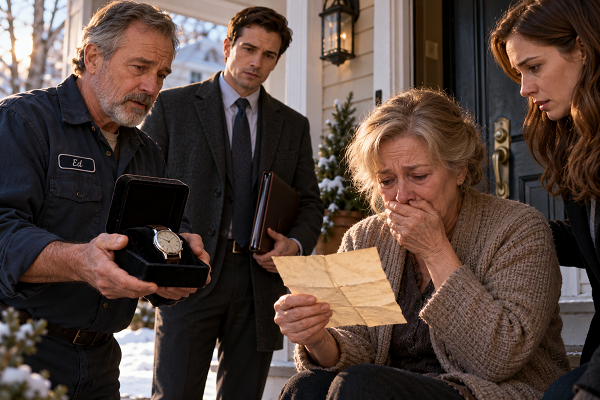
A faint laugh escaped Mom through her tears.
Then she looked at the note again.
This time, she began to read it aloud.
My dearest Margaret,
If you are reading this, then I have either run out of time or finally found the courage to tell you what I should have told you years ago.
Mom stopped. Her breathing grew shallow.
I reached for her hand.
“Keep reading, Mom.”
She swallowed and continued.
There is something I have protected for forty-five years. It was never meant to be mine alone. It belongs to you as much as it belongs to me.
I put the proof somewhere no one would think to look. I chose this watch because I have worn it every day since the beginning, and because I knew that if anything ever happened to me, it would eventually find its way back into your hands.
Forgive me for waiting so long.
I love you more than I have ever been able to say.
Harold.
Mom lowered the paper.
“Is that all?” I asked quietly.
She shook her head.
“No.”
She turned it over.
On the back, six words were written in Dad’s familiar handwriting:
The mill. Locker 214. Ask for Daniel.
Beneath them was a date.
September 17, 1981.
Mr. Cole cleared his throat.
“Mrs. Brennan, your husband contacted my predecessor’s law firm several months before his death. He left instructions for us to investigate certain documents and deliver them to you if we could establish that the watch had been recovered.”
I stared at him.
“Several months before Dad died?”
“Yes. Unfortunately, the information he provided was incomplete, and we were unable to locate the original documents. We knew only that they were connected to his former employer and that he had arranged for something to be preserved.”
“Then why didn’t you come to us while he was still alive?”
“Your father instructed us not to disclose the matter until a specific condition had been met. We honored his wishes. I can explain more once we have verified the records.”
Mom clutched the watch.
“What did my husband do?” she asked.
Mr. Cole’s expression softened.
“I don’t believe this was about something he did, Mrs. Brennan. I believe it was about something he discovered.”
His words hung in the air.
Something he discovered.
I thought about Dad coming home from the steel mill every evening, black smudges on his hands, his shoulders aching, his lunch pail tucked beneath his arm.
He had never seemed like a mysterious man.
He was the sort of person who fixed a leaking faucet rather than calling a plumber. He saved rubber bands in a kitchen drawer and believed a good pair of work boots should last at least five years.
He didn’t gamble. He didn’t hide money from Mom.
At least, that was what I had always believed.
I looked at the note again.
“What is Locker 214?”
Mr. Cole closed his briefcase halfway.
“That’s what we need to find out.”
Ed, the watch shop owner, finally spoke.
“I want you to understand something. When your son sold me the watch, I had no idea any of this was inside. I thought I was buying an old timepiece. But when I found the paper, I realized it was personal. The way it had been sealed made me think someone had gone to a great deal of trouble to protect it.”
He paused, glancing at Mom.
“I’ve been in this business for thirty-two years. People sell watches because they need money, because they’re clearing out a house, or because they no longer want the memories attached to something. But this watch felt different. It felt as though someone was meant to find it.”
Mom looked at him through her tears.
“Thank you.”
Ed shook his head.
“You don’t owe me anything, ma’am. I just couldn’t live with myself if I put that watch in a display case and sold it to a stranger.”
He handed Mr. Cole a small receipt.
“I refunded the forty dollars to the account I use for purchases. I don’t know whether the fellow has already spent the money, but that’s between you and him. The watch belongs with his family.”
I almost laughed at the absurdity of it all.
Scott had sold our father’s most treasured possession for forty dollars.
And now a complete stranger had returned it, cleaned it, placed it in a velvet box, and brought a lawyer to our mother’s door because he believed the watch contained something important.
For the first time in three months, the empty space beside Dad’s reading glasses didn’t feel quite so empty.
But I had no idea that the watch was only the beginning.
Because when Mr. Cole finally opened his briefcase, the first document he placed on our kitchen table bore Dad’s signature.
And the date at the top was September 17, 1981.
The very same date written on the back of the note.
We gathered around the kitchen table where Dad used to read the newspaper every morning. Mom sat in his old chair, and I sat beside her, holding the watch. Ed remained near the doorway, looking uncomfortable in a room where grief had suddenly become something far more complicated.
Mr. Cole removed three folders from his briefcase.
The first contained photocopies of employment records.
The second held several letters.
The third was a sealed envelope with my mother’s name written across the front.
Margaret Brennan. To be delivered personally.
Mom touched the envelope with trembling fingers.
“He wrote that?”
“Yes,” Mr. Cole replied. “Your husband left instructions that it was not to be opened until the original watch had been recovered.”
I looked down at the watch in my hands.
“Why the watch? Why not leave everything with the lawyer?”
Mr. Cole folded his hands.
“That is a reasonable question. Your father appears to have believed that documents kept in a law office might eventually be misplaced, transferred, or overlooked. The watch, on the other hand, was something he expected to remain with his family.”
“He was right about one thing,” I muttered. “It certainly stayed in the family.”
Mom turned toward me.
“Jenny.”
I knew what she meant.
Not now. Not while we were finally getting answers.
I swallowed the anger that had been building inside me ever since Scott admitted what he had done.
Mr. Cole opened the first folder.
“Your father worked at Brennan Steel—”
“Brennan Steel?” I interrupted.
He looked up.
“I’m sorry. I meant North River Steel Works. That was the company where your father worked.”
“I know where he worked. Why did you say Brennan Steel?”
Mr. Cole hesitated.
“Because that is the name mentioned in one of these documents. I assumed it referred to a department or an internal project, but I haven’t established the connection yet.”
He turned a page.
Mom leaned forward.
Dad had started at the mill in 1974, earning barely enough to keep our little house warm and put food on the table. He stayed there for more than thirty years, working overtime whenever he could, especially when Scott and I were young.
He had been promoted twice, but he rarely talked about his job.
To us, the mill was simply the place Dad went every morning and returned from every evening.
Until that afternoon, I had never imagined it could be connected to a secret he had carried for forty-five years.
Mr. Cole continued sorting through the records.
“According to the documents, in September 1981, your father was involved in an incident concerning a piece of equipment and a series of financial transactions.”
“What kind of incident?” I asked.
“The records don’t tell me enough to answer that yet. But they refer to missing inventory, altered purchase orders, and a substantial amount of money.”
Mom’s face tightened.
“How much?”
Mr. Cole checked the page in front of him.
“Approximately $186,000 in 1981.”
I stared at him.
“That much?”
“Yes.”
In today’s money, it would have been a considerable fortune.
Dad had never owned anything extravagant. We had grown up in the same modest house, driven used cars, and gone camping instead of flying somewhere for vacation. He had never behaved like a man who had been anywhere near that kind of money.
“Was my father accused of stealing it?” I asked.
Mr. Cole studied me carefully.
“His name appears in an internal report, but I haven’t found evidence that he personally took the money. In fact, some of the documents suggest he may have been the person who raised concerns about the transactions.”
Mom shook her head.
“Harold would never steal. He worked twelve hours a day whenever he had to. He even brought broken tools home because he didn’t want the company wasting money on replacements.”
“I understand,” Mr. Cole said gently. “I’m not suggesting otherwise.”
He placed a photocopy of a handwritten letter on the table.
The handwriting was not Dad’s. The letters were sharp and hurried, almost impossible to decipher in places.
At the bottom was a signature.
Daniel Whitaker.
Mom stared at the name.
“Daniel,” she whispered.
I turned to her.
“You knew him?”
She pressed her lips together before answering.
“I knew a Daniel who worked at the mill with your father. They were friends for a while. He came to our house a few times when you were little.”
“What happened to him?”
“I don’t know. One day, your father came home and told me Daniel had left the company. When I asked why, he said it wasn’t our business.”
That sounded exactly like Dad.
He never brought his problems at work into the house. He believed a man should leave his troubles at the door so his family could have some peace.
But now I wondered how much that peace had cost him.
Mr. Cole tapped the letter.
“This was written by Daniel Whitaker on September 17, 1981. It appears to concern the same financial irregularities. There’s one sentence I find particularly interesting.”
He read it aloud.
“Harold has the original ledger. If management discovers it, they will make certain neither of us works in this town again.”
Mom covered her mouth.
I felt the room grow cold.
The original ledger.
Locker 214.
Ask for Daniel.
Dad hadn’t left my mother a sentimental message. He had left her a trail.
And someone, forty-five years earlier, had been afraid of what he knew.
Mr. Cole spent the next hour explaining what he could—and couldn’t—establish from the records.
The steel mill had changed ownership twice. Some of its old personnel files had been destroyed, while others were stored in an archive maintained by a company that had acquired the remaining industrial property.
The former locker rooms, however, were part of an older building that had been preserved.
“If Locker 214 still exists,” he explained, “we may be able to determine what your father meant. But first, I need to establish whether any records connected to it have survived.”
“Then let’s go,” I said.
Mom looked down at the watch.
“Today?”
“Why not?”
“Because your father died only three months ago,” she whispered. “And I feel as though I’m hearing his voice again, but I don’t know what he’s trying to tell me.”
I reached across the table and held her hand.
“Maybe we don’t have to understand everything today. But we shouldn’t ignore what he left for us.”
Her gaze shifted to the sealed envelope bearing her name.
Then she nodded.
Mr. Cole gathered the folders.
“I’ll make a few calls first. If we can gain legal access to the building, we’ll arrange a visit. I don’t want anyone entering an abandoned property without permission.”
He gave Mom his card and promised to return the following week.
Ed left after thanking us once more.
Before he stepped off the porch, I shook his hand.
“You did something good today.”
He glanced back toward the kitchen window.
“I hope so. I kept thinking about my own father. He died with so many things left unsaid. If I’d found a message he’d hidden for my mother, I’d want someone to bring it home.”
After Ed left, I stood on the porch for a moment, watching his car disappear down the street.
Forty dollars.
That was all Scott had thought our father’s watch was worth.
He had seen an old object he could turn into quick cash. He hadn’t known about the note hidden inside, the name Daniel Whitaker, or the date that connected everything.
Neither had I.
Now I understood that getting the watch back was only the first step. Whatever Dad had protected for decades was still waiting to be found.
And I was beginning to fear that the truth would be much harder to face than any of us imagined.
PART 3 — Continued
I watched Ed walk to his truck, then went back inside.
Mom was still sitting at the kitchen table. She had placed Dad’s watch beside his reading glasses, as though she were trying to put the two pieces of his life back where they belonged.
For a long time, neither of us spoke.
Finally, she asked, “Jenny, do you think your father was afraid?”
I looked at the note, at the date, at Daniel’s name, and at the number of the locker.
“I don’t know, Mom.”
She ran her thumb along the edge of the table.
“He used to wake up in the middle of the night sometimes. I’d ask him what was wrong, and he’d say he’d been dreaming about the mill.”
My stomach tightened.
“You never told me that.”
“He didn’t want me to worry. He always said it was nothing.”
She stared out the window.
“One night, perhaps thirty years ago, I asked him if he regretted staying there so long. He looked at me for a long time before answering. Then he said, ‘Margaret, sometimes doing the right thing costs more than a man can afford.’”
A chill ran down my arms.
“What did he mean?”
“I thought he was talking about the long hours. The birthdays he missed. The times he couldn’t take a day off because someone had to cover a shift.”
Tears gathered in her eyes.
“Now I don’t know what he meant.”
I sat with her until the afternoon light faded.
We didn’t talk about Scott or the forty dollars. Instead, we talked about Dad.
We remembered the way he whistled off-key while making breakfast on Sunday mornings. The time he drove three hours to bring me a spare tire after my car broke down during college. The way he pretended not to notice whenever Scott borrowed money and never paid it back.
And we remembered the advice Dad had given us whenever life became difficult.
“Whatever happens,” he used to say, “never let money decide what kind of person you become.”
At the time, I thought he was talking about spending habits.
Now I wondered if he had meant something much more important.
Scott called that evening.
Mom had gone upstairs, and I was washing the dishes when my phone began vibrating on the counter. His name appeared on the screen.
I nearly let it go to voicemail.
Then I answered.
“What?”
“Nice way to answer your brother.”
“You sold Dad’s watch.”
Silence followed, then an exasperated sigh.
“Are we still doing this?”
“Yes, Scott. We’re still doing this.”
“Jen, I told you I needed money. I was broke. I figured the watch was worth forty dollars, so I—”
“You sold it for forty dollars and spent the money at a bar.”
He didn’t respond immediately.
“Who told you that?”
“Does it matter?”
“Yeah, it matters. Everyone makes me sound like some kind of criminal.”
I gripped the edge of the counter.
“You took something from Mom’s house without asking her. You sold it. You lied about why you needed the money. And now you’re angry because someone found out what happened.”
“I didn’t lie!”
“You told us you needed gas money.”
“I needed money. What’s the difference?”
I closed my eyes.
There it was again: the same excuse he had used his entire life.
The amount didn’t matter. The lie didn’t matter. Neither did the people he hurt along the way.
Only his own needs mattered.
“Scott, listen to me. The shop owner found something inside the watch. A note Dad left for Mom.”
He went quiet.
“What kind of note?”
“I don’t know everything yet. It mentions the old steel mill, Locker 214, and a man named Daniel Whitaker.”
Scott gave a short laugh.
“So Dad left Mom a treasure map?”
“I’m serious.”
“Fine. Go look for buried gold. Maybe you’ll finally get something out of this family besides another lecture about how irresponsible I am.”
I could hear a television playing in the background. He sounded relaxed, almost amused.
That made me angrier than anything else.
“Scott, Dad was trying to tell Mom something important.”
“Then why didn’t he tell her while he was alive?”
“I don’t know. That’s what we’re trying to find out.”
“Maybe he wanted to leave you a mystery to solve. You’ve always liked that sort of thing.”
I was ready to hang up when he said something that made my hand freeze.
“Wait. You said Daniel Whitaker?”
“Yes.”
The television continued playing, but Scott fell silent.
“Scott?”
“Where did you hear that name?”
“It’s in the note. Why?”
He didn’t answer.
“Scott, do you know something?”
“No.”
The answer came too quickly.
I straightened.
“Look at me and tell me you don’t know anything about Daniel Whitaker.”
“I’m not looking at you. We’re on the phone.”
“Don’t be clever.”
He exhaled sharply.
“Listen, Dad mentioned him once. Years ago. That’s all.”
“When?”
“I don’t remember.”
“What did Dad say?”
“Something about an old coworker.”
“That’s it?”
“Yes.”
I heard a chair scrape faintly in the background. Then Scott’s voice changed.
“Listen, Jen. Whatever you find at that mill, don’t start making accusations against people who aren’t here to defend themselves.”
I stared at the phone.
“What are you talking about?”
“Nothing. Forget it.”
“Scott—”
“I have to go.”
He hung up.
I stood in the kitchen, listening to the silence.
For three months, I had believed Scott sold the watch because he was careless, selfish, and desperate for money.
I still believed those things.
But now I wondered whether there was another reason he had reacted so strangely when I mentioned Daniel Whitaker.
I called him back.
He didn’t answer.
I sent him a text.
What did Dad tell you about Daniel?
The message showed as delivered, but no reply came.
An hour later, Mom came downstairs carrying Dad’s old wooden toolbox.
“What are you doing with that?” I asked.
She set it on the table.
“Looking for something.”
She opened the lid. Inside were screwdrivers, a small hammer, a tape measure, rusty nails, and a few pieces of sandpaper. Everything was arranged just as Dad had left it.
Mom moved the tools aside.
At the bottom lay a folded sheet of paper.
She picked it up.
“Harold used to keep this in his toolbox. I remember seeing it years ago, but I never read it.”
She unfolded the paper.
It was a faded photograph of three men standing outside the steel mill. They wore work clothes and held lunch pails.
Dad stood in the middle.
The man to his left was younger, with dark hair and a serious expression. The man on his right wore a baseball cap and had one arm draped over Dad’s shoulder.
On the back, written in Dad’s handwriting, were three names:
Harold Brennan. Daniel Whitaker. Robert Vale.
Beneath them was another sentence:
The three of us knew the truth.
Mom stared at the photograph.
Then she whispered a name I had never heard her say before.
“Robert Vale.”
I looked at her.
“Who is he?”
She turned the picture over again.
“He became a very important man.”
“How important?”
Mom met my eyes.
“By the time your father retired, Robert Vale was chairman of the company that owned the mill.”
My stomach dropped.
The man who had stood beside Dad in that photograph had eventually become one of the most powerful people connected to the place where Dad had spent his life.
And Dad had written that all three men knew the truth.
I studied the photograph.
Three men.
One secret.
Forty-five years of silence.
Somewhere inside an old building, there might still be a ledger that could explain everything.
But the most troubling question was no longer what Dad had discovered in 1981.
It was why he had waited until the end of his life to tell Mom about it.
PART 4
The following Tuesday, Mr. Cole called.
He had found someone who could authorize access to the former mill property. The building was still standing, although most of the original machinery had been removed. The old locker rooms were in a section that had been closed for decades.
“We can visit on Thursday morning,” he told us. “I’d prefer that we go together. If we find anything, we need to document it properly.”
Mom agreed to come, and I took the day off work.
On Wednesday evening, Scott sent me a text.
Don’t go to the mill.
I stared at the message for a long moment before calling him.
He answered on the fourth ring.
“Why shouldn’t we go?” I asked.
“Because it’s a waste of time.”
“You don’t know that.”
“Dad worked there for thirty years. He probably left some old junk in a locker. What are you expecting to find? A million dollars?”
“I expect to find whatever he wanted Mom to find.”
Scott sighed.
“Jen, listen to me. Sometimes the dead leave things behind because they don’t want anyone to know about them.”
“Then why would Dad write down the locker number?”
“I don’t know!”
His voice rose so suddenly that I pulled the phone away from my ear.
For a moment, neither of us spoke.
Then he lowered his voice.
“Just leave it alone.”
“Why?”
“Because Mom has been through enough.”
I almost laughed.
“That’s what you’re worried about? Mom going through more pain?”
“Don’t start.”
“You stole from her, Scott. You took the one thing she kept beside Dad’s glasses. You left her thinking she’d misplaced it. You don’t get to use her feelings as an excuse now.”
He said nothing.
“If there’s something in that mill that hurts Mom, we’ll deal with it,” I continued. “But I’m not going to let you decide what she gets to know about her own husband.”
“Dad wouldn’t have wanted this.”
“You don’t know what Dad wanted. That’s why we’re going.”
I ended the call.
My hands were shaking—not because I was afraid of the mill, but because I was beginning to understand that whatever lay inside Locker 214 frightened my brother more than the consequences of stealing from our mother.
That night, I barely slept.
At six the next morning, I drove to Mom’s house. She was already dressed and sitting at the kitchen table, with Dad’s watch beside her.
She had carefully wound it, even though it no longer kept time.
“I thought you might want to bring it,” she said.
I nodded.
She placed it in its velvet box and slipped it into her handbag. Then she picked up the photograph.
“We should bring this, too.”
The drive to the old mill took forty minutes.
The building appeared beyond a row of bare trees, its tall brick walls dark against the gray winter sky. A faded sign hung above the main entrance. Most of the windows were boarded up, and weeds had pushed through cracks in the parking lot.
It was difficult to imagine thousands of workers arriving there every morning with their lunch pails, ready to spend another day beside roaring machinery.
Dad had been one of them.
Mr. Cole was waiting at the gate with a representative from the property management company. After introductions and a brief explanation of why we had come, the representative escorted us inside.
The air smelled of dust, old metal, and damp concrete. Our footsteps echoed through the empty corridors.
We passed an old maintenance room, a row of offices, and a break room with faded paint on the walls.
Finally, the representative stopped beside a heavy door.
“The locker rooms are through here,” he said. “Most of the lockers were removed during the first renovation. A few of the old units were left behind.”
He unlocked the door.
Beyond it lay a long room lined with metal lockers. Some stood open, while others were dented or rusted shut. The numbers had been painted over so many times that many were difficult to read.
Mom walked slowly along the row, her fingers brushing the cold metal.
“Your father used to complain about this place,” she murmured. “He said the lockers were so small you couldn’t turn around without hitting your elbows.”
I managed a sad smile.
“That sounds like Dad.”
At the far end of the room, the representative stopped beside a bank of old gray lockers.
“Here we are. These are the ones that were never removed.”
I looked at the numbers.
208.
209.
210.
My heart began to pound.
211.
212.
213.
And then—
214.
The locker stood slightly taller than the others. Its handle was rusted, and a small keyhole sat beneath it.
I looked at Mom.
She reached into her handbag and took out the velvet box containing Dad’s watch. For a moment, she held it close to her chest.
“Whatever is in there,” she whispered, “your father wanted us to find it.”
Mr. Cole stepped forward.
“Let’s see whether it’s still locked.”
Mom took the photograph from her handbag and looked at the writing on the back.
“The three of us knew the truth,” she whispered.
Mr. Cole put on a pair of gloves.
“Before we open it, I want to document its condition.”
He photographed the locker, its number, the handle, and the surrounding area. Then he examined the keyhole.
“There is a lock,” he said. “But it’s very old.”
The property representative called over a maintenance worker with a set of tools. After confirming that the locker belonged to the abandoned facility and that we had permission to open it, the worker carefully removed the damaged lock.
At first, the door wouldn’t budge.
Then it swung open with a long metallic groan.
Inside lay a pair of dusty work gloves, a small metal lunch tin, and a bundle wrapped in oilcloth.
Nothing else.
Mom covered her mouth.
I couldn’t take my eyes off the bundle.
Mr. Cole carefully lifted it out and placed it on a clean surface. The oilcloth had been folded around something flat and rectangular.
He loosened the ties.
Inside was a thick black ledger. Its cover was cracked, and the pages had yellowed at the edges.
Beneath it lay a second envelope.
Dad had written four words across the front:
For Margaret. Read first.
Mom reached for it, but her hands trembled too much to open it.
I gently held her fingers.
“Take your time.”
She drew a shaky breath and opened the envelope.
Inside was a single sheet of paper.
The handwriting was unmistakably Dad’s.
Margaret,
If you have found this, then the watch has finally brought you here.
I need you to understand something before you read the ledger.
For most of our life together, I told myself I was protecting you by keeping quiet. I thought that if I carried the burden alone, you and the children could live without fear.
But silence has a price, and I have paid it for forty-five years.
The truth inside this book could destroy the reputation of a man who spent decades pretending to be honest. It could also restore what was taken from people who had no power to defend themselves.
I did not keep this for revenge.
I kept it because one day, someone might finally be brave enough to ask the right questions.
If that day has come, please don’t let what happened to me happen to anyone else.
I am sorry I could not tell you sooner.
All my love,
Harold.
Mom lowered the letter.
For a long time, she didn’t move.
Then she looked at the black ledger.
“Open it,” she whispered.
Mr. Cole carefully lifted the cover.
The first pages contained dates, invoice numbers, and handwritten entries. Some were signed by people whose names we didn’t recognize. Others referred to equipment purchases and payments made through companies that no longer existed.
He turned several pages.
Then he stopped.
His expression changed.
“What is it?” I asked.
He leaned closer.
“This entry is dated September 17, 1981.”
The same date.
He read the line silently before looking at Mom.
“Mrs. Brennan, I need you to understand that we don’t yet know whether these records are authentic or complete. We’ll need an independent forensic review before drawing any conclusions.”
“Just tell me what it says,” Mom replied.
Mr. Cole turned the ledger toward us.
Three names appeared in the margin:
Harold Brennan. Daniel Whitaker. Robert Vale.
Beneath them was a handwritten note:
Original funds transferred. Copies retained. If anything happens to Daniel, deliver the evidence to Harold.
I felt the blood drain from my face.
“If anything happens to Daniel?”
Mr. Cole turned another page.
A newspaper clipping had been pasted inside.
The headline was faded but still readable:
STEEL MILL EMPLOYEE REPORTED MISSING — POLICE SEEK INFORMATION.
Below it was a photograph of a young man with dark hair and serious eyes.
The same man who stood beside Dad in the photograph.
Daniel Whitaker.
Mom gripped my arm.
“He disappeared?”
Mr. Cole read the date beneath the headline.
September 18, 1981.
One day after the date written on Dad’s note.
I struggled to breathe normally.
We had come looking for an old ledger, expecting perhaps a financial secret or an explanation for something Dad had kept hidden.
We had not expected to find evidence connecting him to a man who had disappeared forty-five years earlier.
The ledger was still open on the table when I noticed something unusual.
The newspaper clipping had been folded in half, and a thin strip of paper was tucked behind it.
I carefully pulled it free.
It was another photograph, smaller than the one Mom had brought from home.
Three men stood outside the steel mill.
Dad.
Daniel.
Robert Vale.
But this time, someone else was visible in the background.
A woman.
Her face had been circled in red ink.
Beneath the photograph, Dad had written six words:
Ask who signed the final payment.
Mr. Cole went completely still.
He stared at the words for several seconds before closing the ledger halfway.
“Mrs. Brennan,” he said quietly, “I think we need to stop here until I can verify something.”
Mom looked directly at him.
“Why?”
He hesitated.
“Because the signature on the final payment appears to belong to someone who was never supposed to have access to these accounts.”
“Who?” I asked.
Mr. Cole glanced at the circled woman, then looked back at the ledger.
“I need to be certain before I tell you.”
Mom stood up.
“No. My husband carried this secret for forty-five years. He left it inside a watch because he wanted me to find it. I buried him, I mourned him, and I spent three months wondering whether he had left me anything beyond an empty space on a dresser.”
Her voice trembled, but she held his gaze.
“You are not going to ask me to wait again without telling me what we have found.”
Mr. Cole looked at her for a long moment.
Finally, he turned the ledger toward her and pointed to the signature.
The name was written in faded blue ink.
Margaret Brennan.
My mother’s name.
For a moment, I couldn’t make sense of what I was seeing.
Then I looked at her.
She had gone completely pale.
“That isn’t possible,” she whispered.
Mr. Cole said nothing.
Mom shook her head.
“I never worked at the mill. I never signed anything for that company. Harold handled every document that came into our house.”
I looked from the signature to the photograph.
The woman in the background had dark hair, a narrow face, and a familiar way of standing, with one hand resting against her hip.
My stomach twisted.
“Mom,” I whispered, “who is that woman?”
Mom stared at the picture. Her lips moved, but at first no sound came out.
Then she finally spoke.
“That isn’t me.”
She looked at me, tears gathering in her eyes.
“But I know exactly who it is.”
When she said the woman’s name, Mr. Cole slowly sat down.
The woman in the photograph had been dead for more than forty years.
And according to the records, she was the last person who had seen Daniel Whitaker alive.
PART 4 — Continued
“Her name was Eleanor,” Mom whispered. “Eleanor Vale.”
For a moment, the abandoned locker room seemed to grow colder.
Mr. Cole looked at the photograph again.
“Eleanor Vale? Robert Vale’s wife?”
Mom nodded slowly.
“She was the sweetest woman I had ever met. She brought us a casserole when Jenny was born. She sent flowers when my mother died. She used to invite us to dinner, and she always remembered Scott’s birthday.”
Her voice cracked.
“She died in a car accident in 1983.”
I stared at the photograph.
The woman standing behind Dad and Daniel wore a small smile. She looked ordinary, kind, and completely unaware that, forty-five years later, her image would sit at the center of a mystery that had followed my father to his grave.
“Why would her name appear on a payment?” I asked.
Mr. Cole carefully closed the ledger.
“That is something we need to investigate. The signature might be genuine, copied, or forged. We cannot assume which without further evidence.”
Mom shook her head.
“Eleanor wouldn’t have stolen anything.”
“Perhaps she didn’t,” he replied. “The signature could have been used without her knowledge.”
I looked at the photograph again.
Dad had written, Ask who signed the final payment.
He had known that signature mattered.
He had known someone would eventually find the ledger.
And he had left us just enough information to begin asking questions.
We left the mill with the ledger secured in a protective case.
As I helped Mom into the car, I looked back at the tall brick building. My father had spent decades walking through those doors. He had worked there, made friends there, and apparently discovered something that changed the course of his life.
I had always believed I knew my father.
Now I wondered how much of his life I had never really seen.
Whatever happened next, we could no longer pretend the watch was simply an old family possession.
It was the beginning of the truth.
The following morning, Mr. Cole called with an update. He had located an archived newspaper report about Daniel Whitaker’s disappearance.
Daniel had been thirty-two when he vanished. He was married, had a young daughter, and had worked at the mill for almost ten years.
On the evening of September 17, 1981, he left work but never arrived home.
His car was found two days later near a rural road several miles from the mill.
There was no evidence of a collision.
No sign of a struggle.
No body.
His wife, Patricia, had reported him missing.
For months, police searched the surrounding area, interviewed coworkers, and examined Daniel’s personal records.
Then the investigation went quiet.
The newspaper described his disappearance as unexplained.
“Did they ever find out what happened to him?” I asked.
“No,” Mr. Cole replied. “At least, not according to the public records I’ve located.”
“What about Robert Vale?”
“Robert gave a statement to investigators. He claimed Daniel had been under considerable financial pressure and suggested that he might have left town voluntarily.”
Mom closed her eyes.
“That’s a lie.”
I turned to her.
“How do you know?”
“Because Daniel came to our house the night before he disappeared.”
I nearly dropped the phone.
“What?”
Mom stood and walked to the window.
“I had forgotten about that evening until I saw his photograph. Harold came home late, and Daniel was with him. They went into the garage and talked for nearly an hour.”
“What did they talk about?”
“I don’t know. Your father asked me to keep the children inside and not disturb them.”
She paused.
“Before Daniel left, he came into the kitchen. He thanked me for making him coffee, then said something strange.”
“What?”
Mom looked back at me.
“He said, ‘If anything happens to me, tell Harold he did the right thing.’”
A chill ran through me.
“Did you ask him what he meant?”
“I did. He smiled and told me not to worry. Then he left.”
Mom pressed her fingertips against the window.
“The next morning, Harold went to work as usual. He came home that evening and sat in the garage for hours. When I asked what was wrong, he said Daniel had disappeared.”
I swallowed.
“And you never talked about it again?”
“Not for years. Eventually, I stopped asking because I thought Harold needed to grieve in his own way.”
She turned toward me.
“Jenny, your father never stopped carrying something that happened that night.”
For the first time, I began to understand the cost of his silence.
He hadn’t simply hidden a financial secret. He had lived for decades with the knowledge that a friend had disappeared, leaving behind a wife and child, and that whatever had happened at the mill might have played a part.
I couldn’t imagine waking up every morning with that burden.
But one question remained.
If Dad knew something important about Daniel’s disappearance, why hadn’t he gone to the police?
Mr. Cole was searching for that answer.
While he did, I decided to confront the one person who seemed determined to stop us from finding it.
My brother.
Scott refused to answer my calls for two days.
On the third day, I drove to his apartment.
He lived in a small building above a laundromat, where the hallway smelled of detergent and stale cigarette smoke. His car was parked outside, although he had told Mom he was working late.
I knocked twice.
There was no answer.
I knocked again.
“Scott, I know you’re in there.”
I heard footsteps inside.
The door opened a few inches, and his face appeared in the gap.
“What do you want?”
“To talk.”
“I’m busy.”
“You’ve been busy avoiding me ever since I mentioned Daniel Whitaker.”
His expression changed.
“Keep your voice down.”
He opened the door and let me inside.
The apartment was cluttered with empty food containers, unpaid bills, and clothes scattered across a chair. A television played quietly in the corner.
Scott looked exhausted.
For a moment, I felt sorry for him.
Then I remembered Mom crying over the missing watch.
“Tell me what you know,” I said.
He rubbed his face.
“I told you. Dad mentioned Daniel years ago.”
“That’s not all.”
“Jenny—”
“Dad left a ledger in Locker 214. It contains records of money transferred through the mill. Daniel disappeared the day after the date written in Dad’s note. And there’s a photograph of Robert Vale’s wife with Dad and Daniel.”
Scott went completely still.
I watched him closely.
“You know something.”
He turned away.
“I didn’t know about the ledger.”
“But you know something about the people involved.”
He remained silent.
I stepped closer.
“Scott, Dad is gone. We can’t ask him questions anymore. Mom has spent her whole life believing he was simply a hardworking man who loved his family. Now we’re finding out that he carried something painful for forty-five years. Whatever you know, we need to understand it.”
Scott sat on the edge of the couch and stared at the floor.
For several seconds, he said nothing.
Then he began to speak.
“When I was twenty-one, Dad took me to lunch.”
I blinked.
“What does that have to do with anything?”
“Just listen.”
He rubbed his hands together.
“It was shortly before I got into my first serious debt. I’d borrowed money from people I shouldn’t have borrowed from. Dad found out, and he was furious. But instead of yelling at me, he took me to that little diner near the highway.”
I remembered the place. Dad used to take us there for pancakes.
Scott continued.
“He told me he’d made a mistake when he was younger. He said one mistake had nearly destroyed somebody else’s life, and he’d spent decades trying to make sure the damage didn’t spread.”
My stomach tightened.
“What mistake?”
“He wouldn’t tell me. I asked whether it had something to do with the mill, and he told me never to ask about Daniel Whitaker.”
“Those were his exact words?”
Scott nodded.
“He said, ‘Some names belong to a time when good people were forced to make terrible choices.’ Then he told me that if anyone ever came asking about Daniel, I should say I knew nothing.”
I stared at my brother.
“And you never asked him why?”
“I was young. I thought he was talking about some stupid workplace dispute.”
Scott stood and walked to the window.
“Then, about six months before Dad died, I visited him one afternoon. He was sitting at the kitchen table with an old envelope. He looked frightened, Jen. I’d never seen him like that.”
“What was in the envelope?”
“I don’t know. He put it away when he saw me.”
“Did he mention Daniel?”
Scott nodded.
“He asked whether I remembered what he’d told me at the diner. I said yes. Then he told me some things had a way of coming back when a man was too old to run from them.”
Tears stung my eyes.
Dad had known his time was running out. He had tried to prepare someone in the family for what might happen after he was gone.
But Scott had been so consumed by his own problems that he hadn’t understood what Dad was trying to tell him.
“What happened to the envelope?” I asked.
“I don’t know.”
“Did Dad say anything else?”
Scott hesitated.
Then he said, “He told me that if I ever found the watch, I should bring it to Mom.”
The words hit me harder than I expected.
I stared at him.
“What?”
Scott’s eyes filled with tears.
“He said that if anything happened to him, the watch belonged to her. He told me never to let it leave the family.”
For a moment, I couldn’t speak.
“You knew that,” I whispered.
Scott nodded.
“And you sold it anyway.”
He covered his face.
“I know.”
“You knew Dad had specifically told you to protect it, and you sold it for forty dollars.”
“I was desperate.”
“You were drunk,” I said.
Scott lowered his hands.
“Yes.”
The admission hung between us.
For the first time since the funeral, he didn’t offer an excuse. He didn’t blame his circumstances or insist the watch was worthless. He simply stood there, looking like a man who had finally recognized the ugliness of his own choices.
“I’m sorry,” he whispered.
I wanted to believe him.
But apologies came easily to Scott.
Changing was harder.
“Why didn’t you tell me about the diner when I called you?”
He swallowed.
“Because I was scared.”
“Of what?”
He looked at me.
“Dad told me that if the truth ever came out, someone might come looking for the ledger.”
I stared at him.
“Who?”
“I don’t know.”
“Scott, this is serious.”
“I know!”
His voice broke.
“I know, Jen. I know what I did. I know I hurt Mom. But when you told me about the ledger, all I could think about was Dad sitting at that table, telling me some people would do anything to keep certain things buried.”
I took a slow breath.
“Then you should help us find out why.”
Scott shook his head.
“What if the truth destroys everything?”
I looked at him.
“Everything has already been destroyed for someone, Scott. Daniel disappeared. Dad carried the secret until he died. Mom spent forty-five years not knowing what her husband was hiding.”
I paused.
“We can’t keep protecting a lie just because the truth might hurt.”
Scott sat down again.
For a long time, he said nothing.
Then he reached into a drawer and pulled out a small, worn notebook.
“I found this in Dad’s garage after the funeral,” he said. “I was going to throw it away, but something stopped me.”
He handed it to me.
The notebook contained old measurements, shopping lists, and reminders about household repairs. Near the back, however, one page was filled with dates and names.
Daniel Whitaker.
Robert Vale.
North River Steel Works.
And one final entry:
October 12 — Patricia. Find her before they do.
I looked at Scott.
“Who’s Patricia?”
“Daniel’s wife.”
I checked the date.
October 12, 2026.
Two days before Dad died.
My hands began to tremble.
Dad had written this only days before his death. He had been trying to find Patricia—and his words suggested he believed someone else might be searching for her, too.
I photographed the page and sent it to Mr. Cole.
His reply arrived less than a minute later.
Do not contact anyone connected to the case until we have reviewed the records. I believe I know where Patricia Whitaker may be living.
Then another message appeared.
There is something else you need to know.
I stared at the screen.
Robert Vale died in 2019.
I looked back at the notebook.
Dad had been trying to find a woman whose husband had disappeared forty-five years earlier. He had been searching for her just days before he died.
And whatever he wanted to tell her, he had never managed to do it.
Mr. Cole located Patricia Whitaker through an old address listed in a newspaper archive. She was living in a small town about two hours away.
Before contacting her, he verified her identity through public records and arranged to meet her with our permission.
Mom insisted on coming.
“I owe her an apology,” she said.
I looked at her.
“For what?”
“For not asking more questions when Daniel disappeared.”
“Mom, you didn’t know what had happened.”
“Neither did she. That’s the point.”
We drove there on a cold Friday morning.
Patricia lived in a modest brick house with a white porch and a small garden. A wind chime hung beside the front door.
She answered after our second knock.
She was in her late seventies, with silver hair and a face marked by time. Her eyes were sharp, but there was a sadness in them that seemed older than the house itself.
Patricia watched us carefully as Mr. Cole introduced himself and explained why we had come.
When he said Daniel’s name, she gripped the doorframe.
For several seconds, she simply stared at Mom.
Then she stepped aside.
“Come in.”
Her living room was filled with books, family photographs, and neatly arranged furniture. On a shelf beside the fireplace stood a picture of a young man holding a little girl.
Daniel and his daughter.
Patricia sat down slowly.
“I wondered when someone would finally come.”
Mom began to cry.
“I’m so sorry.”
Patricia looked at her.
“Why?”
“Because Harold knew Daniel. Because Daniel came to our house the night before he disappeared. And because I never asked enough questions afterward.”
Patricia studied her for a long moment, then shook her head.
“You don’t owe me an apology for something you didn’t understand.”
She turned to Mr. Cole.
“Tell me what you’ve found.”
He explained the watch, the note, the locker, and the ledger.
When he showed her the photograph, Patricia’s hands began to shake. She reached out and touched Daniel’s face.
“Oh, Danny.”
She pressed the photograph to her chest.
“He told me he was going to fix everything.”
Mom leaned forward.
“What do you mean?”
Patricia wiped her eyes.
“Daniel worked in the purchasing department. He discovered that money was being diverted through false invoices. Equipment was recorded as delivered when it never arrived. Payments were approved for companies that had no real operations.”
She looked at the ledger.
“He told me Robert Vale was involved.”
My heart began to pound.
“Robert Vale knew about the theft?”
Patricia nodded.
“Daniel believed Robert had helped organize it. But it wasn’t only about money. Some of the equipment was supposed to be used to improve safety at the mill.”
She turned toward the window.
“Workers had complained about defective machinery. Daniel believed the money being diverted was supposed to pay for repairs and replacement parts. When the money disappeared, the repairs never happened.”
My throat tightened.
“Did someone get hurt?”
Patricia closed her eyes.
“My brother worked at the mill. He lost two fingers in an accident that might have been prevented if the equipment had been repaired properly.”
The room fell silent.
Suddenly, I understood why Dad had carried this burden for so long.
It hadn’t merely been about missing money. It was about people who went to work every morning believing someone was responsible for keeping them safe.
And someone had betrayed that trust.
Patricia continued.
“Daniel gathered copies of invoices and payment records. He wanted to take them to the authorities. But Robert found out.”
“What happened next?” I asked.
Patricia took a shaky breath.
“Daniel came home late one night and told me he had to meet Harold. He said Harold had agreed to help him preserve the evidence.”
Mom nodded slowly.
“That was the night he came to our house.”
“Yes.”
Patricia looked down at the ledger.
“Daniel was afraid. He believed Robert had powerful friends, and he thought the company might try to destroy the evidence.”
“Did Daniel ever tell you what happened on September 17?” Mr. Cole asked.
Patricia shook her head.
“He never came home.”
She stared at the photograph.
“The police asked whether he had been unhappy. They asked if we had argued, whether he had debts, whether there was another woman. They searched our house and went through his personal belongings.”
Her voice grew bitter.
“They wanted to believe he had run away. That was easier than believing someone had made him disappear.”
Tears gathered in my eyes.
“Do you think Robert killed him?”
Patricia looked at me.
“I don’t know what happened to my husband. I’ve spent forty-five years wondering. But I know this: Daniel would never have abandoned his daughter without saying goodbye.”
She rose and walked to a cabinet. From a drawer, she took out a small envelope.
“I kept this because I couldn’t bring myself to throw it away.”
Inside was a faded letter. The writing had begun to blur with age.
Patricia handed it to Mr. Cole.
“This arrived three days after Daniel disappeared. There was no return address.”
He unfolded it carefully and read aloud:
Mrs. Whitaker,
Your husband made a serious mistake. For your family’s safety, you should stop asking questions. He has left town, and he will not be returning.
Do not contact the mill again.
There was no signature, no explanation—only one final typed sentence:
Some doors are better left closed.
Patricia stared at the letter.
“I gave a copy to the police. They said there was no way to identify who had sent it.”
Mr. Cole placed the letter beside the ledger.
“This may be relevant to the investigation.”
Patricia nodded, then looked at Mom.
“Did Harold ever tell you what happened to Daniel?”
Mom shook her head.
“No. But he spent the rest of his life carrying something that seemed to be connected to him.”
Patricia’s eyes filled with tears.
“Then perhaps he knew more than he was able to say.”
She paused.
“There’s something else. About a year before Daniel disappeared, he told me that if anything happened to him, I should look for a woman named Eleanor.”
Mom went rigid.
“Eleanor Vale?”
Patricia nodded.
“Daniel said she was the only person inside the company who might be willing to tell the truth about what Robert was doing.”
I thought about the photograph, the circled face, and the signature in the ledger.
“Did Eleanor ever contact you?”
“Not while she was alive. But after she died, I received a package.”
Mr. Cole leaned forward.
“When?”
“Early 1984. It contained no letter, only a photograph of Daniel and a key.”
“A key?”
Patricia returned to the cabinet and took a small wooden box from a shelf. Inside, wrapped in tissue paper, was an old brass key.
A number had been stamped into its surface.
214.
Mom covered her mouth.
The key to Locker 214.
Patricia looked at us through her tears.
“I never knew what it opened. I kept it because it was the only thing I had left that connected me to my husband.”
Mr. Cole examined it carefully.
“Did you ever try to return to the mill?”
“Once. I went there in 1984, but the property manager told me the old locker rooms had been closed. I was frightened, so I left.”
She sat down again.
“Then, in 1985, I received a telephone call from a man who said he was calling on behalf of Robert Vale. He told me that continuing to search for Daniel would only bring trouble to my daughter.”
Patricia’s voice broke.
“I was a mother. I was terrified. I had already lost my husband. I couldn’t risk losing my child, too.”
Mom reached across the table and held her hand.
For a moment, the two women sat together, bound by a grief that had begun decades before I was born.
Then Patricia looked at me.
“Did Harold leave anything else?”
I thought about Dad’s watch, the note, the ledger, the notebook, and its final entry:
Find her before they do.
“Yes,” I said quietly. “He left a message.”
I told her about the words Dad had written shortly before his death.
Patricia began to cry again.
“He was looking for me.”
“Yes.”
She lowered her head.
“After all these years, he was still trying to make things right.”
I looked at the old key resting on the table.
For the first time, the pieces of the mystery were beginning to fit together.
But two questions remained.
Why had Dad waited until the end of his life to reveal what he knew?
And what exactly had happened to Daniel Whitaker on the night he disappeared?
Mr. Cole gathered the documents.
“I believe we have enough evidence to request a formal review of the original investigation. The ledger, the anonymous letter, and the key may help establish what happened. But we need to proceed carefully.”
Patricia nodded.
Then she reached into the wooden box one final time.
“There was something else in the package,” she said.
She pulled out a folded piece of paper.
“I never showed anyone this because I didn’t understand what it meant.”
She handed it to Mr. Cole.
The note contained a single sentence, written in handwriting none of us recognized:
The man who took the money was not the man who signed the papers.
Mr. Cole looked at the ledger, then at the signature beside the final payment.
Margaret Brennan.
He went very still.
If the sentence was true, someone had used my mother’s name to authorize a transaction she knew nothing about. The woman who had spent forty-five years believing her husband was hiding a secret might have been made part of that secret without ever knowing it.
Over the following weeks, Mr. Cole worked with investigators and independent document examiners to establish whether the ledger was authentic.
The process was slow.
There were no dramatic arrests, sudden confessions, or convenient discoveries that solved everything overnight. Instead, there were old records, interviews, handwriting comparisons, and hours spent checking names against company archives.
It was frustrating, but for the first time, the truth was being examined by people with the authority to investigate it.
The handwriting examiner confirmed that at least three different people had written entries in the ledger. Some were in Dad’s handwriting. Others appeared to match Daniel’s.
The signature beside the final payment, however, did not match Mom’s signature on any verified document.
It appeared to have been forged.
That discovery changed everything.
Investigators also found that the company named in the payment records had been registered shortly before the money disappeared. Its listed address was a vacant office, and its bank account had been closed within months.
One of the people authorized to approve its payments was Robert Vale.
The missing funds had passed through several accounts before disappearing. The ledger recorded transfers totaling almost exactly the original sum of approximately $186,000.
It wasn’t proof of every detail, but it was a substantial lead.
Then investigators uncovered something else.
A former mill accountant, now in his eighties, had kept copies of several reports from 1981. He had saved them because he feared he might someday be blamed for transactions he hadn’t approved.
In one report, Dad’s name appeared beside a handwritten note:
Employee refused to certify equipment delivery. Requested independent inspection.
In another, Daniel had submitted a written complaint about missing funds and safety equipment.
Both complaints had been marked as resolved.
Neither had been properly investigated.
I read those reports in Mr. Cole’s office, sitting beside Mom. The words blurred before my eyes.
My father had spent decades being remembered as a quiet man who fixed things around the house and rarely complained about his job.
But once, he had stood up to people far more powerful than himself.
He had refused to sign a document he believed was false. And when he realized someone was using his coworkers’ safety as a way to steal money, he had tried to stop it.
Mom held one of the reports.
“He never told me.”
Mr. Cole sat across from us.
“Perhaps he thought keeping you uninvolved would protect you.”
Mom looked up.
“But it didn’t protect him.”
“No,” he said quietly. “It may not have.”
She set the paper on the table.
“Harold spent his life believing that if he worked hard, told the truth, and treated people fairly, things would eventually turn out right.”
She shook her head.
“He never understood how cruel people can be when they think no one will ever hold them accountable.”
I took her hand.
“Maybe he understood better than we think.”
She looked at me.
“He kept the evidence.”
I nodded.
“He didn’t give up.”
For the first time, Mom smiled. It was a small, tired smile, but it was real.
And for the first time since Dad’s funeral, I felt we were moving toward something other than grief.
The investigation into Daniel’s disappearance took longer.
The original police file was incomplete, and several witnesses had died. Robert Vale was dead. Eleanor Vale was dead. No one could produce a verified account of what had happened to Daniel after he left work on September 17, 1981.
Still, the ledger and the old letters prompted investigators to reopen the case.
They interviewed former employees, examined archived personnel records, and searched for information that might have been overlooked decades earlier.
One former security guard remembered seeing Daniel leave the mill that evening. He also remembered seeing Robert Vale’s car near the employee parking lot.
The guard had never mentioned it during the original investigation because he had believed it was irrelevant.
Another employee recalled that Daniel had been summoned to a meeting with senior management that afternoon. The meeting wasn’t listed on the official calendar, and the man who had arranged it was Robert Vale.
These accounts weren’t enough to establish what had happened to Daniel. But they were enough to challenge the old assumption that he had simply abandoned his family.
Then a retired mechanic contacted the authorities after hearing about the reopened case.
In 1981, he had worked at a repair garage outside town. He remembered a dark sedan arriving late one night with damage to its front bumper.
The driver had paid cash and asked for the repairs to be completed without paperwork.
The mechanic recognized the car as belonging to a senior executive at the mill. He couldn’t remember whether it had been Robert Vale’s car, but he had kept an old appointment book containing the date and license plate number.
Authorities compared the information with archived vehicle records.
The car had been registered to a company associated with Robert Vale.
The repair had taken place on September 18, 1981—the day after Daniel disappeared.
Investigators examined the information further. They found no surviving evidence that conclusively established who had been driving the car or what had happened to Daniel.
But the discovery supported the possibility that the original investigation had overlooked important evidence.
It also gave Patricia something she had not possessed in forty-five years: a reason to believe her husband had not simply walked away.
When Mr. Cole told her, she sat quietly for a long time.
Then she asked, “Do they think he was murdered?”
Mr. Cole answered honestly.
“They can’t establish that yet. There are serious unanswered questions, and the evidence warrants further investigation. But I won’t promise you an answer that the records don’t support.”
Patricia nodded.
“I appreciate that.”
She looked toward Daniel’s photograph on the shelf.
“For forty-five years, people told me to accept that he had left. They said I should stop searching and move on.”
She wiped her eyes.
“I never believed them.”
Then she turned to Mom.
“Harold didn’t forget him either.”
Mom shook her head.
“No. He carried him with him until the end.”
Patricia closed her eyes.
“Then perhaps we weren’t alone after all.”
Three months after we found the ledger, the company that had acquired the mill agreed to cooperate with the investigation. Several historical records were released.
Among them was an internal memorandum dated September 19, 1981. It described Daniel’s disappearance as a personal matter and instructed managers not to discuss the financial investigation outside the company.
The memorandum had been signed by Robert Vale.
At the bottom was another name: Thomas Mercer, Operations Director.
I had never heard of him.
Mr. Cole explained that Mercer had supervised several departments at the mill and worked closely with Robert Vale. He had also approved some of the transactions listed in the ledger.
But the most important discovery came from a separate file.
It was a handwritten statement dated October 1981.
Dad had written it himself.
In the statement, he explained that he had refused to certify a shipment of replacement equipment because the shipment had never arrived. He had discovered that payment had already been authorized.
When he questioned the discrepancy, he was told to sign the paperwork and stop asking questions.
He refused.
Two days later, Daniel disappeared.
The statement ended with a sentence that made me stop reading:
I believe Daniel is in danger because he intends to reveal the truth. I have preserved the records because I fear the company will destroy them.
I sat in silence.
Mom read the statement twice, then pressed her hand against her mouth.
“He knew Daniel was in danger.”
Mr. Cole nodded.
“It appears he was concerned, yes.”
“Then why didn’t he tell the police everything?”
Mr. Cole took a breath.
“The documents suggest your father did speak to investigators. However, the surviving records indicate that he was warned against making accusations he couldn’t substantiate. He may have feared losing his job—or worse, being accused of participating in the fraud himself.”
Mom stared at the paper.
“He was afraid.”
“Yes,” Mr. Cole replied. “And he may have believed preserving the evidence was the only thing he could safely do.”
I thought about the man I had known.
Dad had never been a coward. He was the person who stood between Scott and trouble when we were children. He was the person who drove through a snowstorm to help a neighbor whose car had broken down. He was the person who stayed late at the hospital when my first child was born, even though the nurses told him to go home and rest.
But courage didn’t mean he had never been afraid.
Sometimes courage meant refusing to sign a false document when everyone around you insisted it was harmless.
Sometimes it meant keeping a record when powerful people wanted it destroyed.
And sometimes it meant carrying the truth for decades, hoping that one day someone else would be strong enough to finish what you had started.
I looked at the watch in its velvet box.
For fifty-one years, it had been part of Dad’s ordinary life. He had worn it while working, raising his children, paying bills, and growing old beside the woman he loved.
But in the end, it had also been his final attempt to tell us what he couldn’t bring himself to say aloud.
The legal review continued for several more months.
The evidence established that substantial funds had been diverted through false invoices and that Mom’s signature had been forged on at least one payment authorization.
Investigators couldn’t prove that every person named in the ledger had knowingly participated in the fraud. Nor could they establish exactly what had happened to Daniel after he disappeared.
Some of the people involved were dead. Others could no longer remember events clearly. Several records had been destroyed in the ordinary course of business before the investigation reopened.
The truth remained incomplete.
But it was no longer buried.
The company issued a formal statement acknowledging serious irregularities in its historical accounting records and apologizing to former employees whose concerns had been ignored. It also agreed to fund an independent review of the safety failures identified in the documents.
No one pretended money could undo what had happened.
It couldn’t restore Daniel to his wife and daughter. It couldn’t give Dad back the forty-five years he had spent carrying his secret. And it couldn’t erase the fear that had silenced people who might otherwise have spoken.
But it was a beginning.
Patricia received formal acknowledgment that the original investigation into her husband’s disappearance had failed to examine several important leads. She also received copies of the newly recovered records.
She held them in her hands and cried.
“I used to think I needed someone to tell me exactly what happened,” she told us one afternoon. “I still want that answer. But at least now I know I wasn’t foolish for believing my husband would never abandon us.”
Mom hugged her.
“You were never foolish.”
Patricia smiled through her tears.
“Neither was Harold.”
Those words stayed with me.
My father had made mistakes. He had kept secrets from his wife. He had allowed fear to silence him. He had waited too long to seek help.
But he had also preserved evidence that might otherwise have disappeared forever.
And when he finally realized time was running out, he tried to make things right.
He hadn’t managed to solve everything.
But he had given us the chance to continue.
The Watch Comes Home
The hardest part of the story, however, wasn’t the investigation.
It was what happened between Scott and Mom.
For weeks after the watch was recovered, Scott avoided visiting her. He sent occasional messages asking whether she was feeling better, but he never came to the house.
Mom pretended not to be hurt.
I knew she was.
One Sunday afternoon, I found her sitting beside Dad’s dresser, holding the watch.
“He was the one who sold it,” she said quietly.
“Yes.”
“He knew how much it meant to me.”
“Yes.”
She turned the watch over in her hands.
“I keep thinking about what would have happened if Ed hadn’t opened it. If he had put it in the display case and sold it to someone else.”
I sat beside her.
“Then we might never have found the ledger.”
She nodded.
“And Scott would never have known what he had thrown away.”
I didn’t know what to say.
Mom placed the watch beside Dad’s glasses.
“I’m angry with him, Jenny. I don’t want to pretend I’m not.”
“You have every right to be.”
“But he’s still my son.”
She looked at me.
“I don’t want to lose another person I love because of something that happened in this family.”
I took her hand.
“Then don’t lose him. But you don’t have to pretend what he did was acceptable.”
She nodded slowly.
That evening, Mom called Scott and invited him to dinner the following Sunday.
He arrived twenty minutes early, carrying a grocery-store bouquet of flowers and a small box of pastries.
He looked nervous. He had shaved and was wearing the shirt Dad had given him for his birthday several years earlier.
Mom opened the door.
For a moment, they simply looked at each other.
Then she stepped aside.
“Come in.”
Scott entered the house. His eyes went immediately to the dresser in the hallway.
Dad’s reading glasses were still there.
Beside them lay the watch.
Scott stopped walking and stared at it for a long time.
Then he began to cry.
“I’m sorry, Mom.”
She didn’t rush to comfort him. She didn’t tell him everything was fine. She simply stood there, giving him the chance to say what he had come to say.
“I stole it,” he continued. “I knew it was important to Dad. I knew he wanted you to have it. And I sold it because I wanted money for a few hours of forgetting how badly I’d messed up my life.”
He wiped his face.
“I keep thinking about how I could have sold it to someone who didn’t care. Someone who might have melted it down or thrown it away. I could have destroyed everything Dad left us.”
Mom’s eyes filled with tears.
“You could have.”
Scott lowered his head.
“I don’t expect you to forgive me.”
“Good,” Mom replied softly. “Because forgiveness isn’t something you can demand.”
He nodded.
Then she continued.
“But I am willing to see whether you can become someone I can trust again.”
Scott looked up.
“How?”
“Start by telling the truth. Even when it’s embarrassing. Even when it costs you something. Stop borrowing money you can’t repay. Stop making promises you have no intention of keeping. And if you need help, ask for it before you hurt someone.”
Scott nodded repeatedly.
“I will.”
Mom looked at him for a long moment.
“Don’t promise me a new life in one afternoon, Scott. Just make one honest decision at a time.”
He began to cry harder.
Then he asked the question I think he had been carrying for months.
“Can I hold the watch?”
Mom hesitated.
For a moment, I thought she might refuse.
Then she took it from the dresser and placed it in his hands.
Scott held it carefully, turning it over to study the scratches and the old steel casing.
“This was the watch Dad wore when he taught me how to ride a bicycle,” he whispered. “He held the seat until I could balance. Then he let go, and I didn’t even realize he wasn’t holding me anymore.”
He gave a broken laugh.
“I remember looking back and seeing him standing in the driveway, smiling like I’d done something amazing.”
Mom wiped her eyes.
“You did do something amazing.”
Scott shook his head.
“I wish I could go back.”
“So do I,” she whispered.
They stood together in the hallway, both crying.
Nothing was magically repaired that evening. Scott still had debts to settle, habits to change, and trust to earn. Mom still carried the hurt of what he had done.
But for the first time, he wasn’t asking her to forget.
He was asking for the chance to become better.
And she was willing to give him that chance.
A year after Ed brought the watch to our door, Mom invited the family to dinner.
She made Dad’s favorite roast chicken, potatoes, and apple pie. The house filled with the familiar sounds of people talking over one another, children running down the hallway, and chairs scraping across the kitchen floor.
Scott arrived with groceries and helped prepare the meal.
He had begun attending counseling to address his financial habits and drinking. He had taken a second job to pay down his debts and started making regular payments on the money he owed.
He still struggled sometimes.
But he no longer pretended his problems were someone else’s fault.
When he made a mistake, he admitted it. When he couldn’t afford something, he said so. And when Mom asked him to help with the house, he showed up.
It wasn’t a dramatic transformation.
It was something more difficult: change that happened quietly, one decision at a time.
After dinner, Mom asked everyone to gather in the living room.
She had placed Dad’s watch on the coffee table. Beside it was the photograph of Dad, Daniel, and Robert outside the mill.
“I want to tell you something,” she said.
The room grew quiet.
“For most of my life, I thought your father was a simple man. He worked hard, loved his family, and tried to do the right thing. I thought that was the whole story.”
She picked up the watch.
“Now I know that a person can live simply and still carry something complicated inside them.”
She looked at Scott.
“Your father made mistakes. He kept secrets. He was afraid. But he also tried to protect people, even when he didn’t know how to protect himself.”
Then she looked around the room.
“I don’t want our family to spend the rest of our lives talking about the money that disappeared, the people who lied, or the things we wish we could change.”
She paused.
“I want us to remember the lesson your father left us.”
She held up the watch.
“Nothing valuable is measured only by what someone will pay for it.”
Scott bowed his head.
Mom continued.
“This watch was worth forty dollars to someone who wanted a few drinks. But to your father, it represented fifty-one years of his life. And to me, it represents a promise he made when he was young and a truth he was finally brave enough to share.”
Her eyes filled with tears.
“It’s not the steel or the glass that makes it valuable. It’s the life that went with it.”
Nobody spoke for several seconds.
Then Scott stood, walked over to Mom, and wrapped his arms around her.
“I love you,” he whispered.
Mom held him tightly.
“I love you too.”
For the first time in a very long time, I felt our family beginning to heal.
Not because the past had disappeared, but because we were finally willing to face it.
Two Years Later
Two years later, Patricia invited us to a small gathering at her home. Her daughter had organized it to honor Daniel’s memory and recognize the people who had helped reopen the investigation.
There were no grand speeches or television cameras. Just family, a few former mill workers, and people who had refused to let an old mystery remain forgotten.
Patricia stood beside a photograph of Daniel.
“My husband was more than a missing-person report,” she said. “He was a father who loved his daughter, a husband who cared for his family, and a man who believed doing the right thing mattered.”
She paused to gather herself.
“For forty-five years, I lived with unanswered questions. I may never know exactly what happened to him. But I know now that he didn’t simply walk away from us. He was trying to do something he believed was right.”
She looked at Mom.
“And I know that Harold never forgot him.”
Mom took her hand.
After the gathering, Patricia gave Mom a small envelope.
Inside was a copy of a photograph taken in 1980. Daniel stood beside Dad at a picnic table, holding a paper plate and laughing.
On the back, Daniel had written:
To Harold, the only man I know who would rather lose his job than sign a lie.
Mom laughed through her tears.
“He would have hated that compliment,” she said. “He always thought he was just doing what anyone should do.”
Patricia smiled.
“Perhaps that’s what made him special.”
We took the photograph home, and Mom placed it beside Dad’s reading glasses.
The empty space that had once seemed like a wound in the room no longer felt empty.
It had become a place where memories could live.
The watch remained with Mom. Ed had offered to repair its movement, but she declined.
“It doesn’t need to tell time anymore,” she said. “It has already told us what we needed to know.”
She kept the new leather strap, though, and occasionally wore the watch on special occasions. Not because she wanted people to ask about it, but because she liked feeling its familiar weight against her wrist.
One afternoon, I visited her and found her sitting by the window, turning the watch over in her hands.
“What are you thinking about?” I asked.
She smiled.
“Your father.”
“Again?”
“Always.”
I sat beside her.
She looked down at the watch.
“When we were young, he told me he wanted to give me something that would last longer than flowers.”
I laughed softly.
“He bought you a watch?”
“He bought himself a watch,” she corrected. “Then he wore it every day for fifty-one years and somehow made it part of our marriage.”
She shook her head with a smile.
“That man could make a lifetime out of the smallest things.”
I looked at her.
“Do you wish he’d told you everything while he was alive?”
Mom’s smile faded.
“Yes.”
She answered without hesitation.
“I wish he’d trusted me enough to share the burden. I wish he’d let me help him. I wish he hadn’t spent so many nights carrying something that frightened him.”
She looked down at the watch.
“But I also understand that he was a man of his time. He thought protecting his family meant keeping trouble away from our door.”
She took my hand.
“He didn’t always understand that sometimes the truth is what protects a family.”
I nodded.
Then she smiled again.
“But he found a way to tell me in the end.”
Outside, the wind moved gently through the trees.
For a moment, I could almost picture Dad sitting in his usual chair, reading the newspaper and pretending not to listen to our conversation.
I could imagine him looking up and saying, “What’s all this serious talk about? Who wants some coffee?”
And I could hear Mom telling him to stop pretending he hadn’t been listening.
The thought made me smile.
For a long time, I had believed Dad’s death was the end of his story.
Then the watch disappeared.
Then Ed arrived with a velvet box.
Then we found the ledger, the photographs, and the truth about a man who had vanished before I was born.
We discovered that Dad had been braver than we knew, more frightened than we imagined, and more human than the perfect picture we had carried in our minds.
He hadn’t solved every mystery.
He hadn’t saved everyone.
He hadn’t lived without regret.
But he had left something behind that mattered more than money.
He had left us a reason to tell the truth.
And that truth had brought two families together, restored a missing man’s dignity, and given my mother the chance to understand the man she had loved for fifty-one years.
As for Scott, he never forgot the watch.
He continued paying his debts, worked hard to rebuild his life, and became the person Mom had always hoped he could be.
He still made mistakes, because people don’t become perfect simply because they regret their past.
But he stopped pretending his mistakes were someone else’s fault.
Whenever he visited Mom, he made a point of checking that Dad’s watch was safely in its velvet box.
One evening, I asked him why.
He looked at the watch for a long time.
“Because I almost threw away the most valuable thing Dad ever left us,” he said.
I thought about correcting him.
The watch wasn’t the most valuable thing Dad had left us.
The lesson was.
But I didn’t say anything.
Some things people have to discover for themselves.
On the anniversary of Dad’s death, Mom and I visited his grave.
We brought flowers and stayed for nearly an hour, talking about everything that had happened.
Before we left, Mom took the watch from her handbag. She held it in both hands and ran her thumb across the scratched steel casing.
“Fifty-one years,” she whispered. “You wore this thing for fifty-one years, Harold.”
She smiled through her tears.
“And you still managed to surprise me.”
Then she placed the watch back in its velvet box.
As we walked toward the car, I looked back at Dad’s headstone.
For most of my life, I had thought a person’s legacy was the house they left behind, the money they saved, or the things their children inherited.
Now I understood that a legacy could be a decision made in a quiet room in 1981.
A document someone refused to sign.
A record someone chose not to destroy.
A secret someone carried for too long, hoping that one day the truth would matter more than fear.
And sometimes, a legacy could be a battered old wristwatch that a careless son sold for forty dollars.
Because even when people make terrible choices, even when families break one another’s hearts, and even when the past seems lost forever, a single act of honesty can still change what happens next.
Dad’s watch had spent fifty-one years measuring time.
But the final thing it gave us was something time alone could never provide.
The truth.
And the chance to make things right.