 By Admin
“People like you don’t belong on land like this. You were raised in the city. You wouldn’t know the first thing about protecting a family’s legacy.”
His words were spoken in front of twenty-three people gathered in the old farmhouse kitchen. My husband, Daniel, stood beside me, staring at the floor. He didn’t defend me. He didn’t defend himself. He simply remained silent while his father explained why selling the farm was the best decision for everyone.
The property had belonged to Daniel’s family for nearly eighty years. His grandfather had built the original farmhouse with his own hands. His father had inherited it, expanded the barns, planted hundreds of trees, and spent most of his life working the land.
But now, at seventy-one, Richard believed the farm was nothing more than an opportunity to collect a substantial amount of money.
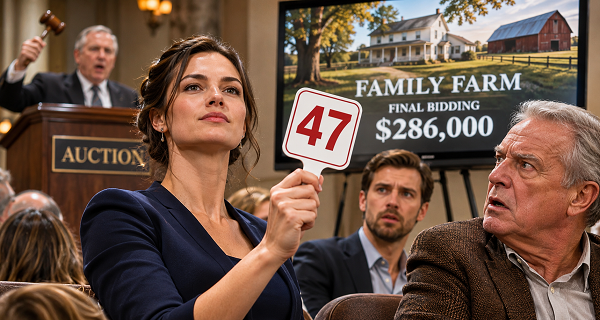
A developer had offered him $286,000.
Richard accepted immediately.
What made the situation even worse was that he blamed me for everything.
He claimed Daniel had changed after marrying me. According to him, his son had abandoned his responsibilities because he had fallen in love with a woman who preferred comfortable houses, shopping centers, and city restaurants.
The truth was very different.
I had never asked Daniel to leave the farm. In fact, I had spent our first three years of marriage helping him restore the old farmhouse, organize the property records, and repair the equipment whenever we could afford the materials.
I loved that place.
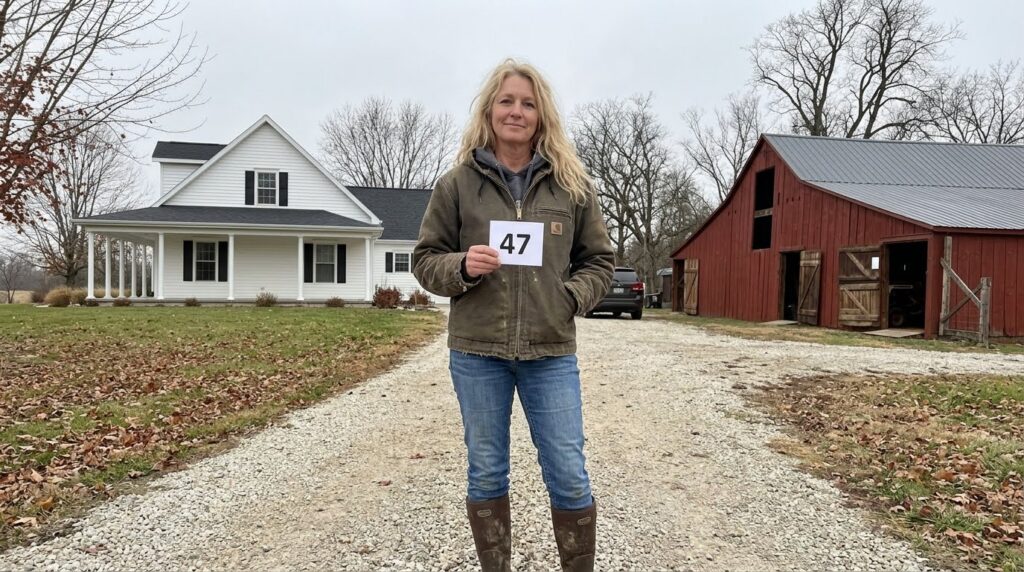
I loved the enormous oak tree beside the driveway, the smell of fresh hay in the mornings, and the little wooden porch where Daniel and I used to drink coffee before starting our day.
But Richard never saw any of that.
To him, I was an outsider.
And when he finally signed the sale agreement, he made sure I understood that I had no place in his family’s future.
Daniel and I drove home in silence that afternoon.
He kept both hands on the steering wheel, his jaw tight.
Finally, I asked him, “Are you going to say something?”
“About what?”
“About your father blaming me for selling the farm.”
Daniel sighed.
“He’s upset. It’s his property. He can do whatever he wants.”
I turned toward the window.
That was the moment I realized something important. Daniel wasn’t going to fight his father. He wasn’t going to demand an explanation. And he certainly wasn’t going to ask Richard to reconsider.
So I stopped expecting him to.
Instead, I made a decision.
If Richard wanted to sell the farm, I would let him.
But I wasn’t going to spend the rest of my life watching the place disappear.
Over the next four years, I worked harder than I ever had before. I took additional shifts at my accounting job, started doing bookkeeping for small businesses on weekends, and stopped spending money on almost everything that wasn’t essential.
Daniel knew I was saving, but he never asked how much.
I opened a separate savings account and kept every document carefully organized. Whenever someone asked why I was working so much, I simply said I was planning for our future.
Nobody knew what I was actually preparing for.
Not even Richard.
During those four years, the developer who purchased the property ran into financial difficulties. The company had planned to build luxury homes and commercial buildings, but rising construction costs and several legal disputes forced it to abandon the project.
Eventually, the land was put back on the market.
When I received the auction announcement, I read it three times.
The family farm was being sold again.
This time, I wasn’t going to let it slip away.
I contacted the auction office, reviewed the property records, arranged financing, and calculated exactly how much I could afford to bid.
The morning of the auction, I arrived early.
I wore a simple navy-blue dress, carried a folder containing my financial documents, and held a small white bidder card.
Number 47.
I sat near the back of the room and waited.
Then I noticed Richard.
He was sitting near the front with Daniel’s older brother, Michael. They hadn’t recognized me immediately.
When Richard finally turned around and saw me, his expression changed.
“What are you doing here?” he whispered.
I smiled politely.
“Buying something.”
He laughed.
“You can’t be serious.”
I didn’t answer.
The auctioneer stepped forward and announced the opening bid.
The bidding started at $180,000.
A representative from a property investment company immediately raised his card.
Another bidder offered $195,000.
The numbers climbed quickly.
$210,000.
$225,000.
$240,000.
I remained still.
Richard began whispering to Michael, clearly convinced that the investment company would win.
Then the auctioneer announced $260,000.
I raised my card.
“Two hundred and sixty-five thousand.”
Several people turned toward me.
The investment representative responded with $270,000.
I raised my card again.
“Two hundred and seventy-five thousand.”
Richard slowly turned around.
His face had gone pale.
The next bid came almost immediately.
“Two hundred and eighty thousand.”
I took a breath.
Then I lifted bidder card number 47.
“Two hundred and eighty-six thousand.”
The room became unusually quiet.
The investment representative studied his paperwork, spoke briefly with his colleague, and shook his head.
The auctioneer looked around.
“Do I have any further offers?”
Silence.
“Going once.”
Richard was now staring directly at me.
“Going twice.”
Daniel had entered the room without my noticing. He stood beside the doorway, looking from his father to me.
“Sold!”
The auctioneer’s hammer struck the wooden desk.
I had just purchased the farm.
And Richard finally understood that the woman he had spent four years dismissing had accomplished something he never thought possible.
But the biggest surprise was still waiting for him.
Because when the auctioneer handed me the preliminary paperwork, I turned toward Daniel and said quietly:
“There’s something you need to know about the money I used to buy this place.”
His expression changed.
And for the first time in four years, Richard didn’t have a single thing to say.