 By Admin
“Rick, take your hand off him. Now,” Tom Callahan said.
He never raised his voice. The security guard immediately removed his hand from his belt, and the busy bank lobby suddenly fell silent. A moment earlier, there had been the usual sounds of customers talking, footsteps crossing the floor, and the coffee machine hissing in the corner. Now, even the ticking of the wall clock seemed unusually loud.
Tom glanced at the muddy footprints on the gray carpet, then at my grandfather’s worn boots. Finally, he turned toward the young teller. Her nameplate read Brittany. As Tom looked at her, I watched the color drain from her face.
“Do you have any idea who this gentleman is?” he asked.
“He… he told me his name is Earl Doyle,” she stammered.
“Earl Doyle,” Tom repeated, “signed the guarantee that made it possible for this bank to open its second branch in 1974. He offered his own land as security when the board members refused to take the risk. Without his signature, there would be no second branch, no office upstairs, and certainly no corner office for me.”
He paused before adding quietly, “There might not even be a bank for us to work in today.”
A woman standing near the back of the line, the same woman who had laughed at my grandfather earlier, suddenly became very interested in her purse. A moment later, she turned around and walked straight out of the building without saying a word.
My name is Casey Doyle. I’m twenty years old, studying agronomy as a sophomore at Iowa State University. Every October, I return home to help with the harvest. I’ve been doing it since I was nine, and honestly, there is nowhere else I would rather be.
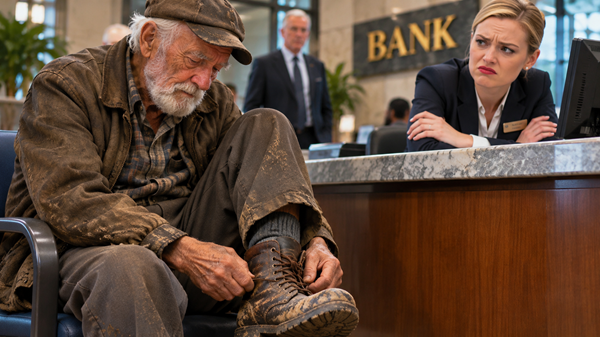
My grandfather is Earl Doyle. He is eighty-four years old and owns a 640-acre farm just outside Marlow, Iowa. He grows corn and soybeans on the same land his father first began cultivating in 1936.
Grandpa is only five-foot-eight, but he is built solidly, like one of the fence posts surrounding his fields. His hands are enormous, his face deeply weathered by decades of sun and wind, and his clothes are almost always the same: denim overalls, a cap from the local feed store, and a pair of old work boots he keeps repairing instead of replacing.
In the past forty years, he has attended only three weddings. He left two of them before the celebrations were over.
My grandmother, Ruth, passed away six years ago. Since then, it has mostly been Grandpa and me sharing the kitchen table at five every morning. He drinks his black coffee while I finish whatever is left in the pot. We listen to the farm report on an old radio that has been around longer than my father.
That Tuesday, we had a problem with the combine. A belt had broken, but it wasn’t a simple repair. The rubber had twisted around the pulley, leaving several parts bent and damaged. We needed a special replacement part from a dealer in Ames.
The dealer had one unusual rule: special-order parts had to be paid for in cash. Apparently, he had been doing that since 2019.
“It’s cheaper that way,” Grandpa explained. “He doesn’t have to pay the card companies, and I don’t have to listen to him complain about it.”
The part would cost two thousand dollars.
So we climbed into the old Ford pickup and headed into town. There was mud covering nearly every inch of the truck, right up to the door handles.
Grandpa hadn’t changed his clothes.
He never changes clothes just because he has somewhere to go.
I hadn’t visited the bank in several years. The last time I remembered it, the building was small and made of brick. The floor was covered with cracked linoleum, and every teller window had a little bowl of candy sitting beside it.
That bank was gone.
In its place stood a modern building with glass entrance doors, a coffee station, and a large poster showing a smiling couple sailing on a beautiful blue lake. Behind the long white counter, the tellers sat in a neat row.
Brittany was new to the job. She looked about twenty-five. Her fingernails were perfectly manicured, and several little decorative charms hung from the lanyard around her neck.
I later learned that she had previously worked at a call center in Des Moines and had only been working inside the bank for eleven days.
You already know what happened next.
She looked at Grandpa’s muddy boots. She examined his identification as though she suspected it was counterfeit. Then she told him that people in his circumstances would probably find the ATM more convenient.
Someone behind us laughed.
I wish I could say I handled the situation calmly.
I didn’t.
“He’s asking to withdraw his own money,” I told her.
My voice cracked slightly when I said the word “own.”
Instead of helping us, Brittany picked up the telephone and called security.
Grandpa stood quietly, holding his cap in both hands.
I had seen him stand like that at funerals. I had seen him stand that way after a hailstorm destroyed forty acres of his soybean crop.
It wasn’t a sign of weakness.
It was simply how he behaved when he decided to give another person the opportunity to finish speaking.
Then Tom Callahan appeared.
As I mentioned earlier, he was moving so quickly across the lobby that he was almost running. He was a tall man wearing a gray three-piece suit, a neatly folded pocket square, and the slightly stooped posture of someone who had spent years listening carefully to other people’s problems.
I had known Tom for as long as I could remember. When I was five, he used to give me lollipops at that very same counter.
He stopped in front of Grandpa and warmly took his hand between both of his.
“Earl! My goodness. I’m so sorry.”
“Morning, Tom,” Grandpa replied.
“Why didn’t you call me? I would have come straight to your house.”
“Didn’t seem like something that required a house visit.” Grandpa nodded toward Brittany. “I just came in to get two thousand dollars for a combine part.”
Tom’s expression changed. His jaw tightened.
He turned toward the teller. When he spoke, his voice was calm and controlled. It was the voice of someone who had made difficult decisions before and never enjoyed making them.
“Brittany, would you please come around from behind the counter?”
She obeyed.
Standing on the gray carpet, she clasped her hands together. The little charms hanging from her lanyard trembled slightly.
“I didn’t know,” she whispered.
“That’s exactly the problem,” Tom answered. “You didn’t know who he was, so you decided what kind of person he must be by looking at his boots. Then you called security.”
“He was… I thought maybe… because of the mud and the cash…”
“It’s his money, Brittany.”
She visibly flinched.
Tom took a breath.
“I want to ask you something, and I need you to answer honestly. If a gentleman wearing an expensive suit had walked up to your window and requested two thousand dollars, what would you have done?”
Brittany opened her mouth, but no words came out.
She looked down.
“I would have asked him how he wanted it,” she finally said in a barely audible voice.
“Exactly.”
“I’m sorry,” she whispered.
“Don’t apologize to me.”
She slowly turned toward my grandfather. It seemed to take her an eternity. Standing in front of an elderly farmer wearing a feed-store cap and faded overalls, she struggled to find the right words.
“Mr. Doyle, I’m truly sorry. I was disrespectful. I judged you without knowing anything about you, and I had no right to do that. I’m very sorry.”
Grandpa looked at her for several seconds.
His eyes are a pale shade of blue, almost gray, like the sky above a harvested field in winter.
“How long have you been working here, young lady?” he asked.
“Eleven days.”
“And where did you work before this?”
“At an insurance call center.”
“And before that?”
“I grew up in Waterloo. My mother cleaned office buildings.”
Grandpa slowly nodded.
“Then you’ve probably experienced what it feels like when someone looks down on you.”
Her expression crumbled.
“Yes, sir.”
“I thought so.”
He turned his cap over in his hands before continuing.
“I’m not going to pretend what happened was acceptable. It wasn’t. But my wife used to say something I never forgot. ‘Everybody gets a chance to make a mistake. What matters is whether they decide to close the door on that mistake or learn to do better.’”
Brittany covered her mouth with her fingers. Tears began rolling down her cheeks.
“I want to make it right,” she whispered.
“Then start doing that.”
I want to tell you what Tom did next, because that part has stayed with me more than anything else that happened that morning.
He didn’t fire Brittany.
He could have. Most people in that lobby probably expected him to. I certainly did.
An employee had humiliated an eighty-four-year-old man in front of his grandson, treated him like a criminal, and called security simply because of the way he looked.
Firing her would have been an easy decision.
But Tom chose another path.
“Brittany, take the rest of the morning off. Go home and get some rest. I want you in my office at eight tomorrow morning.”
“Mr. Callahan, does that mean I’m…”
“We’ll talk tomorrow.”
She nodded. Her face was still pale. She collected her purse from underneath the counter and walked through the glass doors, moving carefully as though the ground beneath her might suddenly shift.
Tom returned to Grandpa and gently placed a hand on his shoulder.
“Earl, please come into my office. I’d like to make you a proper cup of coffee.”
“I’d like to get my two thousand dollars first.”
“Of course.”
Tom turned toward the young man working at the next window.
“Daniel, could you prepare two thousand dollars for Mr. Doyle? And please bring me his account records. I’d like to look through them.”
“Yes, Mr. Callahan.”
Grandpa looked puzzled.
“What do you need my account records for?”
“Because there’s something I’ve wanted to show you for a very long time,” Tom answered. “I’ve just never found the courage to do it.”
Tom’s corner office looked almost exactly as it had years earlier.
There was the same oak desk, the same green banker’s lamp, and the same black-and-white photograph hanging on the wall.
The photograph showed a group of twelve men wearing suits and hats. They were standing outside a brick building with a hand-painted sign that read:
Marlow Farmers & Merchants Bank — Established 1952.
I had seen that picture countless times.
But I had never paid attention to the man standing in the second row. He was small and thin, wearing a worn work jacket and holding his hat against his chest.
“That’s you, Grandpa,” I said.
He glanced toward the photograph.
“I was thirty-one then.”
“You’re in the founders’ picture!”
“I was just a customer. They probably wanted somebody standing there when the sun was shining.”
Tom handed him a cup of coffee in a real ceramic mug.
“It’s a long story, Casey,” Grandpa said. “Nothing important.”
“It is important,” Tom interrupted. His voice began to shake. “Earl, it’s the reason I’m sitting in this office today.”
What happened next is the story Tom told us that morning, while the winter sunlight slowly spread across his oak desk.
Back in 1973, the Marlow Farmers & Merchants Bank was close to collapse.
The town had already lost its cannery. Two grain elevators had shut down, and the bank was struggling to survive with only one branch, one vault, and a board of five men who refused to accept that their business might be coming to an end.
They kept hoping that things would somehow improve.
Tom’s father, Walter Callahan, worked as a loan officer at the time. He often stayed late, sitting alone at his desk with the lights switched off, trying to make the numbers work.
No matter how many times he calculated them, they never added up.
The bank needed another branch in Dunmore, a small town eighteen miles to the east. A new highway was being built nearby, and the board believed the location could eventually become profitable.
But the state would not approve the new branch without a financial guarantee.
They needed collateral.
They needed someone who owned valuable land, had an excellent reputation, and was willing to put that land at risk.
The board approached six local farmers.
Five refused.
Then they approached my grandfather.
“Your grandfather was only twenty-nine years old,” Tom explained. “He had a baby on the way and still owed money on his family farm. He had absolutely no obligation to help us. He barely knew my father.”
One Sunday, Grandpa came to the bank wearing that same old work jacket. He sat with Walter in the kitchen for nearly three hours.
When their conversation was over, he said something Walter never forgot.
“Walt, I don’t understand much about running a bank. But I know one thing. A town that doesn’t have a bank is usually a town where people eventually stop staying.”
Grandpa offered the northern quarter of his property as collateral.
One hundred and sixty acres.
It was the land he owned outright.
If the new branch failed, he could have lost everything he had worked to build.
And he had a baby on the way.
“He never told anyone about the risk he was taking,” Tom continued. “He simply signed the papers and went home.”
Grandpa stared into his coffee.
“It wasn’t anything special,” he quietly said.
Tom shook his head.
“It was one of the most important things anyone ever did for this bank. The Dunmore branch opened in March 1974. By 1976, it was already making a profit. By 1980, it had become the strongest part of the entire institution.”
He spread his hands across the desk.
“My father became president because of what happened there. I grew up in this building. The profits helped fund my college education. Almost everything I’ve been able to accomplish started with that one signature your grandfather gave us on a Sunday afternoon.”
Grandpa looked at Tom.
“You would have done the same thing.”
Tom’s eyes filled with tears.
“I honestly don’t know if I would have, Earl. I’ve thought about it many times. And for forty-nine years, I’ve wanted to thank you properly. But every time I tried, you changed the subject.”
I turned toward my grandfather.
I had spent my entire life with him, yet I had never heard this story.
I knew him as a farmer who understood the weather, the soil, and the machinery better than anyone. I knew him as a man who repaired fences during thunderstorms and refused to buy a newer truck because the old one still worked.
He wasn’t someone who said “I love you” very often.
Instead, he left the porch light on until I came home.
“Why didn’t you ever tell me about this?” I asked.
He gave a small shrug.
“There’s not much of a story to tell. It was simply the right thing to do.”
“But you could have lost the farm.”
“I put one quarter-section at risk. I still had six.”
“Grandpa…”
“Casey,” he said, setting down his mug. “My father once told me something. He said, ‘A man who keeps a record of everything he gives is running a business, not living a life.’”
A faint smile appeared on his face.
“I never wanted to live that way.”
Tom made a sound that was somewhere between a laugh and a sob. He walked over to the wall and stood in front of the old photograph.
“My father hung this picture the day you signed those papers,” he explained. “He insisted you be included. I always wondered why you were standing in the second row instead of the front.”
He paused.
“Dad told me you had stepped back because you didn’t want attention. He said he’d never met another man who was so uncomfortable receiving credit for doing something good.”
Grandpa looked at him.
“I had hay to bring in.”
Tom laughed through his tears.
“Yes, Earl. You had hay to bring in.”
Then he carefully removed the photograph from the wall and turned it around.
Written on the back, in faded blue ink, was a short message in Walter Callahan’s handwriting.
Tom had never shown it to anyone.
He handed the frame to Grandpa.
Grandpa held it at arm’s length, squinted at the writing, and reached into the pocket of his overalls for his reading glasses.
He studied the message for a long time.
Then he passed it to me.
It read:
“Earl Doyle is one of the reasons this bank exists. If anyone ever treats him as though he is less important than the man who founded it, I hope whoever runs this place remembers who truly helped build it.”
— W.C.
Ten minutes later, we returned to the lobby.
The bank employees had gathered there at Tom’s request. Eleven tellers, loan officers, and clerks stood in a loose semicircle on the gray carpet.
Some wore formal jackets, while others had cardigans. Rick, the security guard, stood at one end of the group. He was a broad man with a gray mustache, and he was holding his cap in both hands.
Grandpa had initially refused to take part.
“Tom, there’s no need to turn this into some big ceremony,” he had said.
Tom answered, “Earl, this isn’t about making you feel important. It’s about making sure everyone else understands something.”
So there we stood.
My grandfather in his work overalls, me in my college sweatshirt, and the bank president standing in front of a group of employees who had never heard the story of the man who helped save their institution.
Tom told them everything.
He didn’t exaggerate or try to make the story sound more dramatic than it was. He simply explained what Grandpa had done and what it had meant to the bank.
When he mentioned the 160 acres, one of the younger loan officers covered her mouth in surprise.
“This gentleman walked into our bank this morning wearing the same kind of clothes he wears when he works on his farm,” Tom said. “And one of our employees treated him as though he had no business being here.”
He paused and looked around the room.
“I want every one of you to think about that.”
Nobody spoke.
“This isn’t about Earl being a founder. It isn’t about his age, and it isn’t about the fact that he’s my friend. It’s about something much simpler.”
He looked at each employee.
“Every person who comes through those doors is important to somebody. Someone’s grandfather. Someone’s mother. Someone who has spent sixty-one years working honestly, or perhaps only sixty-one days trying to build a better life.”
He turned toward Rick.
“We have no idea what people have done, what they have sacrificed, or what they are carrying with them when they walk into this building. So from now on, I want us to remember one thing: every customer deserves to be treated with the same respect we would show Earl Doyle.”
Rick cleared his throat and shifted his weight.
Then he spoke, his voice rough with embarrassment.
“Mr. Doyle, I’m sorry. I put my hand on my belt when I came over. I shouldn’t have done that.”
Grandpa looked at him.
“You were doing your job.”
“I wasn’t doing it the right way.”
“Maybe not,” Grandpa replied. “But you stopped when Tom asked you to. That counts for something.”
Rick’s mustache moved slightly as he nodded.
Then he stepped back.
Something unexpected happened to me at that moment.
For nearly an hour, I had been carrying my anger around like a burning coal. I had imagined all the things I wanted to say to Brittany, to Tom, and to anyone who had witnessed what happened.
I had even been thinking about writing a terrible review of the bank.
But as I looked around at those eleven employees, I felt the anger slowly disappear.
They weren’t monsters.
They were ordinary people who had forgotten how important it was to really see another human being.
I thought about Brittany leaving the building with her pale face and trembling hands. I thought about her mother, who had cleaned offices. I thought about how easily people judge others and how quickly the same thing can happen to any one of us.
And I wondered how often people make mistakes without ever getting the chance to understand what those mistakes mean.
“Grandpa,” I whispered.
“Hmm?”
“Can I ask you something?”
He nodded.
“Are you angry?”
He thought about it for a moment, as though the question itself was something he hadn’t considered.
“No,” he said. “I’m a little tired, but I’m not angry.”
“Why aren’t you angry?”
He smiled.
“I’ve had people look down on me who were much better at it than that young lady. And I’ve had people look up to me who were much worse.”
Then he gave a quiet laugh.
Brittany returned to the bank the following morning at eight o’clock.
I wasn’t there, but Tom told me what happened. Brittany later filled in the rest of the story.
She had barely slept.
During the night, she had practiced what she would say. First, she rehearsed resigning. Then she practiced apologizing. After that, she tried to prepare a defense of her actions.
She went over all three possibilities again and again.
When she arrived, she wore a simple gray blouse. Her colorful lanyard was gone, and her carefully manicured nails had been bitten down.
She sat across from Tom’s desk beneath the soft light of the green banker’s lamp.
“I’d like to resign,” she said. “Before you have to ask me to.”
Tom looked at her.
“I’m not going to ask you to resign.”
She blinked in surprise.
“I’m sorry?”
“Brittany, I’ve been running this bank for twenty-two years. During that time, I’ve had to let seventeen employees go. Not once did I enjoy doing it.”
He folded his hands on the desk.
“I’m not going to dismiss you simply because you’re young, frightened, and made a serious mistake. If I did that, I’d be punishing someone for being human. And I would probably have to fire myself, too.”
She stared at him.
“I want to ask you something,” Tom continued. “And I need you to tell me the truth.”
“Yes, sir.”
“Why did you call security?”
She remained silent for a long time.
The only sound in the office was the faint humming of the lamp.
“Because I was scared,” she finally admitted. “I was afraid of making a mistake. The amount of money, the identification, the way he looked… I’d been trained to follow a checklist.”
She struggled to continue.
“When I saw an older man covered in dirt asking for that much cash, all the warning signs I had memorized started going off in my head. I panicked.”
Her voice began to shake.
“Then I made that comment about the ATM. I don’t even know why I said it. I think I wanted to sound as though I belonged here.”
Tom leaned back slightly.
“Belonged where?”
“Here. In a bank. Wearing a nice blouse and working behind a counter.”
She wiped her eyes.
“I grew up in a trailer, Mr. Callahan. My mother spent years cleaning floors at an insurance company. I got this job because I learned how to smile even when I was nervous.”
She paused.
“When I looked at Mr. Doyle in those boots, I thought about my mother. And I hated that I thought about her that way. I hated what was going through my mind.”
Tom didn’t interrupt.
“So I treated him in the exact way I would never want anyone to treat her,” Brittany whispered. “I judged him before I even gave him a chance.”
I won’t pretend everything was suddenly fixed.
Tom didn’t immediately forgive her, hand her a promotion, or tell her to forget what happened.
Instead, he placed her