 By Admin
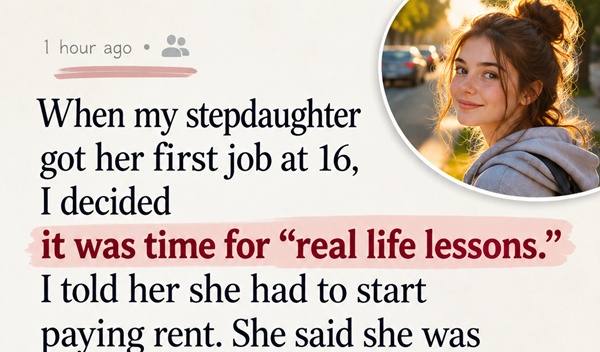
Even years later, there are nights when I wake up remembering the look on my sixteen-year-old stepdaughter’s face when I told her she could either start paying rent or find somewhere else to live.
At the time, I convinced myself I was doing the right thing.
I thought I was preparing her for adulthood. I thought she needed to understand that money didn’t grow on trees and that every privilege came with responsibilities.
I told myself I was being a responsible parent.
The truth was much harder to accept.
I was an exhausted woman who had allowed financial stress and personal frustration to turn her into someone her own stepdaughter no longer felt safe around.
And it took three months of silence, a handful of crumpled banknotes, and one heartbreaking conversation at my front door to make me understand what I had done.
My stepdaughter’s name was Emily.
She was sixteen when she got her first job at a small grocery store about fifteen minutes from our house.
I still remember the afternoon she came home with her first paycheck.
She burst through the front door, dropped her backpack beside the stairs, and hurried into the kitchen, where I was sorting through a pile of bills.
“Guess what!” she announced.
I looked up.
“What happened?”
“I got paid!”
She held up the envelope as if it contained a million dollars.
I smiled despite myself.
“Congratulations, sweetheart.”
She pulled out the money and counted it twice, her excitement growing with every bill.
It wasn’t much. After taxes, she had earned enough to cover a few small expenses and put something aside.
But to Emily, it represented something enormous.
It was the beginning of a future she could build with her own hands.
“I’m going to save almost all of it,” she explained. “I want to have enough money to move out when I turn eighteen.”
I remember those words clearly.
Not because they were disrespectful.
Not because she was demanding anything.
But because something about her growing independence made me uncomfortable.
At the time, I didn’t understand why.
I had been married to her father, David, for nearly six years. Emily had been ten when I entered her life. She was quiet around me at first, but over the years, we had developed a relationship that I believed was becoming stronger.
I attended her school events when I could. I bought her birthday presents, helped with homework, and occasionally stayed up late listening to her talk about her friends.
We weren’t perfect, but I thought we were doing well.
Then she started growing up.
She became more private about her life. She spent more time planning for college, researching apartments, and talking about what she wanted to do after high school.
She no longer asked for my opinion about every little decision.
And instead of recognizing those changes as normal, I began interpreting them as rejection.
I thought she was pulling away from me.
I thought she no longer appreciated what David and I provided.
I never said those things aloud, but the feelings were there.
At the same time, our financial situation was getting worse.
David worked long shifts at a warehouse. Some evenings, he came home so tired that he barely managed to eat before falling asleep on the couch.
I worked at a medical office, where I spent my days answering phones, scheduling appointments, and dealing with demanding patients.
When I got home, there were still groceries to buy, laundry to wash, meals to prepare, and bills waiting on the kitchen counter.
Our mortgage payment had increased.
The car needed repairs.
The electricity bill seemed to climb every month.
Every time I thought we had finally caught up, another expense appeared.
I was exhausted, and I was frightened that we would eventually fall behind.
But I didn’t know how to admit that I was struggling.
Instead of talking honestly with David about the pressure I was under, I carried it around until even small things irritated me.
And whenever Emily mentioned saving money to move out, I found myself thinking about everything we were paying for her.
Her meals.
Her clothes.
The electricity she used.
The roof over her head.
I began keeping a mental record of every expense.
It wasn’t fair, but at the time, I convinced myself that my frustration was justified.
One Thursday evening, everything finally spilled over.
David was working late, and Emily and I were having dinner together.
She had spent most of the meal talking about her job.
Her manager had offered her an extra shift on Saturday, and she was excited because the additional hours would help her savings grow faster.
“I’ve almost reached nine hundred dollars,” she told me proudly. “If I keep working during the summer, I might have several thousand saved by graduation.”
I nodded without really listening.
My attention was on the stack of unpaid bills beside the refrigerator.
The water bill was overdue.
Our car insurance payment was coming up.
And I had spent most of the afternoon trying to work out which expenses could wait another week.
Emily continued talking about her plans.
She wanted to find a small apartment after graduation, preferably near a college she hoped to attend.
She had even started looking into transportation costs.
“I don’t want to depend on Dad for everything,” she said. “I want to be ready when I’m eighteen.”
Something inside me snapped.
I put down my fork.
“Emily, don’t you think it’s time you started contributing to this household?”
She stopped talking.
“What do you mean?”
“You have a job now. You’re earning money. You should understand that living somewhere costs money.”
She looked at me as if she hadn’t understood the question.
“Are you talking about paying rent?”
“Yes.”
Her expression changed immediately.
“But I’m sixteen.”
“I know exactly how old you are.”
“Then why are you asking me to pay rent?”
I should have taken a breath.
I should have explained that I was worried about money and needed help figuring out our finances.
I should have remembered that she was a teenager who had only recently started working.
Instead, I allowed my frustration to speak for me.
“Because this household doesn’t run itself. Your father works himself to exhaustion, and I’m the one worrying about every bill. You have money coming in now, so it’s reasonable that you contribute.”
Emily put down her fork.
“I can help buy groceries sometimes,” she offered. “But I don’t earn that much. I’m trying to save for college and an apartment.”
I heard her words as an argument rather than an attempt to find a compromise.
“So you expect us to pay for everything while you keep all your money for yourself?”
Her face fell.
“That’s not what I said.”
“Then what are you saying?”
“I’m saying I want to save enough money so I won’t have to ask anyone for help when I’m older.”
There was nothing wrong with that answer.
I know that now.
But at the time, I felt as if she were telling me she wanted to leave our family behind.
I pushed my chair away from the table.
“Well, you can’t have it both ways.”
Emily stared at me.
“What does that mean?”
“It means this isn’t a free hotel. If you’re old enough to work, you’re old enough to contribute. This isn’t a shelter, Emily. You either pay rent or you leave.”
The words came out cold and sharp.
For a moment, neither of us moved.
Emily’s eyes searched my face, as if she were waiting for me to smile and admit I was joking.
I didn’t.
She swallowed.
“Are you serious?”
That was my chance.
One simple apology could have changed everything.
I could have sat back down and told her that I was worried about money, that I had spoken out of anger, and that I never intended to make her feel unwelcome.
Instead, pride took over.
“You’re old enough to have a job. You’re old enough to learn that life isn’t free.”
Emily looked down at her plate.
Then she nodded once.
“Okay.”
She stood, carried her dishes to the sink, and walked upstairs.
I heard her bedroom door close.
I sat alone at the table, staring at the food neither of us had finished.
For a few minutes, I felt victorious.
I told myself that I had finally made my point.
I assumed she would complain to David, we would have an argument, and eventually everyone would calm down.
I never imagined that she would take my words literally.
When David came home that night, I told him Emily and I had disagreed about money.
I deliberately left out the worst part.
I didn’t tell him I had threatened to make her leave.
I told myself I would explain everything in the morning if it became necessary.
That was my first real act of cowardice.
The next morning, Emily’s bedroom was empty.
Her bed was made.
Her schoolbooks were still stacked on the desk.
But several drawers stood open, and half her clothes were gone.
Her gray hoodie, the one she wore almost every weekend, had disappeared.
So had her backpack, her toiletries, and the small notebook where she recorded every dollar she saved.
At first, I assumed she had left early for school.
Then I noticed the envelope on her desk.
Inside was a short handwritten note.
Six words.
“I won’t be a burden anymore.”
My stomach dropped.
I called her immediately.
No answer.
I called again.
Nothing.
Then I sent a message asking where she was.
She didn’t respond.
By the time David came downstairs and saw the note, I was pacing through the kitchen with my phone in my hand.
He read it once.
Then again.
“What happened?”
I tried to explain that Emily had been upset about a disagreement.
He looked at me.
“What did you say to her?”
I hesitated.
That hesitation told him more than my explanation ever could.
“Tell me exactly what happened.”
So I did.
I told him about the dinner, the money, and the argument.
Finally, I repeated the words I had used.
“This isn’t a shelter. Pay rent or leave.”
David stared at me.
For several seconds, he didn’t speak.
Then he asked a question that made my face burn.
“You told my sixteen-year-old daughter she had to pay rent or leave her home?”
“I didn’t think she’d actually go!”
His expression hardened.
“Then why would you say it?”
“I was stressed. We have so many bills, and I thought she needed to understand—”
“Understand what? That she isn’t welcome here unless she pays us?”
“That’s not what I meant.”
“Maybe it isn’t what you meant. But it’s what you told her.”
I had no answer.
David grabbed his phone and began calling Emily.
He called her repeatedly.
He sent messages telling her he loved her and wanted her to come home.
She didn’t answer.
We contacted her closest friends.
We reached out to the school.
As the hours passed, our fear grew.
We eventually contacted the police because we didn’t know where she was and needed to make sure she was safe.
That evening, we received confirmation that Emily was staying with a friend’s family.
She had a place to sleep.
She was safe.
She was still attending school.
Relief washed over me, followed immediately by shame.
Emily had left her own home because she believed she was no longer wanted there.
David drove to her friend’s house that night.
He returned several hours later, looking older than he had that morning.
“She’s not coming back yet,” he told me.
I stood up.
“What did she say?”
He rubbed his face.
“She said she needs time.”
“But you explained that she doesn’t have to pay rent, didn’t you?”
“Yes.”
“Then why won’t she come home?”
David looked at me for a long moment.
“Because she doesn’t believe you want her here.”
I felt those words like a blow to the chest.
He told me that when he had asked Emily why she wouldn’t return, she had started crying.
Then she had said something he couldn’t forget.
“I don’t want to live somewhere I’m not wanted.”
I sat down.
I wanted to argue that I had never meant to make her feel that way.
But what difference would that make?
She had heard my words.
She had believed them.
And she had acted on them.
Over the following weeks, David tried to maintain contact with her.
Sometimes she answered his messages.
Sometimes she agreed to meet him for lunch.
But whenever he mentioned returning home, she became quiet.
I sent apologies, too.
At first, they were terrible apologies.
I wrote that I had been overwhelmed.
I explained how difficult the bills had become.
I said I had spoken without thinking.
I even told her that she knew how much I cared about her.
She didn’t respond.
Eventually, David sat beside me in the living room and said something I desperately needed to hear.
“Stop explaining why you did it. Start acknowledging what you did to her.”
I wanted to defend myself.
I wanted him to understand that I hadn’t intended for any of this to happen.
But I was beginning to realize that my intentions weren’t the only thing that mattered.
So I wrote Emily another message.
This time, I didn’t mention money.
I didn’t mention stress.
I didn’t ask her to forgive me.
I wrote:
“Emily, I was wrong. You were sixteen, and you deserved to feel safe in your own home. I had no right to threaten that security. You were trying to plan for your future, and I made you feel ashamed of it. I’m sorry.”
She read the message.
I knew because the status changed.
But she didn’t reply.
Two weeks passed.
Then a month.
Emily continued going to school and working at the grocery store.
David saw her when she agreed to meet him.
He brought her things she needed and made sure she had enough to eat.
Eventually, we learned that she had moved out of her friend’s house and was renting a small room with two older girls.
She paid for it with the money she earned from her job.
When David told me, I felt physically sick.
She was sixteen.
She should have been worrying about homework, friendships, and what she wanted to do after graduation.
Instead, she was trying to calculate whether her next paycheck would cover her room, transportation, and food.
I had wanted her to learn responsibility.
But I had confused responsibility with punishment.
And now she was carrying a burden I had helped create.
Our house felt painfully empty without her.
I missed the ordinary sounds I had once complained about.
Her music playing upstairs.
The front door opening when she came home from school.
Her footsteps in the hallway.
The occasional late-night trip to the kitchen when she wanted cereal or toast.
I even missed finding her mugs beside the sink.
Those little things had seemed insignificant when she was living with us.
Now they felt like pieces of a life I had damaged.
David and I argued more than we ever had before.
He was angry with me.
Sometimes he said things that hurt.
But I knew that beneath his anger was fear for his daughter and disappointment in the person he had trusted to help raise her.
I couldn’t blame him.
I had told myself I was teaching Emily to become independent.
Instead, I had made her believe she needed to earn her place in our family.
Almost three months passed.
Then, one rainy evening, someone knocked on our front door.
It was a little after ten.
David was working a late shift, and I was sitting on the couch, pretending to watch television while my mind wandered back to Emily.
When I heard the knock, I assumed it was a neighbor.
I opened the door.
And froze.
Emily stood beneath the porch light.
Her hair was pulled into a loose, messy bun.
Her face looked tired, and her gray hoodie hung from her shoulders.
She was holding a worn envelope in both hands.
For a few seconds, we simply stared at each other.
I had imagined this moment dozens of times.
In some versions, she came home angry.
In others, she burst into tears and demanded an explanation.
Sometimes I imagined her forgiving me immediately, and sometimes I imagined her telling me she never wanted to see me again.
I had prepared speeches for every possibility.
But when she finally spoke, all those rehearsed words disappeared.
“Can I come inside?”
I stepped away from the door.
“Of course, sweetheart.”
She entered the hallway but kept her shoes on.
That small detail broke my heart.
She had once walked through this house without thinking, dropping her backpack by the stairs and heading straight to the kitchen.
Now she stood near the entrance like a stranger waiting to be told where she was allowed to sit.
She held out the envelope.
“I brought something.”
I looked at it.
“What is it?”
Her fingers tightened around the paper.
“The money.”
I didn’t understand.
“What money?”
“The rent.”
For a moment, I couldn’t speak.
Emily looked down at the envelope.
“I know it’s late. I wanted to bring it sooner, but I couldn’t afford to miss work, and I needed to pay for my room first.”
She swallowed.
“I have almost all of it now.”
She placed the envelope in my hands.
It was heavier than I expected.
Inside were small bills and folded notes, carefully arranged into stacks.
Ten-dollar bills.
Twenties.
Fives.
Even a few ones.
On top was a piece of notebook paper.
In her handwriting were three words.
Rent. Three months.
I felt the blood drain from my face.
“Emily…”
She immediately looked worried.
“Is something wrong?”
I stared at her.
She had come back to the house where she grew up carrying money she had earned by working long shifts after school.
She believed she owed us for the months she had been gone.
She had taken my cruel words so seriously that she had spent three months trying to prove she wasn’t a burden.
“Where did you get all this?” I asked, even though I already knew the answer.
She wiped her palms against her jeans.
“I worked extra shifts whenever they let me.”
Her voice was small.
“I stopped buying lunch at school. I walked to work when I could, even when it rained, because I wanted to save the bus fare.”
She glanced at the envelope.
“I know it’s not a lot compared with what everything costs. But I wanted to pay what I owed.”
My throat tightened.
“You don’t owe me anything.”
She looked confused.
“But you said I had to pay rent.”
“I know what I said.”
“Then why are you saying I don’t owe you?”
Because I was wrong.
Because I had allowed my frustration to become more important than your security.
Because you were a child, and I had made you feel as though you needed to buy your place in your own family.
But the words caught in my throat.
Emily’s eyes filled with tears.
“I really tried,” she whispered.
That was the moment I broke.
I placed the envelope on the hallway table and took a breath.
“Emily, listen to me. You don’t owe me rent. You never did.”
She stared at me.
“But you told me to leave.”
“I know.”
“You said this wasn’t a shelter.”
“I know.”
Her voice trembled.
“So what was I supposed to do?”
I had no answer that could repair what I had done.
She looked away and wiped her face.
“I wasn’t trying to be selfish when I said I wanted to move out at eighteen. I wasn’t trying to hurt you or Dad.”
“I know, sweetheart.”
“I just wanted to save enough money so I could go to college and get my own place someday.”
She paused.
“I thought you’d be proud of me.”
Those words cut deeper than any accusation could have.
Because I should have been proud.
She was sixteen years old, going to school, working part-time, and carefully planning for a future she wanted to build herself.
She hadn’t asked us to buy her an apartment.
She hadn’t demanded expensive clothes or endless spending money.
She had simply wanted to prepare for adulthood.
And I had responded by making her feel unwelcome.
I looked down at the envelope.
I imagined her counting those bills after a long shift.
I imagined her writing down every dollar in her little notebook.
I imagined her walking home in the rain because she thought she needed to save enough money to pay me.
And then I imagined her lying awake in someone else’s house, wondering whether she had anywhere she truly belonged.
I couldn’t hold back my tears.
“Emily, I’m so sorry.”
She didn’t move.
I continued, forcing myself not to make excuses.
“I was worried about our bills, and I was overwhelmed. But that wasn’t your fault. I should have talked to your father and worked through my problems like an adult.”
She stared at the floor.
“Instead, I took my frustration out on you.”
My voice cracked.
“You were trying to do something good for yourself. You were trying to become independent, and I made you feel like you were doing something wrong.”
A tear rolled down her cheek.
“I really thought you wanted me gone.”
I covered my mouth.
There it was.
The truth I had spent three months trying not to face.
She hadn’t left because she wanted to abandon us.
She had left because she believed she had no choice.
“I never wanted you gone,” I whispered. “But I made you believe that, and I’m responsible for it.”
She began crying harder.
“I didn’t know what else to do.”
I wanted to hug her immediately, but I stopped myself.
I had spent months deciding what I thought was best for her without listening to what she needed.
I wasn’t going to make that mistake again.
“Can I hug you?” I asked.
Emily hesitated.
Then she nodded.
I wrapped my arms around her.
For a moment, she stood stiffly.
Then she began sobbing against my shoulder.
I held her as she cried.
I didn’t tell her to calm down.
I didn’t explain myself.
I didn’t ask her to forgive me.
I simply stayed there, holding the girl I had hurt and wishing I could turn back time.
Eventually, her breathing slowed.
I stepped back and gently wiped a tear from her cheek.
“You can come home, Emily. You don’t have to pay us anything.”
She looked at me uncertainly.
“Are you sure?”
“Yes.”
“What if we argue again?”
“Then we talk about it. We don’t threaten to take away your home.”
She lowered her eyes.
I continued.
“And if you’re worried about money or your future, you can talk to us. You don’t have to handle everything alone.”
She looked at the envelope on the table.
“What should I do with this?”
“Keep it.”
“But—”
“Emily, that money belongs to you. You worked for it. You saved it. You earned every dollar.”
She stared at me for a long moment.
Then she whispered, “Thank you.”
When David arrived home, he found us sitting at the kitchen table.
Emily was drinking a cup of tea.
The envelope rested between us.
He stopped in the doorway.
For a moment, he looked as if he couldn’t believe what he was seeing.
“Emily?”
She turned toward him.
“Hi, Dad.”
He crossed the room and pulled her into his arms.
She began crying again.
David held her tightly, kissing the top of her head and telling her how much he had missed her.
I stepped aside and let them have their moment.
When they finally sat down, we talked for hours.
Emily told us about the nights she had slept on her friend’s couch.
She told us about the room she had rented afterward and how difficult it was to balance school, work, and living expenses.
She told us how embarrassed she had felt asking other people for help.
She had worried that her friends would think she was irresponsible.
She had worried that her teachers might find out.
Most of all, she had worried that returning home would mean admitting she had failed.
David listened with tears in his eyes.
I listened without interrupting.
For the first time, I understood that an apology wasn’t a magic sentence that erased the consequences of what you had done.
Emily needed more than words.
She needed to know that the people responsible for her care could be trusted again.
That night, I made her a promise.
She would never have to pay rent while she was a minor.
She would never have to wonder whether she had a place in our home.
And if we ever disagreed about money, chores, responsibilities, or future plans, we would discuss those things without threats or humiliation.
Emily didn’t immediately throw her arms around me and declare that everything was forgiven.
And I didn’t expect her to.
Trust is not rebuilt in a single evening.
Sometimes, the person who hurt you has to prove through ordinary, repeated actions that they have changed.
For the first few weeks after Emily returned, our relationship remained awkward.
She spent more time with David.
When she needed something, she often asked him instead of me.
Sometimes she seemed uncomfortable when I entered her room.
I accepted it.
I had no right to demand that she return to the way things had been before.
I had to earn her trust back.
So I started with small things.
I stopped making comments about the money she earned.
I asked about her day without turning every conversation into a lecture.
When she talked about college, I listened.
When she discussed moving out someday, I encouraged her to plan carefully instead of treating her independence as a personal rejection.
Slowly, the tension began to ease.
One evening, she came into the kitchen while I was preparing dinner.
“Can I ask you something?”
“Of course.”
“Would you help me practice for a job interview?”
I turned toward her.
“Absolutely.”
She smiled faintly.
It was a small moment.
But to me, it felt like the first brick being placed back into a wall I had helped tear down.
A few weeks later, she showed me her savings notebook.
The same notebook she had taken when she left.
The pages were filled with numbers, dates, and careful calculations.
She had begun saving again.
This time, I didn’t feel threatened by her plans.
I felt proud.
When Emily turned eighteen, David and I helped her compare college costs, transportation expenses, and rental options.
We talked about budgeting.
We discussed the importance of having emergency savings.
We helped her understand what living independently would actually cost.
But we never told her she had to leave.
And we never made her feel that staying was a debt she needed to repay.
When she eventually moved into a small apartment near her college, we helped her carry boxes upstairs.
She had saved enough money to cover her deposit, basic furniture, and the first few months of expenses.
She had worked hard for that independence.
And this time, I was genuinely happy for her.
As we finished unpacking, Emily disappeared into her bedroom.
She returned holding a small framed photograph.
It showed the three of us at a family gathering years earlier, before everything had become complicated.
“I thought you might want this,” she said.
I accepted it carefully.
“Thank you, sweetheart.”
She hesitated.
Then she hugged me.
It wasn’t a dramatic moment.
There was no speech.
No promise that we would never hurt each other again.
Just a hug.
But it was the first time in a long while that I felt she was choosing to be close to me rather than simply being polite.
I held her for a few seconds longer than usual.
When she pulled away, I smiled.
“I’m proud of you, Emily.”
She looked at me.
“Really?”
“More than you know.”
She smiled back.
And for the first time, I understood that supporting her independence didn’t mean losing her.
It meant giving her the confidence to build a life of her own while knowing she would always have people who cared about her.
Today, Emily is older, independent, and building a future she is proud of.
Our relationship has grown stronger, although I know that neither of us can erase what happened.
Sometimes, she visits on weekends.
We cook dinner together, talk about college, and laugh about ordinary things.
Occasionally, she tells me about a problem she’s facing and asks for my opinion.
When that happens, I remind myself to listen before offering advice.
I don’t always get everything right.
No parent does.
But I have learned that being a parent isn’t about winning every disagreement.
It isn’t about proving that you’re the authority in the house.
And it certainly isn’t about making a child feel indebted for the basic care and security they deserve.
Sometimes, the most important thing a parent can do is admit they were wrong.
I still have the envelope Emily brought to our door that night.
I kept the little piece of notebook paper she placed inside it.
Three words.
“Rent. Three months.”
I keep it in a drawer in my bedroom.
Not because I want to punish myself.
I keep it because I never want to forget how deeply my words affected someone who trusted me.
Whenever I see that note, I remember the girl standing beneath the porch light, holding the money she had worked so hard to save.
I remember how frightened she looked when she asked whether she could come inside.
And I remember the question she asked me when I tried to return the money.
“What was I supposed to do?”
I wish I could go back to that Thursday evening and answer her differently.
I wish I had put down my fork, taken a breath, and asked her what she needed instead of demanding what I thought she owed.
I wish I had recognized that her desire to leave home someday wasn’t a rejection of our family.
It was a sign that she was growing up.
But I can’t change that night.
All I can do is make sure the lesson stays with me.
Children don’t become responsible adults because we frighten them into independence.
They become responsible adults when we teach them how to manage money, make thoughtful decisions, ask for help when they need it, and take ownership of their choices.
And they become confident enough to face the world when they know they have somewhere safe to return.
Emily never needed to prove that she deserved a home.
She needed to know that she was loved, even when we disagreed.
I failed to give her that reassurance when she needed it most.
But she gave me an opportunity to learn from my mistake.
And I will always be grateful that she eventually felt safe enough to walk through our front door again.
If there’s one thing I hope other parents take from my story, it’s this: never use a child’s need for a home as a weapon during an argument. You may forget the words you say in anger, but a child might carry them for years.
Teach responsibility.
Encourage independence.
Set reasonable boundaries.
But never make a child believe that love and belonging are things they must earn.