 By Admin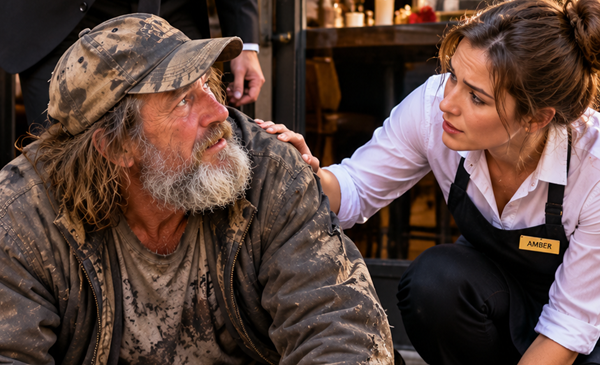
The moment I hit the sidewalk, I heard my restaurant manager laughing behind the glass door.
“Stay out,” Kyle Brenner shouted. “And don’t come back.”
My palms scraped against the concrete. My old jacket had torn at the shoulder, and my knee throbbed from the fall. People walked past without stopping. One woman pulled her dog away from me, while a man in an expensive suit stepped around me as though I were nothing more than a discarded bag.
But the pain wasn’t what bothered me.
What I had witnessed inside my own restaurant was far worse.
Through the glass, I had seen my hostess secretly swiping a customer’s credit card through a hidden device. And the look on Kyle’s face told me he knew exactly what she was doing.
That afternoon, I hadn’t come to fire anyone.
I had come to discover the truth about the restaurant I had spent eleven years building in my mother’s memory.
Instead, I uncovered a crime that had been hurting my customers for months.
My name is Frank Delgado. I’m fifty-two years old, and everything I believe about kindness, business, and human nature began with a little diner on Fulton Street.
The Promise I Made to My Mother
My mother, Rosalind Delgado, was known to everyone as Rosie. For thirty-eight years, she worked as a waitress at a modest neighborhood diner called the Blue Plate.
The place had eleven tables, a long counter, and a bell above the entrance that jingled whenever someone came through the door.
Rosie knew her customers by name. She remembered who liked extra cream in their coffee, whose children were struggling in school, and who had recently lost a loved one.
But there was one thing about my mother that mattered more than anything else.
She never let anyone leave hungry.
Sometimes a man would come in wearing a coat that had survived too many winters. He might have only a handful of coins, barely enough for a cup of coffee.
My mother would take his money and bring him soup, a grilled cheese sandwich, and something warm to drink.
If the bill came to more than he could afford, she’d quietly cover the difference with her tips.
When I was twelve, I asked her why she kept doing it.
“Frankie,” she said, looking me straight in the eyes, “I see somebody’s son when that man walks through the door. Somebody who once had a mother worrying about whether he’d eaten.”
She paused, then returned to wiping the counter.
“Maybe his mother isn’t here anymore. Maybe she’s far away. So somebody has to take care of him for a little while. Today, that’s me.”
Those words stayed with me.
Eighteen years ago, my mother died of pancreatic cancer. In her final days, she held my hand and asked me to promise her one thing.
“Whatever you do with your life, Frankie, don’t let anybody leave hungry.”
I promised.
It took me years of hard work to honor that promise.
I started washing dishes at Gallagher’s Steakhouse after the factory where I worked closed. I learned to cook, moved through several restaurant kitchens, and eventually saved enough money to open my own place.
I named it Rosie’s.
The restaurant stood on Grand Avenue, in a brick building that had once housed a pharmacy. I put up photographs of my mother beside the register and framed her handwritten chicken-and-dumpling soup recipe in the kitchen.
I even kept a glass jar on the counter with a handwritten label:
ROSIE’S RULE
Customers could contribute whatever they wanted. That money paid for meals for anyone who couldn’t afford one.
Sometimes regulars dropped in spare change. Other times, someone quietly slipped a twenty-dollar bill into the jar.
For years, Rosie’s became exactly the kind of place my mother would have loved.
Then I made a mistake.
The Manager Who Changed Everything
Two years ago, I opened a second restaurant in a suburban shopping center.
I thought expanding the business would give my family greater financial security. Instead, the new location consumed nearly every waking hour.
I hired a general manager named Kyle Brenner to oversee the original restaurant.
Kyle was thirty-four, had a business degree, and spoke confidently about profit margins, table turnover, and maximizing revenue.
He promised to run Rosie’s as though it belonged to him.
At first, the financial reports looked excellent. Revenue increased, expenses dropped, and Kyle sent me neat spreadsheets every Monday.
I trusted the numbers.
What I failed to notice was that the restaurant was losing something no spreadsheet could measure.
It was losing its heart.
The complaints began arriving slowly.
A longtime customer told me the staff had become cold. Another complained that her family had been kept waiting despite several empty tables. An elderly regular who had eaten breakfast at Rosie’s for years suddenly stopped coming.
Whenever I questioned Kyle, he had an explanation.
“We’re running a tighter operation now,” he told me. “Some customers were taking advantage of the old system. They’d sit for hours over a cup of coffee. We need to protect the business.”
I wanted to believe him.
Then, one evening, my longtime cook Luis Ortega asked me to meet him behind the restaurant.
Luis had worked beside me since opening day. He was quiet, experienced, and not the kind of man who complained without a reason.
“Boss,” he said, “you need to see how they treat people who look like they can’t pay.”
He told me that Kyle and several employees were deliberately mistreating customers who appeared poor. They claimed tables were reserved when they were empty, seated people near the bathrooms, and ignored them until they finally left.
Worst of all, Kyle had removed the Rosie’s Rule jar.
He had called it unprofessional.
When Luis asked where the money had gone, Kyle said it had been absorbed into general revenue.
“There was almost three hundred dollars in that jar,” Luis told me.
I felt sick.
“Why didn’t you tell me sooner?”
Luis lowered his eyes.
“I tried. You were busy with the new restaurant. Then Kyle warned me that I could lose my job if I kept questioning him. I’ve got grandchildren depending on me, Frank. I was scared.”
I put a hand on his shoulder.
“No, Luis. I should have listened.”
That night, I couldn’t sleep.
My mother had spent nearly four decades teaching me that a restaurant was more than a place to sell food. Somehow, while chasing expansion and profits, I had allowed someone else to turn her life’s work into something she would barely recognize.
My wife, Denise, listened as I explained everything.
“Then go see what’s happening,” she said.
“If I walk in as myself, everyone will behave differently.”
She studied me for a moment.
“What are you thinking, Frank?”
“I want to know how they treat someone who looks like he has nothing.”
Denise immediately objected. She thought the idea was reckless, but I had already made up my mind.
The following day, I went to a thrift store and bought a worn jacket, faded jeans, an old cap, and boots with a sole held together by duct tape.
The entire outfit cost eleven dollars.
I left my watch and wedding ring at home. I didn’t shave, and I rubbed a little dirt onto my hands.
Before I left, Denise adjusted the collar of my jacket.
“Your mother would either be proud of you or hit you with a dish towel,” she said.
“Probably both,” I replied.
Then I walked toward my own restaurant.
Four Dollars and a Closed Door
I arrived at Rosie’s just after noon.
The bell above the entrance jingled, the same bell I had installed eleven years earlier.
The dining room was only half full. Several tables beside the windows stood empty.
Behind the new hostess stand, a young woman named Madison was looking at her phone.
She glanced up, examined my clothes, and immediately changed her expression.
“Could I get a glass of water?” I asked. “And maybe a bowl of soup? I’ve got four dollars.”
I held out my crumpled bills and coins.
Madison barely looked at the money.
“We’re full.”
I glanced around the dining room.
“There are empty tables over there.”
“Those are reserved.”
“All of them?”
She sighed impatiently.
“Sir, there’s a fast-food place on Sixth Street. You should try there.”
I stood beneath the photographs of my mother, holding four dollars in my hand.
I had worked in restaurants for twenty years. I had cooked thousands of meals, washed dishes, cleaned floors, and done whatever it took to build a business.
Yet standing in my own restaurant, I felt invisible.
I turned toward the door.
Then a young waitress called after me.
“Excuse me, sir. Wait.”
Her name tag read AMBER.
She approached without looking at my worn clothes or dirty boots. She looked at my face.
“Come on,” she said gently. “You can sit by the window.”
Madison immediately objected.
“Amber, those tables are reserved.”
“Then show me the reservation,” Amber replied.
Madison said nothing.
Amber led me to a table beside the window and pulled out a chair.
“Would you like our chicken-and-dumpling soup? It’s the best thing we make.”
I nodded.
A few minutes later, she returned with a generous bowl of steaming soup, warm rolls, butter, black coffee, and a glass of water with lemon.
She placed everything in front of me carefully, as though I were the most important customer in the room.
I tasted the soup.
It was exactly as I remembered it from my mother’s kitchen.
When I tried to leave my four dollars on the table, Amber shook her head.
“Put that away. It’s on me.”
“I can pay.”
“I know. But you don’t have to today.”
She smiled.
“Someone helped me once when I was struggling. I’m just passing it on.”
I nearly broke down.
My mother had been right. Kindness could survive even when the world seemed determined to squeeze it out.
Then the kitchen door swung open.
Kyle came striding toward my table, his expensive watch catching the light.
“What is this?” he demanded. “Who let him in?”
Amber stepped forward.
“I did. He’s hungry.”
Kyle laughed.
“This is a restaurant, not a charity.”
“It’s one bowl of soup,” Amber said.
“And tomorrow it’ll be five people, then ten. Customers don’t want to eat next to people like him.”
He pointed directly at me.
I lowered my eyes, pretending to be embarrassed.
“Please,” I said. “I’m not causing trouble.”
Kyle grabbed my arm and pulled me out of the chair.
My knee struck the table, knocking over my coffee.
“Get out!”
He dragged me toward the entrance and shoved me through the door.
I stumbled onto the sidewalk, scraping both palms against the concrete.
But as I lost my balance, I turned toward the hostess stand.
And that was when I saw something that changed everything.
The Secret Behind the Hostess Stand
An elderly woman in a purple coat was paying her bill.
Madison took the customer’s credit card and appeared to run it through the restaurant’s payment terminal.
But I saw what happened beneath the counter.
She had secretly swiped the card through a small black device hidden from the customer. Only afterward did she use the legitimate card reader.
The entire movement took barely two seconds.
Then I noticed Kyle glancing toward her hand.
He knew.
Suddenly, the complaints from my regular customers made sense in a horrifying new way.
Had the people who stopped visiting Rosie’s simply felt unwelcome? Or had something more sinister happened to them?
I knew about credit-card skimming. Criminals could use devices to steal card information and create fraudulent copies.
My customers might have been losing money without realizing where the theft began.
I stood beside the building and quietly recorded Madison repeating the suspicious action with another customer’s card.
A few minutes later, Amber came outside carrying a paper bag.
“Are you okay?” she asked when she saw my bleeding hands.
She handed me the bag.
“I packed the rest of your soup and some rolls. There’s a twenty-dollar bill in there, too.”
I stared at her.
“Why would you do that? You’ll get in trouble.”
Amber looked down.
“When I was seventeen, my mother’s boyfriend kicked me out. I lived in my car for months. There was a diner near the bus station, and a woman who worked there gave me coffee and toast every morning without charging me.”
Her voice softened.
“She never asked questions. I never even learned her name. But I remember what she did for me.”
She looked back at the restaurant.
“Somebody has to do that for people.”
Before I could respond, Kyle burst through the door.
He accused Amber of stealing food and immediately fired her.
Then he turned toward me.
“I saw you recording something. Give me your phone.”
I refused.
He grabbed at my jacket, twisted my wrist, and knocked the paper bag onto the sidewalk. The soup spilled across the concrete.
When Amber tried to intervene, Kyle shoved her against the brick wall.
That was the moment I stopped pretending.
I pulled out my phone and called 911.
“My name is Frank Delgado,” I said clearly. “I’m the owner of Rosie’s Restaurant at 412 Grand Avenue. My manager has assaulted me and one of my employees. I also believe there’s a credit-card skimming operation inside the restaurant. There’s a device at the hostess stand. Please send officers immediately.”
Kyle’s expression changed completely.
“Frank Delgado?” Amber whispered.
I removed my cap.
“Hello, Amber. It’s nice to meet you.”
Kyle turned and rushed back inside, desperate to reach Madison and the hidden device.
I followed him.
Madison stood frozen behind the hostess stand, holding the black device halfway out of her purse.
“Put it on the counter,” I told her.
Kyle ordered her to hand it over to him.
I kept my voice steady.
“The police are coming. Whatever you’ve done, they’re going to find out. You need to decide whether you’re going to keep protecting him.”
Madison looked at Kyle, then back at me.
Finally, she placed the device on the counter.
Four minutes later, police cars pulled up outside Rosie’s.
What the Police Discovered
The officers found the skimming device exactly where Madison had left it.
With my permission, they searched Kyle’s office.
Inside a locked drawer, they discovered a laptop, additional skimming devices, blank plastic cards, and a handwritten notebook filled with names, dates, and numbers.
Detective Sharon Vance, who specialized in financial crimes, examined the evidence.
“Mr. Delgado, this appears to have been going on for about fourteen months,” she told me. “We’ve identified hundreds of potentially compromised cards.”
The operation was more extensive than I had imagined.
Kyle had been stealing customers’ payment information and working with an accomplice who created duplicate cards and used them to make fraudulent purchases.
The investigation eventually connected the scheme to hundreds of stolen card numbers.
Kyle had also recruited another employee, paying him to help identify and discourage customers who might ask questions.
The people they considered troublesome weren’t merely inconvenient customers.
They were ordinary people whose money and dignity had been treated as disposable.
Amber, meanwhile, had been injured while trying to stop Kyle. Luis stayed beside her while officers took statements.
I sat by the window, looking at the photographs of my mother.
I had spent months trusting reports that showed excellent financial results while ignoring the people telling me something was wrong.
I had been so focused on growing my business that I had neglected the very place I had built to honor my mother.
That failure belonged to me.
I couldn’t undo what had happened, but I could take responsibility for what came next.
The Customers I Had Let Down
The following morning, I began making phone calls.
Detective Vance provided a preliminary list of customers connected to the investigation. I contacted every person I could identify.
Some were furious. Others were confused. A few hadn’t even noticed the fraudulent charges.
One man told me that more than a thousand dollars had been stolen from his account. His bank had taken weeks to resolve the problem, and a missed rent payment had nearly cost him his apartment.
I listened without interrupting.
“You have every right to be angry,” I told him. “I’m sorry. I should have been paying attention.”
I promised to cover legitimate losses that the banks hadn’t refunded, along with related fees and other verified costs.
I also offered the affected customers free meals at Rosie’s if they ever felt comfortable returning.
Not everyone accepted.
I understood.
An apology doesn’t erase the experience that made someone stop trusting you.
Then I called Walt Henshaw, a seventy-four-year-old man who had eaten breakfast at Rosie’s almost every weekday for nine years.
He told me that he’d noticed fraudulent charges, but that wasn’t why he’d stopped coming.
The real reason was simpler.
One day, Kyle had asked whether Walt intended to order anything besides coffee because the counter seats were supposedly reserved for “real customers.”
Walt had been eating at Rosie’s since the day it opened.
He had simply stopped believing he belonged there.
I closed my eyes.
“Walt, would you come in tomorrow morning?” I asked. “Seven-thirty. I’ll cook your breakfast myself.”
There was a long silence.
“Two eggs over easy,” he finally said. “Rye toast.”
“I remember.”
The next morning, Walt returned to his usual stool.
I cooked his eggs, poured his coffee, and served his toast.
I didn’t charge him.
He left a five-dollar bill beneath his cup anyway.
“Put it in the jar,” he said.
There was no jar yet.
That afternoon, I bought a large glass jar, wrote ROSIE’S RULE on a label, and placed it beside the register beneath my mother’s photograph.
Walt’s five dollars went inside first.
The Conversation I Had Been Dreading
Mrs. Kowalczyk was the last person on my list.
She had visited Rosie’s every Sunday after church for years, always ordering chicken soup and half a tuna sandwich.
I eventually drove to her house because I couldn’t bring myself to have that conversation over the phone.
She was eighty-two, frail, and leaning on a walker when she answered the door.
“Frankie,” she said.
I apologized and told her what the investigation had uncovered.
She listened quietly.
Then she told me that more than eighteen hundred dollars had disappeared from her Social Security account. She had struggled to buy her heart medication that month, and her granddaughter had needed to help.
But the money wasn’t what hurt her most.
She told me how Madison had spoken to her the last time she visited the restaurant.
Because her hands were unsteady, Mrs. Kowalczyk had taken a little longer to get her purse open.
The hostess had embarrassed her in front of other customers, suggesting she should bring someone who could handle the task for her.
Mrs. Kowalczyk had gone home believing that perhaps she was simply too old to belong in places like Rosie’s anymore.
Then the fraudulent charges appeared, and she decided never to return.
“Your mother would never have treated me that way,” she said.
“No,” I replied. “She wouldn’t have.”
I promised to reimburse her for the money she had lost, including the cost of her medication.
Then I asked whether she would let me pick her up the following Sunday.
“I’ll drive you to Rosie’s, sit with you, and bring you home. You can take as long as you need with your purse.”
She studied me for a long moment.
“Chicken and dumplings,” she said. “Half a tuna sandwich.”
“I remember.”
“And I’m still leaving you two dollars.”
I smiled.
“I know you are.”
Justice—and a Second Chance
The investigation continued for months.
Kyle’s accomplice turned out to be his cousin, who had been producing duplicate cards and using them for fraudulent purchases in several states.
Kyle eventually accepted a plea agreement involving financial fraud, identity theft, and the assault charges stemming from the incident outside the restaurant.
He was sentenced to six years in prison.
Madison cooperated with investigators and received probation and community service.
She later wrote me a letter explaining that she had convinced herself the scheme was harmless because Kyle had repeatedly told her that banks would reimburse the victims.
While completing her community service at a food bank, she encountered an elderly man who needed extra time and assistance carrying his groceries.
She remembered Mrs. Kowalczyk.
Madison helped him carry his bags to the bus stop.
In her letter, she admitted how ashamed she had felt when she realized how easily impatience could become cruelty.
I kept the letter, though I wasn’t ready to respond.
Some mistakes have consequences that cannot be erased with a few kind gestures. Still, I hoped she was beginning to understand the harm she had helped cause.
As for Rosie’s, I made another difficult decision.
I sold the second restaurant.
It had been profitable, and walking away meant giving up an opportunity I had worked hard to create. But I finally understood that financial success meant very little if it required abandoning the values that had given the business its purpose.
With the proceeds, I reimbursed the affected customers for the losses and fees I had promised to cover.
The total came to approximately forty-one thousand dollars.
Denise looked at the final figures and shook her head.
“Your mother would have hit you with a dish towel for taking so long to figure this out,” she said.
“But she’d be proud of you now.”
I laughed.
“Probably both.”
“Definitely both,” she replied.
I promoted Amber to general manager.
At first, she protested that she lacked a business degree and had never managed a restaurant.
I reminded her that I had hired a man with impressive qualifications, and he had nearly destroyed everything my mother had taught me.
“What I need from a manager,” I told her, “is someone who looks at a person’s face before looking at their shoes.”
Amber accepted.
Luis became our kitchen manager, received a raise, and continued preparing my mother’s recipes exactly as she had written them.
We restored the restaurant’s original rule and displayed it on a chalkboard near the entrance:
NOBODY LEAVES HUNGRY.
We also dedicated the table beside the front window to anyone who needed a meal but couldn’t afford one.
Luis made a small brass plaque for it in his garage.
It read:
ROSIE’S TABLE
The table was never reserved.
Anyone who came in hungry could sit down, receive a bowl of soup, some bread, and a cup of coffee, and eat without being asked to explain their circumstances.
The jar beside the register began filling again. Customers contributed money quietly, often without telling anyone.
The restaurant was becoming the place my mother had always wanted it to be.
The Man Who Returned to the Window
One Thursday afternoon, the bell above the entrance jingled.
A man with a gray beard and a weathered coat stood just inside the doorway. A flattened cardboard sign protruded from his pocket.
I recognized him immediately.
He was the man sitting on the corner of Grand and Fifth whom I had passed while walking to the restaurant in disguise.
That morning, he had been the only stranger who looked me in the eye.
Now he stood inside Rosie’s, studying the room with the cautious expression of someone accustomed to being turned away.
Amber was working at the hostess stand.
She didn’t look at his coat or his shoes.
She looked at his face.
“Hi there,” she said warmly. “Are you hungry?”
The man hesitated.
“I’ve got a couple of dollars.”
“Keep them,” Amber replied. “Come sit by the window. It’s the best table we’ve got.”
She guided him to Rosie’s Table and pulled out his chair.
I went into the kitchen and prepared a generous bowl of chicken-and-dumpling soup. I added two warm rolls and poured him a cup of black coffee.
Then I carried the meal to his table myself.
He looked up at me.
“Do I know you?” he asked.
“We passed each other once,” I told him. “On the corner. You were the only person who looked at me that day.”
He didn’t remember.
That was all right.
People rarely remember the small kindnesses they offer to strangers. But those who receive them often carry the memory for years.
The man picked up his spoon and tasted the soup.
He closed his eyes for a moment.
“That’s good,” he said quietly. “That’s real good.”
“It’s my mother’s recipe,” I replied.
Then I returned to the counter and stood beneath her photograph, watching him eat.
For the first time in a long while, I felt certain that I was keeping the promise I had made to her.
I had spent years believing that building a successful restaurant meant making the numbers work.
Now I understood something far more important.
A restaurant isn’t measured only by its revenue, its reputation, or the number of tables it fills.
It’s measured by how it treats the person who walks through the door with nothing to offer.
My mother understood that long before I did.
She knew that a hungry stranger wasn’t a problem to manage or a threat to a business.
He was somebody’s son.
And sometimes, all it takes to change someone’s day—or even their life—is one person willing to open a door, pull out a chair, and say:
“Come in. You’re welcome here.”